Case Media
Case Notes
This page keeps the media, full prompt, and original source together so you can inspect the result first and decide whether the prompt is worth copying, saving, or comparing.
Case Insights
To make this page easier to search, cite, and reuse later, the case is also broken down into practical guidance about usage, visual cues, and prompt structure.
Best Fit Scenarios
- Use this as a ui & social screens benchmark when you need a fast style baseline before rewriting your own prompt.
- It is especially helpful if your target overlaps with Illustration, UI, Screenshot and you want to judge the image result before tuning wording.
- Keep it as a control sample when you compare nearby prompt variants one variable at a time.
Visual Signals To Notice
- The clearest style signals here are Illustration, UI, Screenshot, so those should usually stay in your first rewrite.
- The important layer is usually interface density, card hierarchy, and how the screen tells the story before you read small text.
- This case keeps 2 media outputs, which makes it easier to check whether the style remains stable across multiple results.
How The Prompt Is Structured
- The prompt reads as a long, highly specified prompt, which is useful when you want to judge how much specificity this direction needs.
- Its keyword cluster is centered on Illustration, UI, Screenshot, so you can usually keep that cluster while swapping subject, camera, layout, or copy details.
- A practical rewrite path is: keep the outcome, keep the strongest style cues, then replace only the subject and environment blocks.
Good Follow-up Questions
- What changes first if you keep Illustration, UI, Screenshot but switch the subject matter?
- Which part of the result comes from section-level structure (UI & Social Screens) versus tag-level style cues?
- Which related cases in the same section give you a cleaner or more extreme variation of the same direction?
Full Prompt
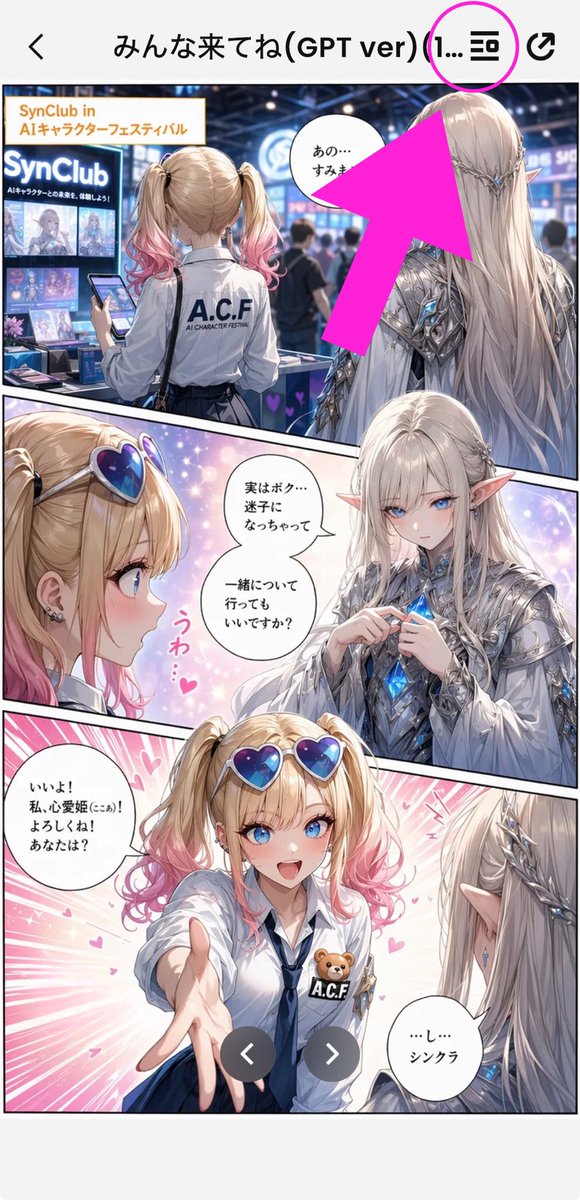
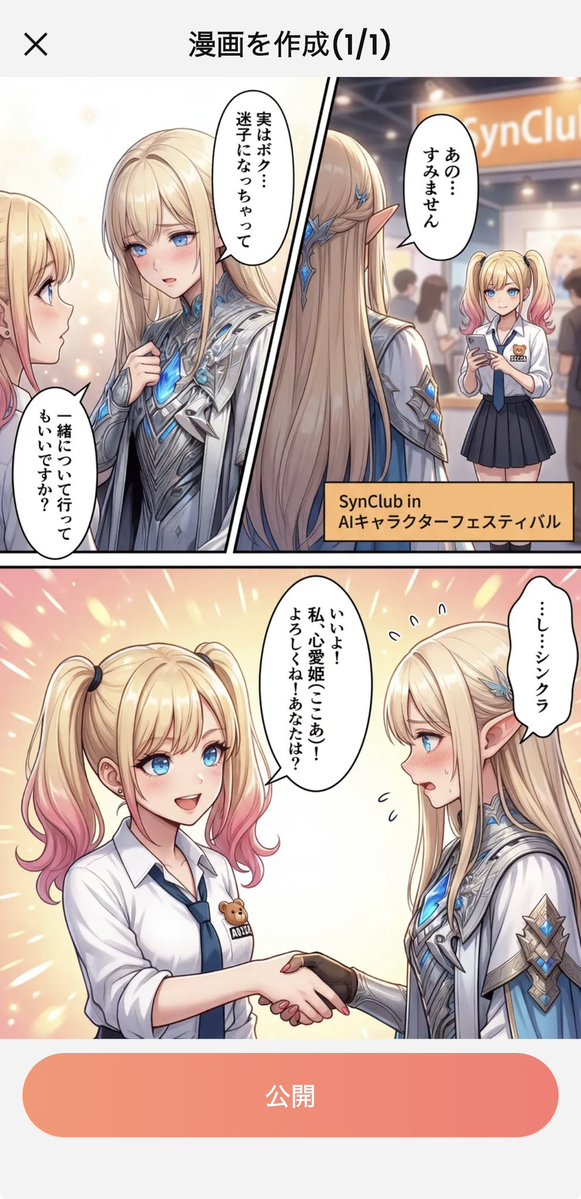
Goal: Create a vertical smartphone app screenshot showing a completed manga creation preview inside a Japanese UI, with an anime-style comic page about a blonde schoolgirl meeting an elegant elf-like character at an AI character festival. Canvas: Tall mobile screenshot, approximately 9:16 aspect ratio, white app background. At the very top is a simple app header: a black “×” close icon on the left and the centered Japanese title “漫画を作成(1/1)” in bold black text. At the bottom is a large rounded coral-to-pink gradient button labeled “公開” in white. Main comic layout: The comic page occupies most of the screen between the header and the publish button. Use crisp black manga panel borders. There are exactly 3 visible comic areas: 1) a narrow cropped top-left area showing part of the schoolgirl and a speech bubble, 2) a top section split diagonally between the elf character close-up and the festival booth scene, and 3) one large bottom panel showing a handshake. Characters: Include exactly 2 main characters, repeated across the panels. Character A is a cute blonde teenage schoolgirl with twin ponytails, pink-dipped hair ends, blue eyes, a white short-sleeve shirt, navy tie, dark pleated skirt, and a small teddy-bear badge on her shirt. Character B is a tall beautiful elf-like fantasy person with very long blond hair, pointed ears, blue crystal hair ornaments, pale skin, and ornate silver-white futuristic armor with glowing blue gems and cape-like details. Cover the faces of the close-up characters with flat beige rectangular privacy blocks, as if anonymized. Top comic section: On the right side, show Character A standing in a convention or festival hall holding a smartphone. Behind her is a warm blurred booth sign reading “SynClub” and indistinct people. Add an orange rectangular caption box at the lower right of this top section reading “SynClub in\nAIキャラクターフェスティバル”. On the left/center of the top section, show Character B from the front and back in a dramatic diagonal split-panel composition, with glowing blue fantasy details. Bottom comic panel: Show Character A and Character B facing each other and shaking hands warmly. Character A looks excited and friendly; Character B looks slightly shy or nervous. The background is a bright pastel burst of warm light, sparkles, and celebratory rays. Text content: Use exactly 5 speech bubbles with Japanese text: 1) cropped bubble at left: “一緒について行ってもいいですか?” 2) vertical bubble near Character B in top section: “実はボク…迷子になっちゃって” 3) top-right bubble near Character A: “あの…すみません” 4) bottom-center bubble from Character A: “いいよ!私、心愛姫ここあ!よろしくね!あなたは?” 5) bottom-right bubble from Character B: “…し…シンクラ”. Visual style: Polished modern Japanese anime and webtoon style, clean line art, glossy lighting, soft gradients, warm convention lighting, bright fantasy blue accents, high detail clothing, expressive manga speech bubbles, smartphone screenshot realism. Constraints: Keep the UI text and button clearly legible. Use exactly 5 speech bubbles, exactly 2 main character designs, and the 3 comic areas described. Do not add extra panels, extra major characters, watermarks, or English translations inside the image. Customizable app title: {argument name="app title" default="漫画を作成(1/1)"}. Customizable booth name: {argument name="booth name" default="SynClub"}. Customizable event caption: {argument name="event caption" default="SynClub in AIキャラクターフェスティバル"}. Customizable publish button text: {argument name="publish button text" default="公開"}. Customizable elf name line: {argument name="elf name line" default="…し…シンクラ"}.