Case Media
Case Notes
This page keeps the media, full prompt, and original source together so you can inspect the result first and decide whether the prompt is worth copying, saving, or comparing.
Case Insights
To make this page easier to search, cite, and reuse later, the case is also broken down into practical guidance about usage, visual cues, and prompt structure.
Best Fit Scenarios
- Use this as a ui & social screens benchmark when you need a fast style baseline before rewriting your own prompt.
- It is especially helpful if your target overlaps with Cinematic, Illustration, UI and you want to judge the image result before tuning wording.
- Keep it as a control sample when you compare nearby prompt variants one variable at a time.
Visual Signals To Notice
- The clearest style signals here are Cinematic, Illustration, UI, so those should usually stay in your first rewrite.
- The important layer is usually interface density, card hierarchy, and how the screen tells the story before you read small text.
- This case keeps one primary output, so the first image should be treated as the main visual reference.
How The Prompt Is Structured
- The prompt reads as a long, highly specified prompt, which is useful when you want to judge how much specificity this direction needs.
- Its keyword cluster is centered on Cinematic, Illustration, UI, so you can usually keep that cluster while swapping subject, camera, layout, or copy details.
- A practical rewrite path is: keep the outcome, keep the strongest style cues, then replace only the subject and environment blocks.
Good Follow-up Questions
- What changes first if you keep Cinematic, Illustration, UI but switch the subject matter?
- Which part of the result comes from section-level structure (UI & Social Screens) versus tag-level style cues?
- Which related cases in the same section give you a cleaner or more extreme variation of the same direction?
Full Prompt
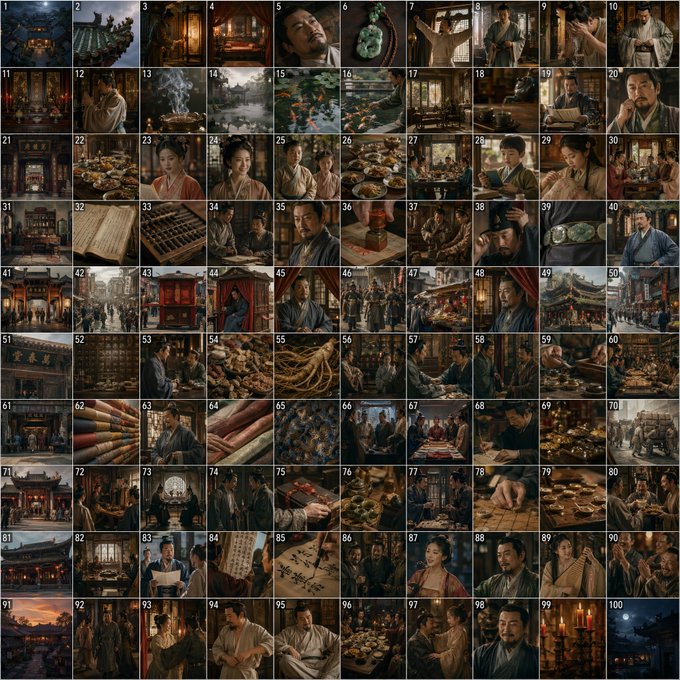
100-grid storyboard frame of Ximen Qing game, 10×10 grid layout, 1:1 square aspect ratio. 【Grid Layout】 100 equal-sized square grids, strictly arranged in 10 rows and 10 columns, even spacing between grids, professional game storyboard style. 【Story Content】 Telling the complete day of the wealthy Ming Dynasty merchant Ximen Qing, from dawn to late night: Grids 1-10: Waking up at dawn, luxury mansion bedroom, washing and dressing Grids 11-20: Ancestral hall sacrifice, feeding fish in the courtyard, tasting tea and reading newspapers Grids 21-30: Family breakfast, reunion with wife and children, happy and harmonious Grids 31-40: Managing accounts in the study, steward reporting, preparing to go out Grids 41-50: Traveling by sedan chair, bustling street market, heading to the shop Grids 51-60: Pharmacy business, inspecting medicinal herbs, receiving customers Grids 61-70: Silk warehouse, inspecting goods and bargaining, signing contracts and trading Grids 71-80: Visiting officials, giving gifts and playing chess, collusion between officials and businessmen Grids 81-90: Tea house elegant gathering, listening to music and appreciating paintings, socializing with literati Grids 91-100: Returning home at sunset, family banquet reunion, lighting lamps and going to bed 【Visual Style】 Cinematic realistic style, high restoration of Ming Dynasty history, exquisite clothing and prop details, dramatic lighting and shadow, alternating between long shots, medium shots, close-up detail shots. 【Color Tone】 Dawn: Cold blue tone, pale gold Daytime: Warm yellow, emerald green, vermilion Dusk: Orange red, purple clouds Night: Deep blue, lantern red, moonlight silver 【Technical Requirements】 High resolution, each grid is of game CG-level quality, professional and diverse composition, accurate research on Ming Dynasty architecture, clothing, and props.