Case Media
Case Notes
This page keeps the media, full prompt, and original source together so you can inspect the result first and decide whether the prompt is worth copying, saving, or comparing.
Case Insights
To make this page easier to search, cite, and reuse later, the case is also broken down into practical guidance about usage, visual cues, and prompt structure.
Best Fit Scenarios
- Use this as a poster & illustration benchmark when you need a fast style baseline before rewriting your own prompt.
- It is especially helpful if your target overlaps with Fashion, Poster, Illustration and you want to judge the image result before tuning wording.
- Keep it as a control sample when you compare nearby prompt variants one variable at a time.
Visual Signals To Notice
- The clearest style signals here are Fashion, Poster, Illustration, so those should usually stay in your first rewrite.
- Pay close attention to layout rhythm, headline hierarchy, illustration texture, and how information is staged in the frame.
- This case keeps 2 media outputs, which makes it easier to check whether the style remains stable across multiple results.
How The Prompt Is Structured
- The prompt reads as a long, highly specified prompt, which is useful when you want to judge how much specificity this direction needs.
- Its keyword cluster is centered on Fashion, Poster, Illustration, so you can usually keep that cluster while swapping subject, camera, layout, or copy details.
- A practical rewrite path is: keep the outcome, keep the strongest style cues, then replace only the subject and environment blocks.
Good Follow-up Questions
- What changes first if you keep Fashion, Poster, Illustration but switch the subject matter?
- Which part of the result comes from section-level structure (Poster & Illustration) versus tag-level style cues?
- Which related cases in the same section give you a cleaner or more extreme variation of the same direction?
Full Prompt
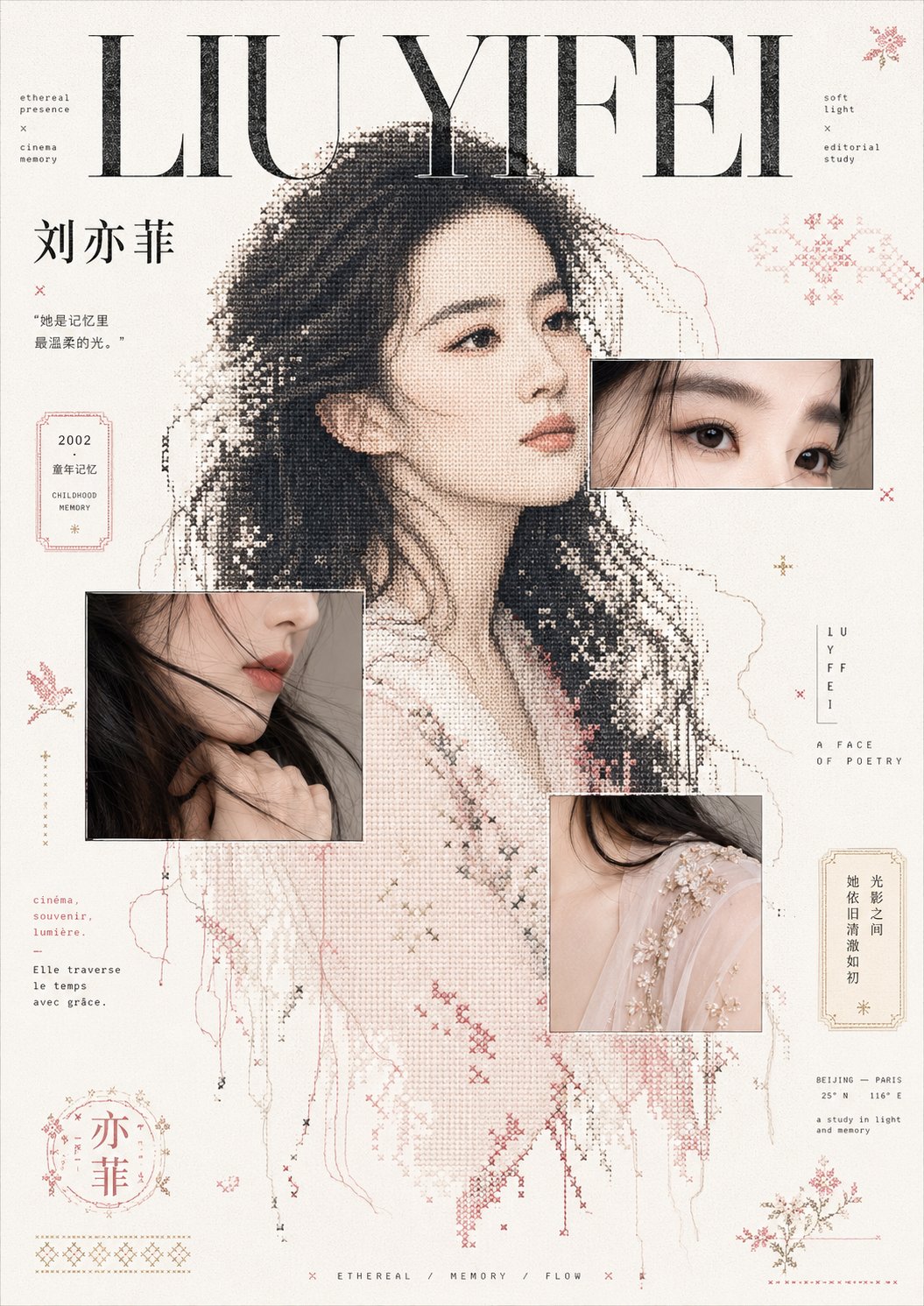
Generate an editorial magazine-style collage image based on a specific theme: the composition uses large areas of bright white space to support the content. The strongest visual weight comes from an enlarged silhouette of the main subject. The silhouette is shaped using a mixture of coarse halftone dots, pixel cross-stitch, and broken stitches. The edges retain an unfinished thread feel and a few loose points, translating the physical subject into a graphic that exists between a printing screen and hand embroidery. Two or three partial image windows with thin line outlines are overlaid on the main subject, capturing only the most tactile and recognizable details of the theme. The windows overlap with the pixel silhouette, creating layers where real images and dot patterns calibrate with each other. Typography serves as the core composition: a massive high-contrast serif title anchors the upper visual hierarchy, supplemented by narrow-letter-spaced pixel handwritten phrases, small captions, and scattered micro-annotations. The layout maintains the calmness, emptiness, and rhythmic reading pace of French editorial design. The background retains clean paper grain and slight scanning noise, with surrounding scattered folk art patterns derived from the theme, symbolic stamps, broken borders, and dot-matrix decorations, like graphic marks torn from old fabrics, receipts, and childhood memories. Colors are extracted from the theme's own materials, emotions, and cultural signals: high-brightness clear base colors are used in large areas, structural information uses clear dark colors to establish the center of gravity, and a small amount of theme-derived accent colors are used only for sub-titles, thin frames, and decorative symbols, maintaining a bright, clean mood with a touch of childhood ritual; all color boundaries are clear, saturation is restrained but not muddy, the texture is an airy paper feel and printing grain, without any aged or dirty treatment. Theme: Liu Yifei