Case Media
Case Notes
This page keeps the media, full prompt, and original source together so you can inspect the result first and decide whether the prompt is worth copying, saving, or comparing.
Case Insights
To make this page easier to search, cite, and reuse later, the case is also broken down into practical guidance about usage, visual cues, and prompt structure.
Best Fit Scenarios
- Use this as a poster & illustration benchmark when you need a fast style baseline before rewriting your own prompt.
- It is especially helpful if your target overlaps with Poster, Illustration, City Visual and you want to judge the image result before tuning wording.
- Keep it as a control sample when you compare nearby prompt variants one variable at a time.
Visual Signals To Notice
- The clearest style signals here are Poster, Illustration, City Visual, so those should usually stay in your first rewrite.
- Pay close attention to layout rhythm, headline hierarchy, illustration texture, and how information is staged in the frame.
- This case keeps one primary output, so the first image should be treated as the main visual reference.
How The Prompt Is Structured
- The prompt reads as a long, highly specified prompt, which is useful when you want to judge how much specificity this direction needs.
- Its keyword cluster is centered on Poster, Illustration, City Visual, so you can usually keep that cluster while swapping subject, camera, layout, or copy details.
- A practical rewrite path is: keep the outcome, keep the strongest style cues, then replace only the subject and environment blocks.
Good Follow-up Questions
- What changes first if you keep Poster, Illustration, City Visual but switch the subject matter?
- Which part of the result comes from section-level structure (Poster & Illustration) versus tag-level style cues?
- Which related cases in the same section give you a cleaner or more extreme variation of the same direction?
Full Prompt
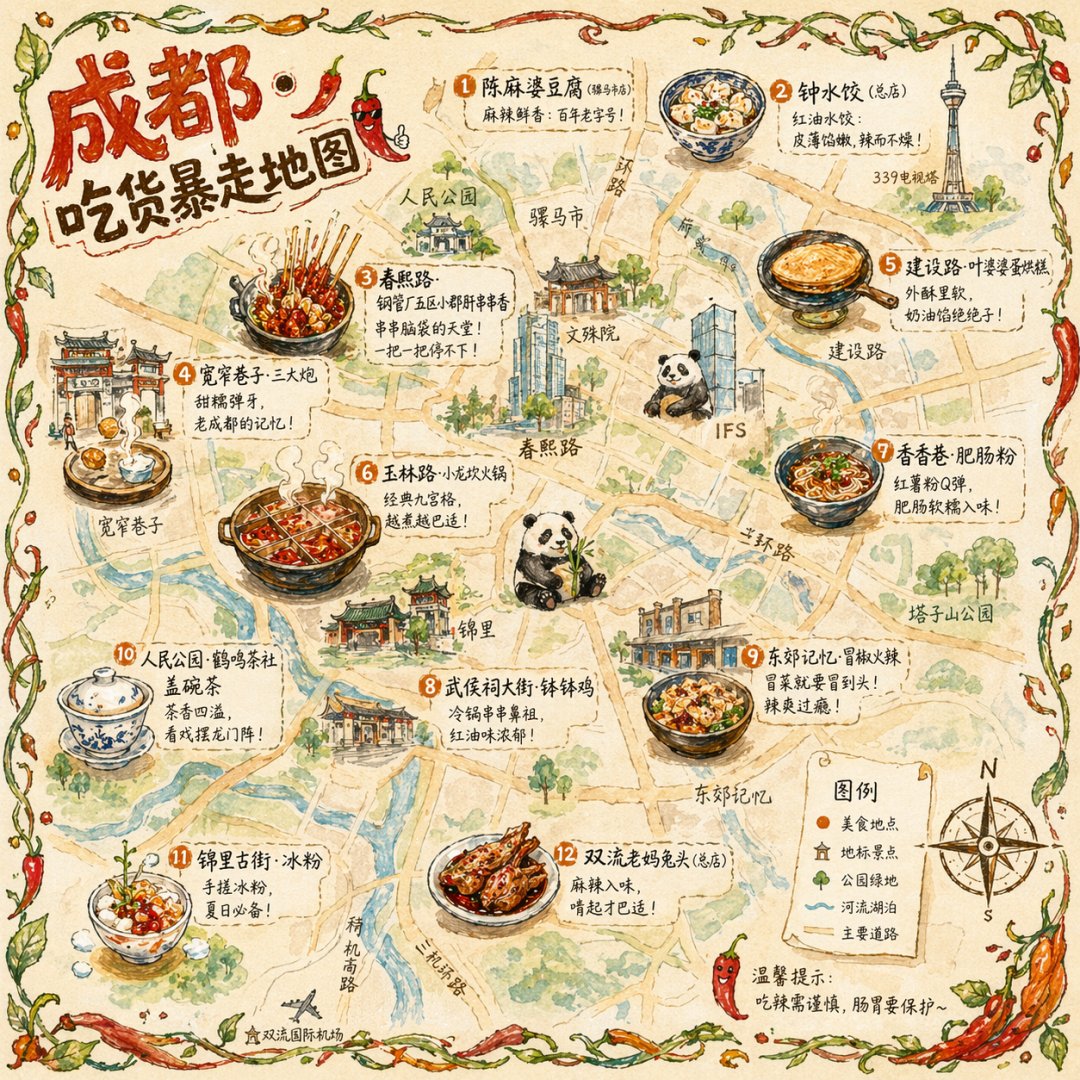
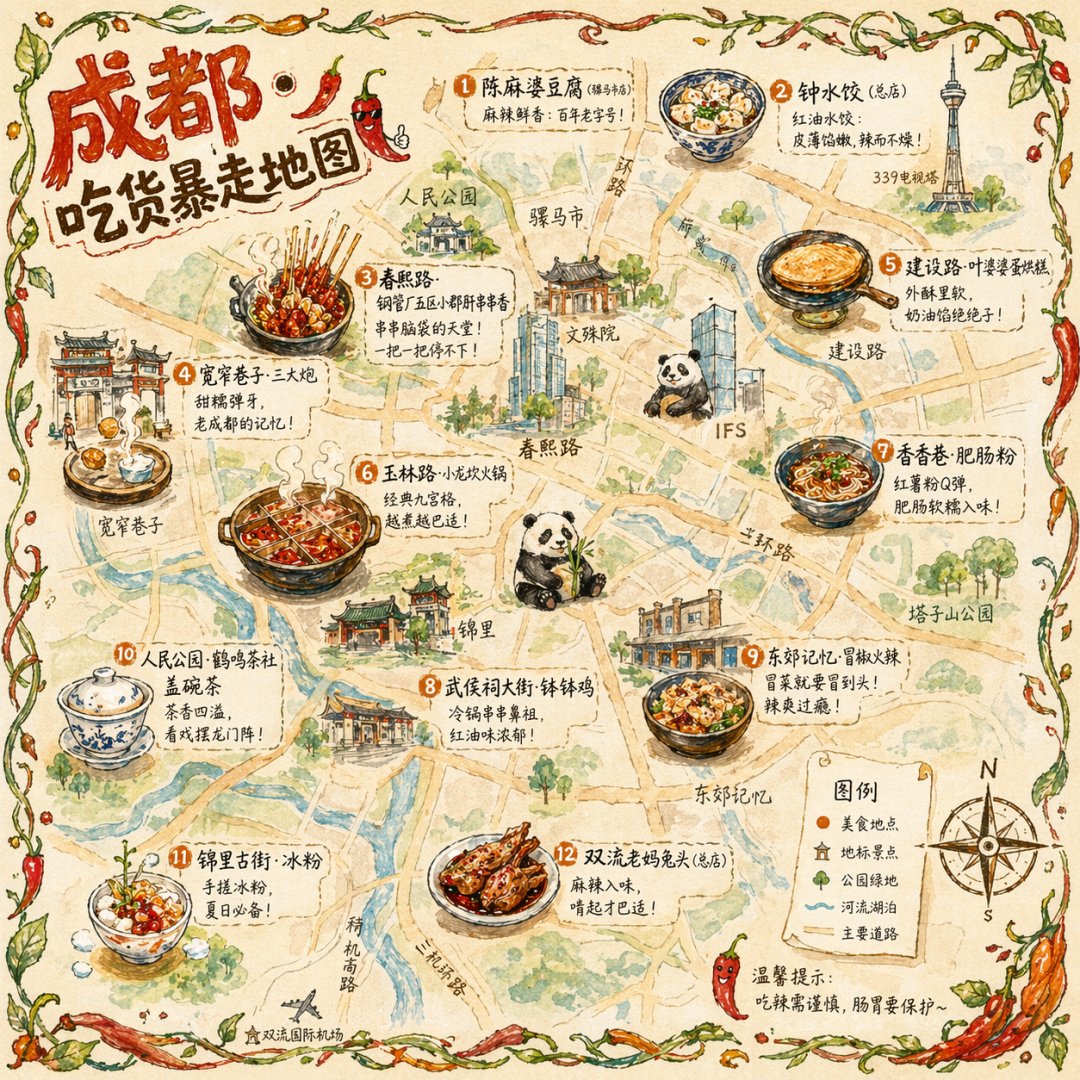
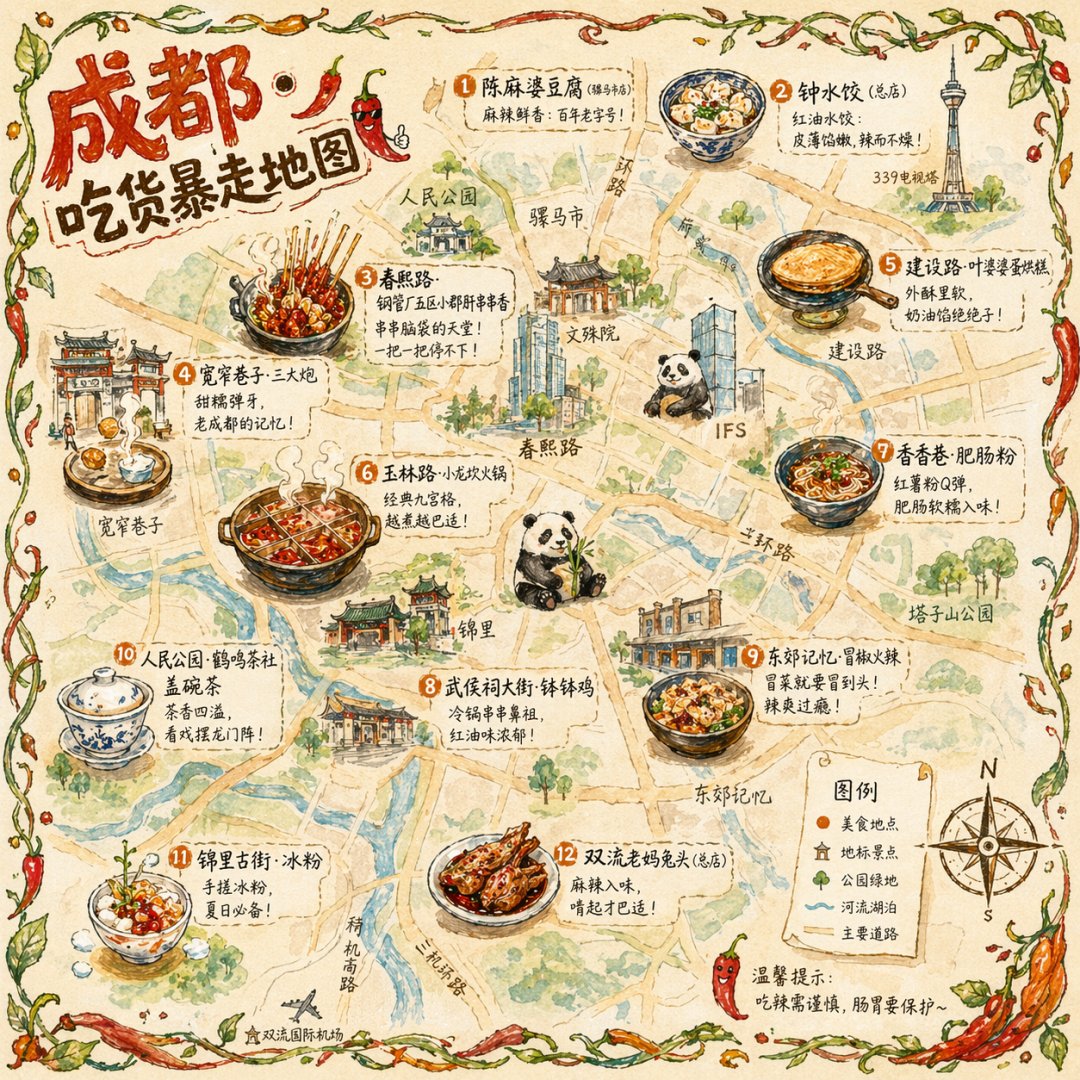
[中文] 一张手绘风格的城市美食地图,以成都为主题。画面以鸟瞰视角的手绘简化城市地图为底,标注主要道路和地标但不追求精确比例而是追求可爱的手绘感。地图上分布着 12 个美食地点的精致手绘小插画:春熙路的串串香(一把竹签插着各种食材冒着热气)、宽窄巷子的三大炮(三个糯米团子飞向铜盘)、建设路的蛋烘糕(金黄酥脆正在翻面)、玉林路的火锅(九宫格锅翻滚冒泡)等,每个插画约占地图的 5% 面积,旁边用手写体标注店名和一句推荐语"凌晨两点还在排队的那家"。地图边缘用手绘藤蔓和辣椒装饰形成边框。右下角有一个手绘指南针和图例说明。左上角标题"成都·吃货暴走地图"使用胖圆的手绘美术字配辣椒装饰。整体画风为水彩+彩铅混合的手绘质感,颜色以暖色系(辣椒红、姜黄、翠绿)为主,图片比例 1:1。 [English] A hand-drawn style city food map themed around Chengdu. The background is a bird's-eye view hand-drawn simplified city map, marking main roads and landmarks, not pursuing precise proportions but pursuing a cute hand-drawn feel. Distributed on the map are exquisite hand-drawn small illustrations of 12 food locations: Chuandu Chuanxiang skewers at Chunxi Road (a bunch of bamboo skewers with various ingredients emitting steam), Sandapao at Kuanzhai Alley (three glutinous rice balls flying towards a copper plate), Danhonggao at Jianshe Road (golden and crispy, being flipped), hotpot at Yulin Road (nine-grid pot rolling and bubbling), etc. Each illustration accounts for about 5% of the map area, with handwritten store names and a recommendation phrase "the one with a queue even at 2 AM" next to it. The edge of the map is decorated with hand-drawn vines and chili peppers to form a border. There is a hand-drawn compass and legend description in the bottom right corner. The title "Chengdu · Foodie Walking Map" in the top left corner uses chubby round hand-drawn artistic fonts decorated with chili peppers. The overall art style is a mixed hand-drawn texture of watercolor and colored pencils, with colors mainly in warm tones (chili red, ginger yellow, emerald green), image ratio 1:1.