Case Media
Case Notes
This page keeps the media, full prompt, and original source together so you can inspect the result first and decide whether the prompt is worth copying, saving, or comparing.
Case Insights
To make this page easier to search, cite, and reuse later, the case is also broken down into practical guidance about usage, visual cues, and prompt structure.
Best Fit Scenarios
- Use this as a portrait & photography benchmark when you need a fast style baseline before rewriting your own prompt.
- It is especially helpful if your target overlaps with Neon, Portrait, Cinematic and you want to judge the image result before tuning wording.
- Keep it as a control sample when you compare nearby prompt variants one variable at a time.
Visual Signals To Notice
- The clearest style signals here are Neon, Portrait, Cinematic, so those should usually stay in your first rewrite.
- Focus on framing, light direction, pose, and the distance between subject and camera.
- This case keeps one primary output, so the first image should be treated as the main visual reference.
How The Prompt Is Structured
- The prompt reads as a long, highly specified prompt, which is useful when you want to judge how much specificity this direction needs.
- Its keyword cluster is centered on Neon, Portrait, Cinematic, so you can usually keep that cluster while swapping subject, camera, layout, or copy details.
- A practical rewrite path is: keep the outcome, keep the strongest style cues, then replace only the subject and environment blocks.
Good Follow-up Questions
- What changes first if you keep Neon, Portrait, Cinematic but switch the subject matter?
- Which part of the result comes from section-level structure (Portrait & Photography) versus tag-level style cues?
- Which related cases in the same section give you a cleaner or more extreme variation of the same direction?
Full Prompt
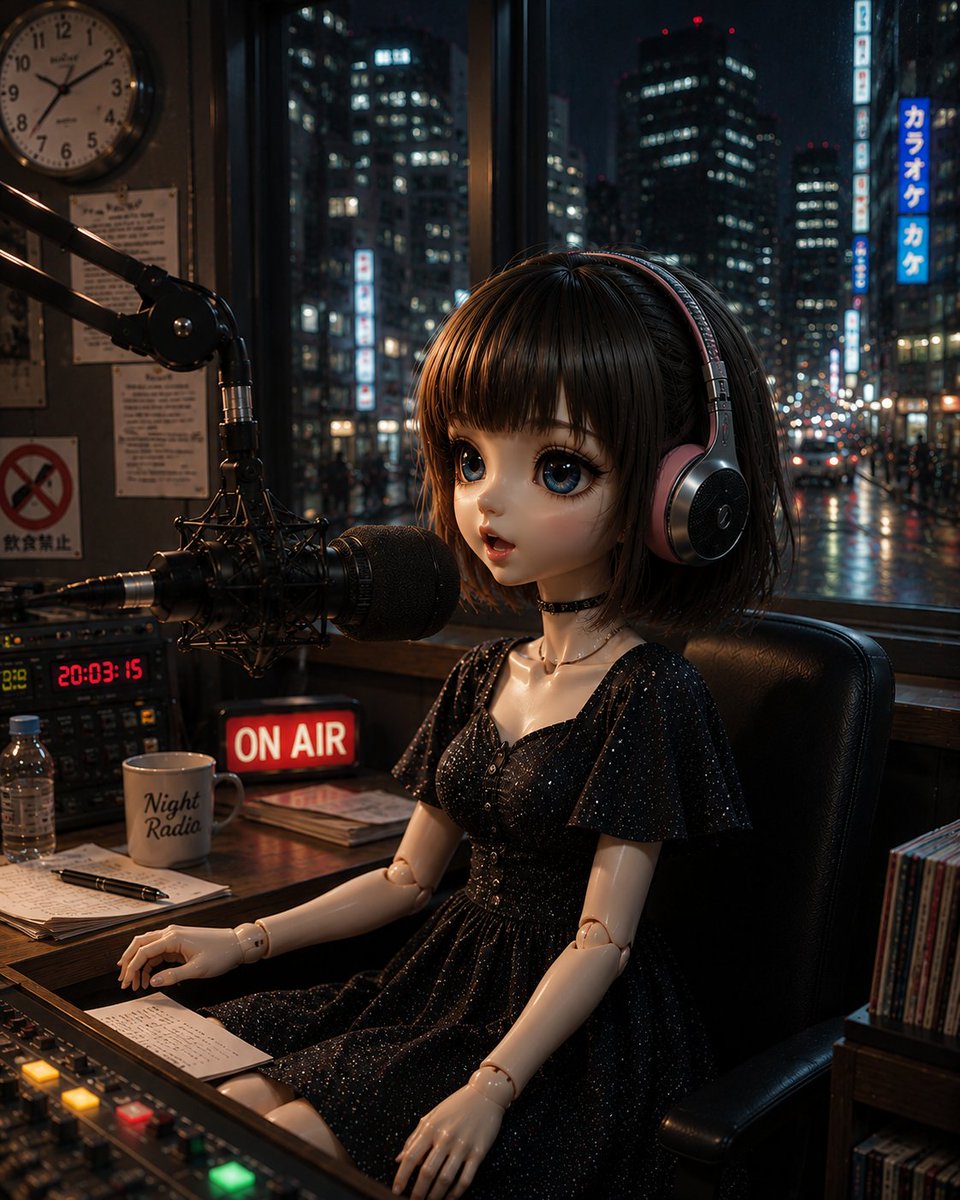
Create a cinematic photorealistic night-time radio studio scene in vertical portrait composition. A realistic ball-jointed female doll host with a short {argument name="hair color" default="dark brown"} bob haircut and straight bangs sits in a black leather chair at a wooden broadcast desk, wearing large over-ear headphones and a subtly sparkling black short-sleeve dress with a delicate necklace and bracelet; her face is intentionally covered by a plain centered {argument name="face cover color" default="dark brown"} rectangular block, as if anonymized. Place a large professional condenser microphone with shock mount and boom arm directly in front of her mouth, plus a mixing console in the foreground with glowing colored buttons. Include exactly 6 prominent desk/studio props: a red illuminated "ON AIR" sign, a digital clock reading "20:03:15", a white mug labeled "Night Radio", a clear plastic water bottle, handwritten notes with a pen, and a small stack of papers or notebook. The studio interior should feel cramped, warm, and atmospheric, with posters and notices on the wall, an analog clock in the upper left, shelves of CDs or records at the right edge, and reflections on polished wood. Through the large window behind her, show a rainy {argument name="city" default="Tokyo"} night street with wet pavement, blurred traffic lights, high-rise office buildings full of lit windows, and vertical Japanese-style neon signs including blue karaoke signage. Use moody low-key lighting, warm tungsten highlights inside the studio contrasting with cool blue city lights outside, shallow depth of field, realistic glass reflections, highly detailed textures, and the feeling of an intimate late-night broadcast where the host is reading listener mail. Add optional Japanese radio-show mood text context: {argument name="quote" default="次のお便りは異教徒さんから〜"}.