Case Media
Case Notes
This page keeps the media, full prompt, and original source together so you can inspect the result first and decide whether the prompt is worth copying, saving, or comparing.
Case Insights
To make this page easier to search, cite, and reuse later, the case is also broken down into practical guidance about usage, visual cues, and prompt structure.
Best Fit Scenarios
- Use this as a character design benchmark when you need a fast style baseline before rewriting your own prompt.
- It is especially helpful if your target overlaps with Illustration, Character, Anime and you want to judge the image result before tuning wording.
- Keep it as a control sample when you compare nearby prompt variants one variable at a time.
Visual Signals To Notice
- The clearest style signals here are Illustration, Character, Anime, so those should usually stay in your first rewrite.
- Look at silhouette, costume language, mood styling, and whether the character reads clearly at a glance.
- This case keeps one primary output, so the first image should be treated as the main visual reference.
How The Prompt Is Structured
- The prompt reads as a long, highly specified prompt, which is useful when you want to judge how much specificity this direction needs.
- Its keyword cluster is centered on Illustration, Character, Anime, so you can usually keep that cluster while swapping subject, camera, layout, or copy details.
- A practical rewrite path is: keep the outcome, keep the strongest style cues, then replace only the subject and environment blocks.
Good Follow-up Questions
- What changes first if you keep Illustration, Character, Anime but switch the subject matter?
- Which part of the result comes from section-level structure (Character Design) versus tag-level style cues?
- Which related cases in the same section give you a cleaner or more extreme variation of the same direction?
Full Prompt
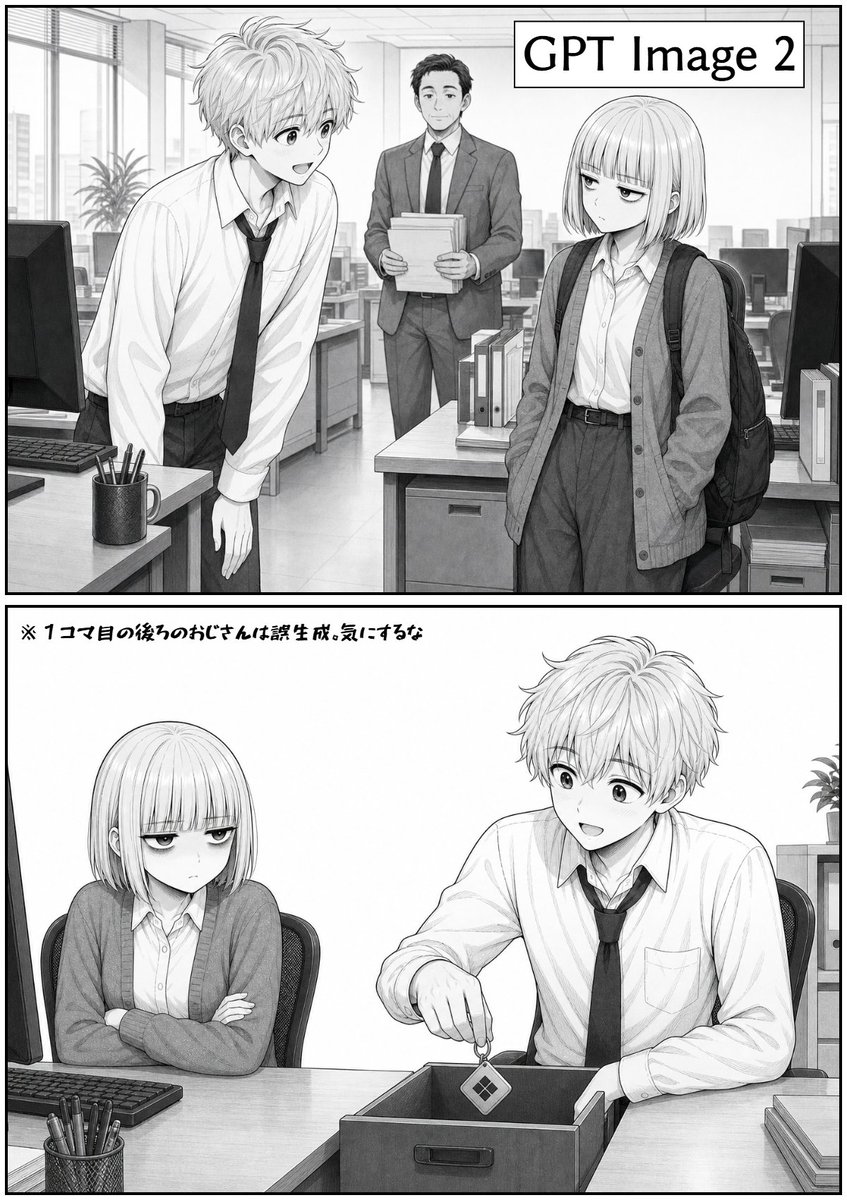
Goal: Create a black-and-white manga-style two-panel comic page set in a modern office, comparing an image generation engine. Canvas: Vertical page, roughly 2:3 aspect ratio, with a thick black outer border and two stacked rectangular panels separated by a thick horizontal gutter. Use detailed pencil/ink line art, grayscale screentone shading, clean manga draftsmanship, realistic office perspective, and no color. Layout: Panel 1 occupies the top half. Panel 2 occupies the bottom half. Both panels have crisp black borders and a light, high-key office background with desks, computers, binders, windows, ceiling panels, and city buildings visible through large windows. Panel 1: Show exactly 3 characters in an open-plan office: 1 tall messy-haired young man on the left leaning forward over a desk, wearing a white dress shirt with rolled sleeves, loosened black necktie, and dark trousers; 1 middle-aged office man in the center background wearing a suit and tie while holding a stack of papers; 1 young woman on the right with a short bob haircut, wearing a white blouse, oversized cardigan, high-waisted trousers, and a backpack over one shoulder. Add a rectangular sign in the upper-right corner reading {argument name="engine label" default="GPT Image 2"} in bold black sans-serif text inside a thin black outline box. The three character faces should be intentionally obscured by soft gray rectangular blur blocks, while hair, clothing, and body language remain visible. Panel 2: Show exactly 2 characters seated at a meeting desk: the bob-haired young woman on the left, arms crossed, looking stern or unimpressed; the messy-haired young man on the right, seated and holding a small square tag or card above an open storage box on the tabletop, as if dropping it in. The desk includes exactly 5 visible prop groups: 1 keyboard on the left, 1 mesh pen cup filled with pens in the front-left, 1 open rectangular storage box in the center, 1 stack of papers or folders on the right, and 1 small office shelf or cabinet with binders in the rear-right background. Their faces should again be covered by soft gray rectangular blur blocks. Text content: At the top-left of Panel 2, include a handwritten Japanese note: {argument name="note text" default="※ 1コマ目の後ろのおじさんは誤生成。気にするな"}. Keep it small, casual, and manga-like. Character details: The young man has {argument name="male hairstyle" default="messy light-colored wavy hair"}, a slim build, slightly slouched posture, and a loose tie. The young woman has {argument name="female hairstyle" default="straight chin-length bob with blunt bangs"}, a reserved expression implied by posture, and a school-office hybrid outfit. The background office should feel believable and detailed, with monitors, binders, desk drawers, and window blinds. Constraints: Use exactly 2 panels, exactly 3 characters in the first panel, exactly 2 characters in the second panel, exactly 2 visible text elements, grayscale only, manga line art only, no speech bubbles, no extra captions, no watermark, no photorealistic rendering.