Case Media
Case Notes
This page keeps the media, full prompt, and original source together so you can inspect the result first and decide whether the prompt is worth copying, saving, or comparing.
Case Insights
To make this page easier to search, cite, and reuse later, the case is also broken down into practical guidance about usage, visual cues, and prompt structure.
Best Fit Scenarios
- Use this as a character design benchmark when you need a fast style baseline before rewriting your own prompt.
- It is especially helpful if your target overlaps with Fashion, Illustration, Character and you want to judge the image result before tuning wording.
- Keep it as a control sample when you compare nearby prompt variants one variable at a time.
Visual Signals To Notice
- The clearest style signals here are Fashion, Illustration, Character, so those should usually stay in your first rewrite.
- Look at silhouette, costume language, mood styling, and whether the character reads clearly at a glance.
- This case keeps one primary output, so the first image should be treated as the main visual reference.
How The Prompt Is Structured
- The prompt reads as a long, highly specified prompt, which is useful when you want to judge how much specificity this direction needs.
- Its keyword cluster is centered on Fashion, Illustration, Character, so you can usually keep that cluster while swapping subject, camera, layout, or copy details.
- A practical rewrite path is: keep the outcome, keep the strongest style cues, then replace only the subject and environment blocks.
Good Follow-up Questions
- What changes first if you keep Fashion, Illustration, Character but switch the subject matter?
- Which part of the result comes from section-level structure (Character Design) versus tag-level style cues?
- Which related cases in the same section give you a cleaner or more extreme variation of the same direction?
Full Prompt
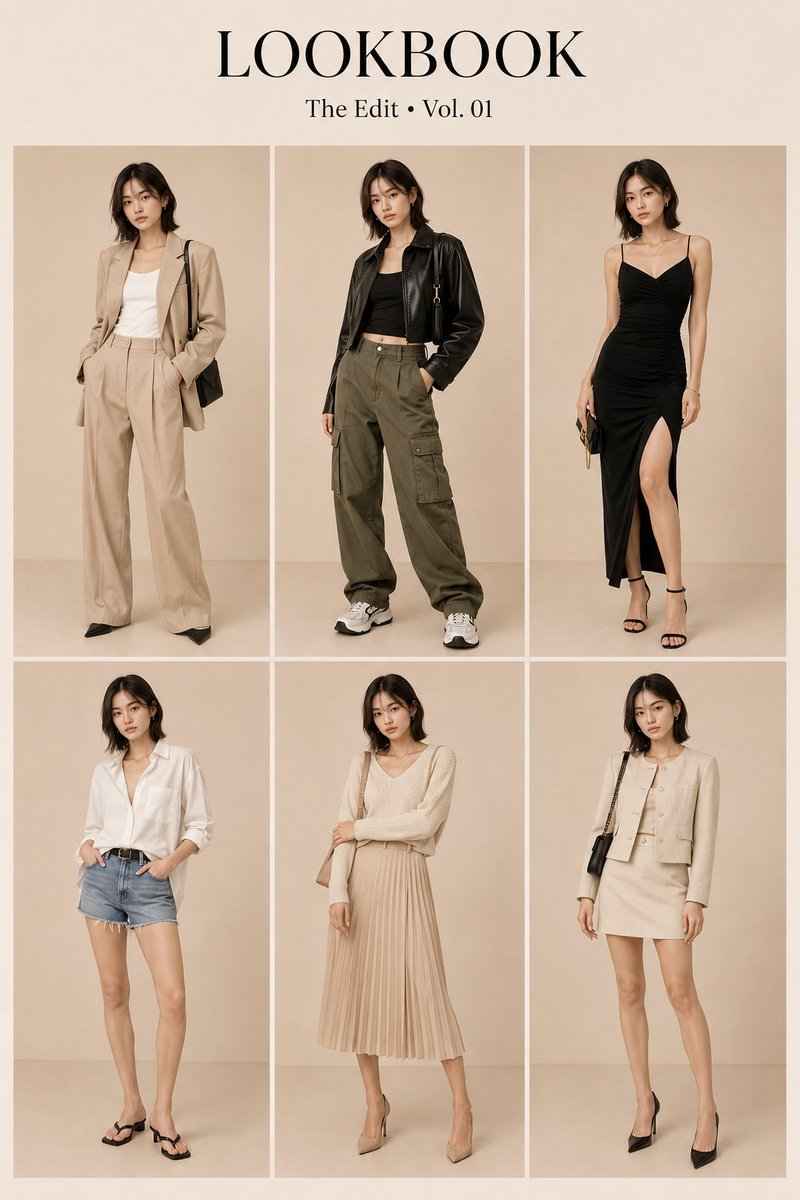
Create a high-end Korean fashion lookbook featuring the same {argument name="subject" default="Japanese woman"} across all six looks, with strong identity consistency throughout the entire image. Her facial features, age, ethnicity, hairstyle, body proportions, and overall presence should remain unchanged in every panel, making it unmistakably the same person wearing different outfits.\n\nArrange the composition as a clean and elegant 2×3 grid with six equal-sized full-body panels. Maintain consistent model scale, clear spacing between panels, and balanced editorial symmetry. At the top center, include refined luxury serif typography reading: '{argument name="title" default="LOOKBOOK — The Edit • Vol. 01"}'.\n\nEach panel should showcase a different outfit and natural fashion pose:\n\n1. Beige oversized blazer, white top, wide-leg trousers, and heels.\n2. Cropped leather jacket, fitted top, cargo pants, and luxury sneakers.\n3. Black fitted evening dress with sophisticated accessories.\n4. White oversized shirt paired with denim shorts.\n5. Cream knit sweater with a pleated midi skirt.\n6. Monochrome tailored jacket and matching skirt set.\n\nGive each look a unique standing pose and subtle change in expression while maintaining the same model identity and luxury campaign energy. The body language should feel confident, polished, and suitable for a premium department-store fashion catalog.\n\nUse a seamless warm ivory-beige cyclorama studio background with no props or furniture. Lighting should be soft, diffused, and inspired by Vogue Korea editorials, creating realistic shadows, natural skin texture, visible pores, and beautifully rendered fabric details. The final image should feel like ultra-premium commercial fashion photography with HDR quality, photorealistic detail, and 8K-level sharpness.\n\nPrioritize strict identity preservation, full-body visibility in every panel, clear panel separation, consistent proportions, and a sophisticated luxury presentation.\n\nAvoid: identity changes, different faces, face swapping, cropped figures, overlapping subjects, extra limbs, anatomical errors, cluttered backgrounds, props, furniture, logos, watermarks, anime styling, CGI, illustrations, overly smooth plastic skin, blur, or low-resolution output.