Case Media
Case Notes
This page keeps the media, full prompt, and original source together so you can inspect the result first and decide whether the prompt is worth copying, saving, or comparing.
Case Insights
To make this page easier to search, cite, and reuse later, the case is also broken down into practical guidance about usage, visual cues, and prompt structure.
Best Fit Scenarios
- Use this as a character design benchmark when you need a fast style baseline before rewriting your own prompt.
- It is especially helpful if your target overlaps with Cinematic, Illustration, Character and you want to judge the image result before tuning wording.
- Keep it as a control sample when you compare nearby prompt variants one variable at a time.
Visual Signals To Notice
- The clearest style signals here are Cinematic, Illustration, Character, so those should usually stay in your first rewrite.
- Look at silhouette, costume language, mood styling, and whether the character reads clearly at a glance.
- This case keeps one primary output, so the first image should be treated as the main visual reference.
How The Prompt Is Structured
- The prompt reads as a long, highly specified prompt, which is useful when you want to judge how much specificity this direction needs.
- Its keyword cluster is centered on Cinematic, Illustration, Character, so you can usually keep that cluster while swapping subject, camera, layout, or copy details.
- A practical rewrite path is: keep the outcome, keep the strongest style cues, then replace only the subject and environment blocks.
Good Follow-up Questions
- What changes first if you keep Cinematic, Illustration, Character but switch the subject matter?
- Which part of the result comes from section-level structure (Character Design) versus tag-level style cues?
- Which related cases in the same section give you a cleaner or more extreme variation of the same direction?
Full Prompt
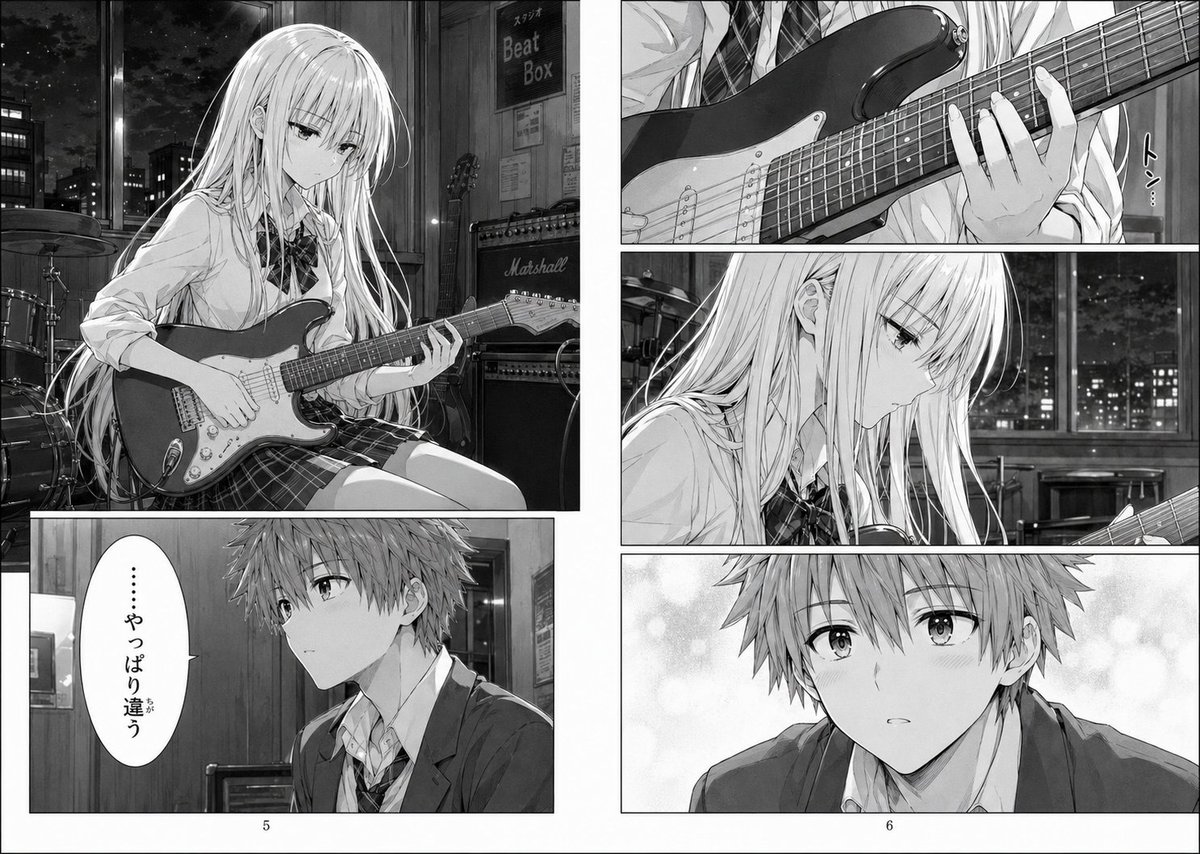
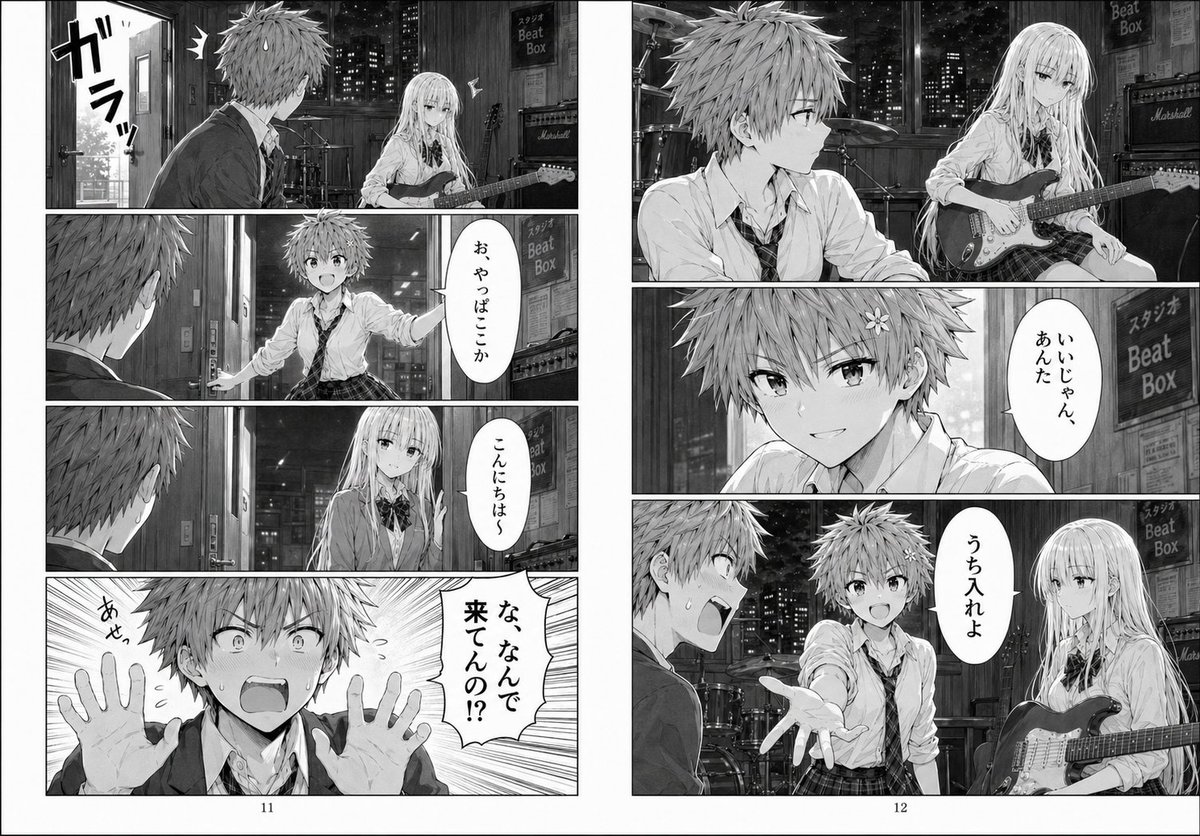
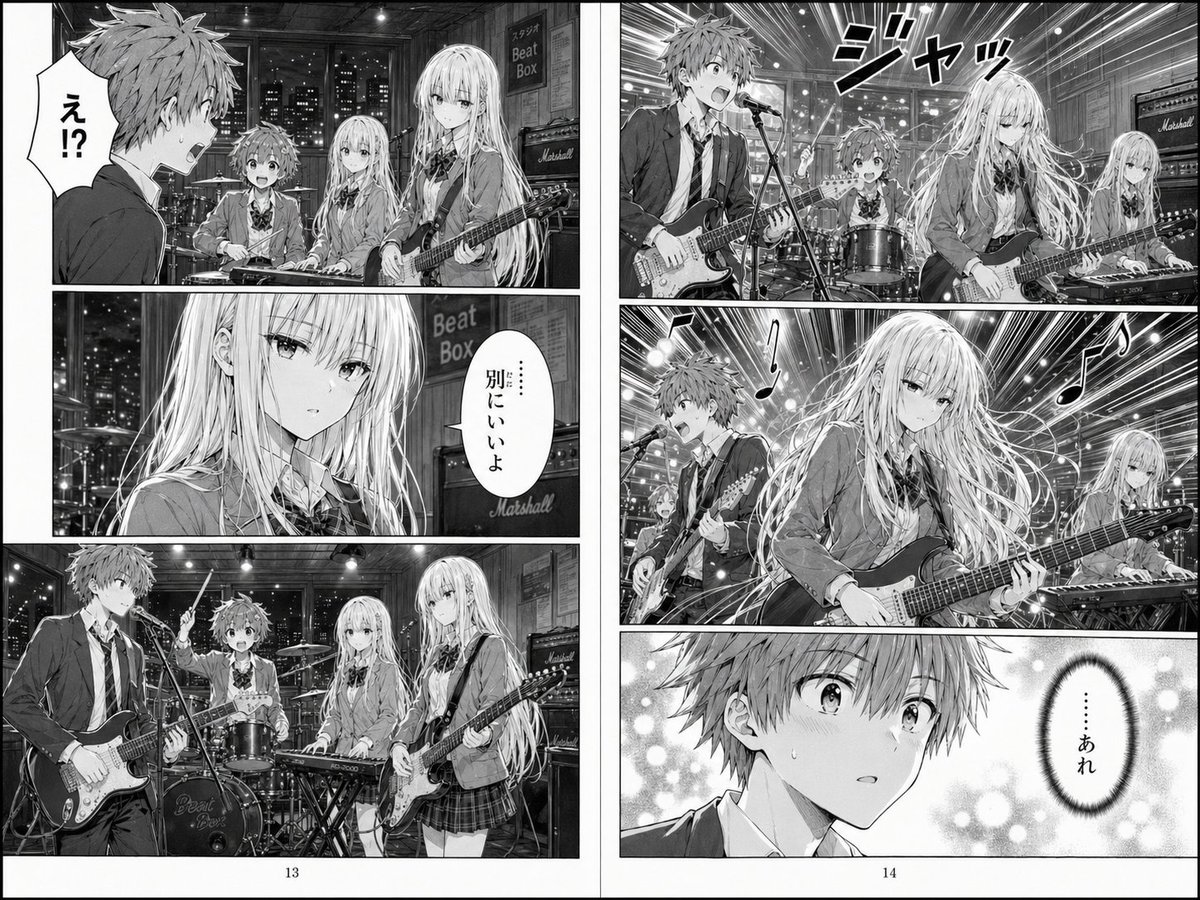
A two-page black-and-white manga spread set in a nighttime high school band rehearsal studio, drawn in polished modern shonen/seinen manga style with detailed screentones, dramatic lighting, expressive speed lines, and glossy instrument rendering. The scene shows 4 visible band members in school uniforms: a surprised teenage boy with messy short hair at guitar and vocal mic, a calm beautiful teenage girl with very long flowing light hair playing electric guitar in the foreground, a petite long-haired teenage girl at a keyboard, and a drummer in the back whose face is intentionally obscured by a soft blur. The studio has large windows revealing a city skyline at night, hanging ceiling lights, amps including a visible Marshall stack, a drum kit with a band logo on the bass drum, cables, and a wall sign reading “Beat Box.” Compose it as a printed manga spread with 7 panels total across 2 pages, including gutters, page borders, and page numbers 13 and 14 at the bottom. Left page: 3 panels — top panel with the shocked boy turning toward the girls and a large Japanese speech bubble saying “え!?”; middle panel is a close-up of the long-haired guitarist girl with a calm expression and a Japanese speech bubble saying “……別にいいよ”; bottom panel is a wider full-band rehearsal shot with all 4 members in the studio. Right page: 4 panels — top panel is an explosive performance shot with the boy singing and playing while the long-haired girl plays guitar, with large sound-effect text “ジャッ”; middle panel is a dynamic close-up of the long-haired guitarist playing intensely, with flowing hair, musical note symbols, radiant speed lines, and the keyboard girl visible in the back; bottom panel is a close-up of the boy’s stunned face with soft bokeh and a vertical Japanese speech bubble saying “……あれ”. Emphasize the emotional contrast: awkward surprise turning into admiration as the girl’s guitar performance changes the mood. Use monochrome only, no color, authentic manga lettering, cinematic framing, layered depth, and highly detailed hair and instrument strings.