Case Media
Case Notes
This page keeps the media, full prompt, and original source together so you can inspect the result first and decide whether the prompt is worth copying, saving, or comparing.
Case Insights
To make this page easier to search, cite, and reuse later, the case is also broken down into practical guidance about usage, visual cues, and prompt structure.
Best Fit Scenarios
- Use this as a character design benchmark when you need a fast style baseline before rewriting your own prompt.
- It is especially helpful if your target overlaps with Cinematic, Illustration, Character and you want to judge the image result before tuning wording.
- Keep it as a control sample when you compare nearby prompt variants one variable at a time.
Visual Signals To Notice
- The clearest style signals here are Cinematic, Illustration, Character, so those should usually stay in your first rewrite.
- Look at silhouette, costume language, mood styling, and whether the character reads clearly at a glance.
- This case keeps one primary output, so the first image should be treated as the main visual reference.
How The Prompt Is Structured
- The prompt reads as a long, highly specified prompt, which is useful when you want to judge how much specificity this direction needs.
- Its keyword cluster is centered on Cinematic, Illustration, Character, so you can usually keep that cluster while swapping subject, camera, layout, or copy details.
- A practical rewrite path is: keep the outcome, keep the strongest style cues, then replace only the subject and environment blocks.
Good Follow-up Questions
- What changes first if you keep Cinematic, Illustration, Character but switch the subject matter?
- Which part of the result comes from section-level structure (Character Design) versus tag-level style cues?
- Which related cases in the same section give you a cleaner or more extreme variation of the same direction?
Full Prompt
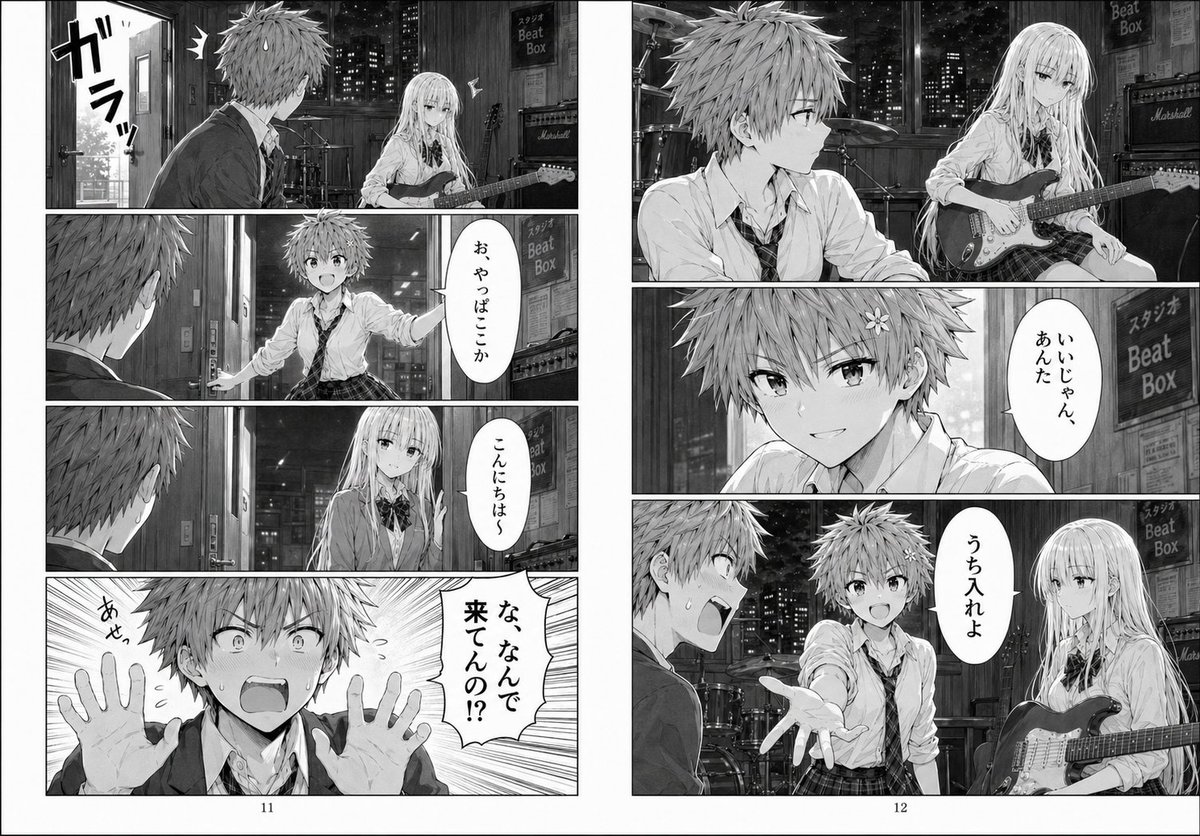
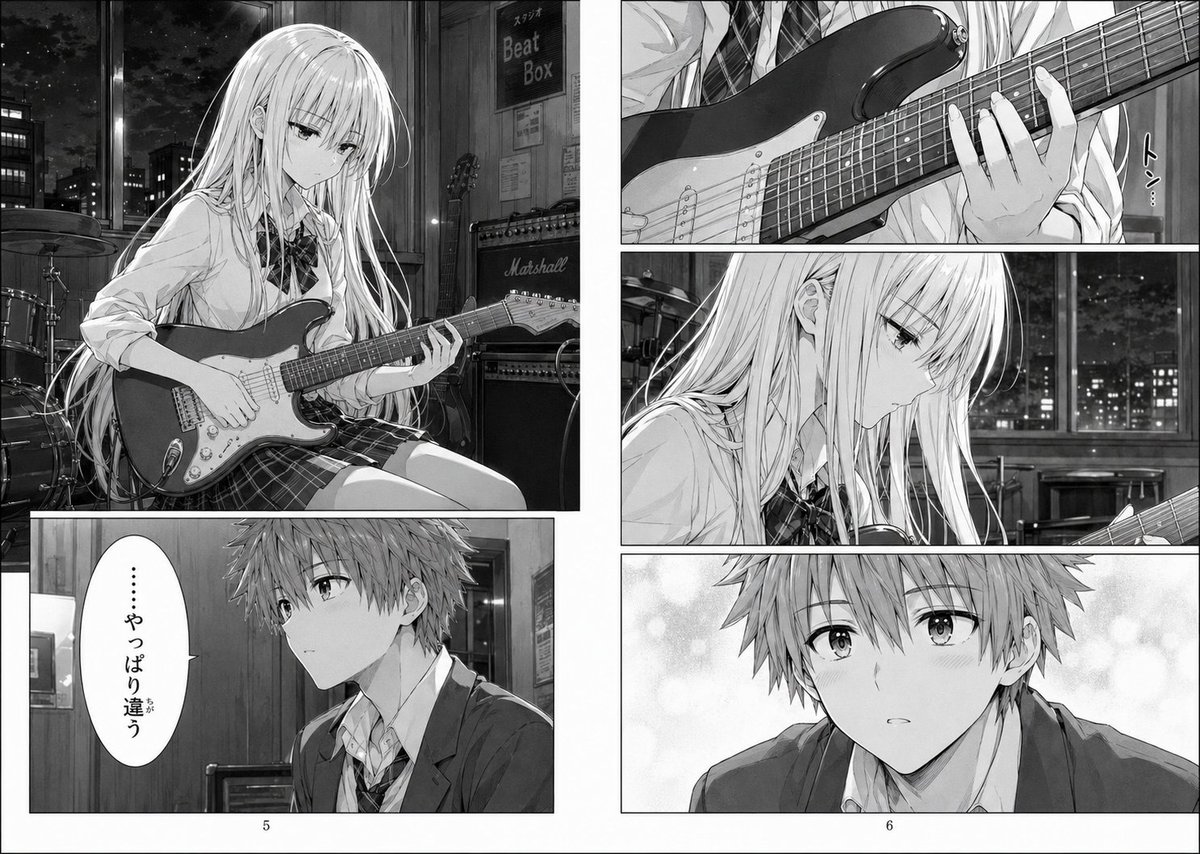
A black-and-white manga page spread with 5 panels on a clean white background and thin black gutters, drawn in highly detailed modern seinen/shoujo hybrid line art with soft screentones, reflective highlights, and a quiet melancholic mood. The setting is a nighttime music studio classroom with large windows showing a city skyline full of lit buildings against a dark sky. Main subject: a slender high school girl with very long straight light hair and blunt bangs, delicate features, and a serious introspective expression, wearing a Japanese school uniform consisting of a white button-up shirt, loosened striped ribbon tie, and plaid skirt, seated and playing a solid-body electric guitar that resembles a Stratocaster. In the large upper-left panel, show her in three-quarter view holding the guitar across her lap, left hand on the fretboard and right hand near the pickups, surrounded by studio equipment including 1 drum kit in the back left, 2 stacked guitar amplifiers on the right, and a wall sign reading "Beat Box" near the door. In the narrow upper-right panel, show a close-up of the guitar neck and her fretting hand, with the small vertical Japanese sound effect text "トン…". In the tall middle-right panel, show a close side-profile close-up of the girl looking down at the instrument with a pensive, almost disappointed expression, with the night city lights blurred through the window behind her. In the lower-left panel, show 1 teenage boy in a school blazer and loosened tie, seated indoors and turned slightly to the side; his face is obscured by a large soft gray rectangular censor block, and beside him is 1 vertical speech balloon containing the Japanese text "……やっぱり違う". In the lower-right panel, show a closer view of the same boy from the chest up against a soft bokeh screentone background; his face is again obscured by a large gray censor block. Add printed page numbers centered at the bottom margins: "5" under the left page and "6" under the right page. Emphasize a subtle narrative theme of realizing that the sound feels wrong, as if this is a continuation page from a dramatic school-band manga. Keep everything monochrome, polished, cinematic, and emotionally restrained.