Case Media
Case Notes
This page keeps the media, full prompt, and original source together so you can inspect the result first and decide whether the prompt is worth copying, saving, or comparing.
Case Insights
To make this page easier to search, cite, and reuse later, the case is also broken down into practical guidance about usage, visual cues, and prompt structure.
Best Fit Scenarios
- Use this as a character design benchmark when you need a fast style baseline before rewriting your own prompt.
- It is especially helpful if your target overlaps with Cinematic, Illustration, Character and you want to judge the image result before tuning wording.
- Keep it as a control sample when you compare nearby prompt variants one variable at a time.
Visual Signals To Notice
- The clearest style signals here are Cinematic, Illustration, Character, so those should usually stay in your first rewrite.
- Look at silhouette, costume language, mood styling, and whether the character reads clearly at a glance.
- This case keeps one primary output, so the first image should be treated as the main visual reference.
How The Prompt Is Structured
- The prompt reads as a long, highly specified prompt, which is useful when you want to judge how much specificity this direction needs.
- Its keyword cluster is centered on Cinematic, Illustration, Character, so you can usually keep that cluster while swapping subject, camera, layout, or copy details.
- A practical rewrite path is: keep the outcome, keep the strongest style cues, then replace only the subject and environment blocks.
Good Follow-up Questions
- What changes first if you keep Cinematic, Illustration, Character but switch the subject matter?
- Which part of the result comes from section-level structure (Character Design) versus tag-level style cues?
- Which related cases in the same section give you a cleaner or more extreme variation of the same direction?
Full Prompt
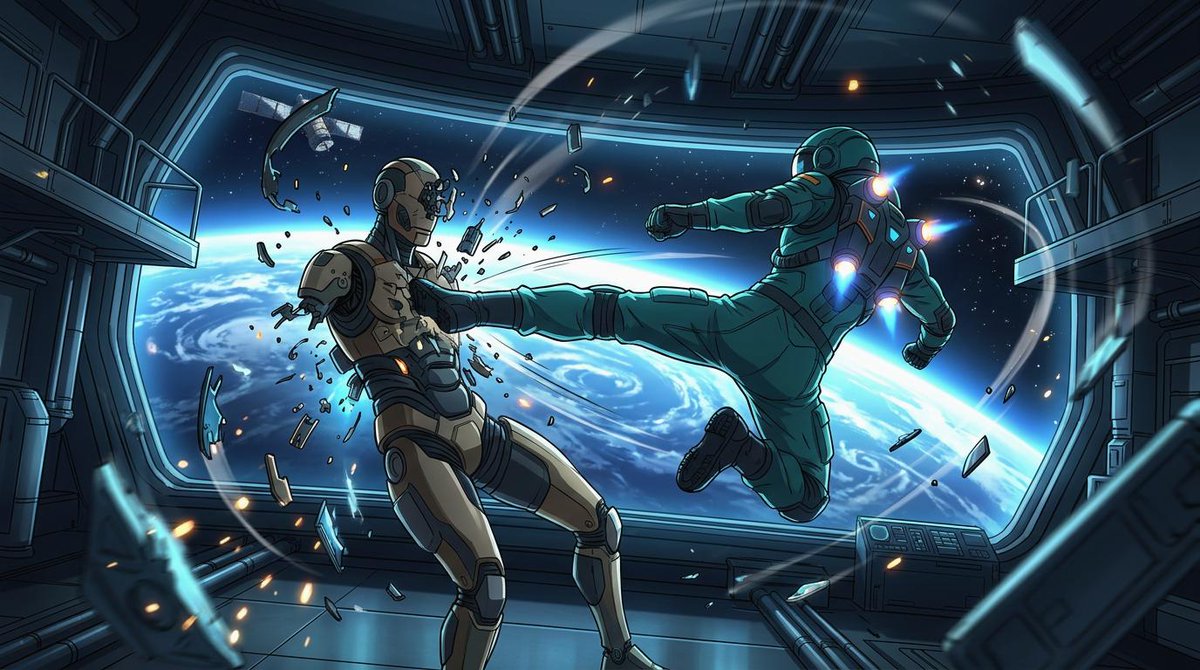
Create a cinematic widescreen sci-fi anime action illustration inside a damaged orbital space station corridor, with Earth and deep space visible through a huge panoramic window. The scene shows exactly two armored figures in zero gravity: on the right, {argument name="attacking astronaut suit color" default="teal green"} powered astronaut armor with glowing blue-white jet thrusters on the back, shoulders, and boots, flying horizontally from right to left and delivering a full-force side kick; on the left, {argument name="defender armor color" default="beige and dark gray"} humanoid combat android or armored astronaut recoils from the kick, chest shattered with fragments and sparks bursting outward. The attacker’s leg is fully extended into the defender’s torso, one arm punched forward and the other pulled back, body tilted dynamically as if propelled by suit jets. Count the major visible subjects and effects precisely: 2 armored figures, 1 enormous curved observation window, 1 view of Earth’s blue horizon with swirling clouds, 1 small satellite outside the window, 2 side balcony platforms, 1 control console at lower right, many floating metal shards and glass fragments, and multiple orange sparks and blue energy streaks arcing through the room. Use a polished Japanese anime / graphic novel style with crisp ink outlines, dramatic perspective, high contrast cel shading, detailed mechanical panels, pipes, rails, and sci-fi wall seams. Lighting should be cold cyan from Earth and the window, accented by orange impact sparks and vivid blue thruster glows. Make the composition dynamic and diagonal, with debris trails and motion arcs emphasizing weightless movement. Canvas: {argument name="aspect ratio" default="16:9 widescreen"}. Mood: {argument name="mood" default="intense orbital combat"}. No text, no logos, no watermark.