Case Media
Case Notes
This page keeps the media, full prompt, and original source together so you can inspect the result first and decide whether the prompt is worth copying, saving, or comparing.
Case Insights
To make this page easier to search, cite, and reuse later, the case is also broken down into practical guidance about usage, visual cues, and prompt structure.
Best Fit Scenarios
- Use this as a character design benchmark when you need a fast style baseline before rewriting your own prompt.
- It is especially helpful if your target overlaps with Cinematic, Illustration, Character and you want to judge the image result before tuning wording.
- Keep it as a control sample when you compare nearby prompt variants one variable at a time.
Visual Signals To Notice
- The clearest style signals here are Cinematic, Illustration, Character, so those should usually stay in your first rewrite.
- Look at silhouette, costume language, mood styling, and whether the character reads clearly at a glance.
- This case keeps one primary output, so the first image should be treated as the main visual reference.
How The Prompt Is Structured
- The prompt reads as a long, highly specified prompt, which is useful when you want to judge how much specificity this direction needs.
- Its keyword cluster is centered on Cinematic, Illustration, Character, so you can usually keep that cluster while swapping subject, camera, layout, or copy details.
- A practical rewrite path is: keep the outcome, keep the strongest style cues, then replace only the subject and environment blocks.
Good Follow-up Questions
- What changes first if you keep Cinematic, Illustration, Character but switch the subject matter?
- Which part of the result comes from section-level structure (Character Design) versus tag-level style cues?
- Which related cases in the same section give you a cleaner or more extreme variation of the same direction?
Full Prompt
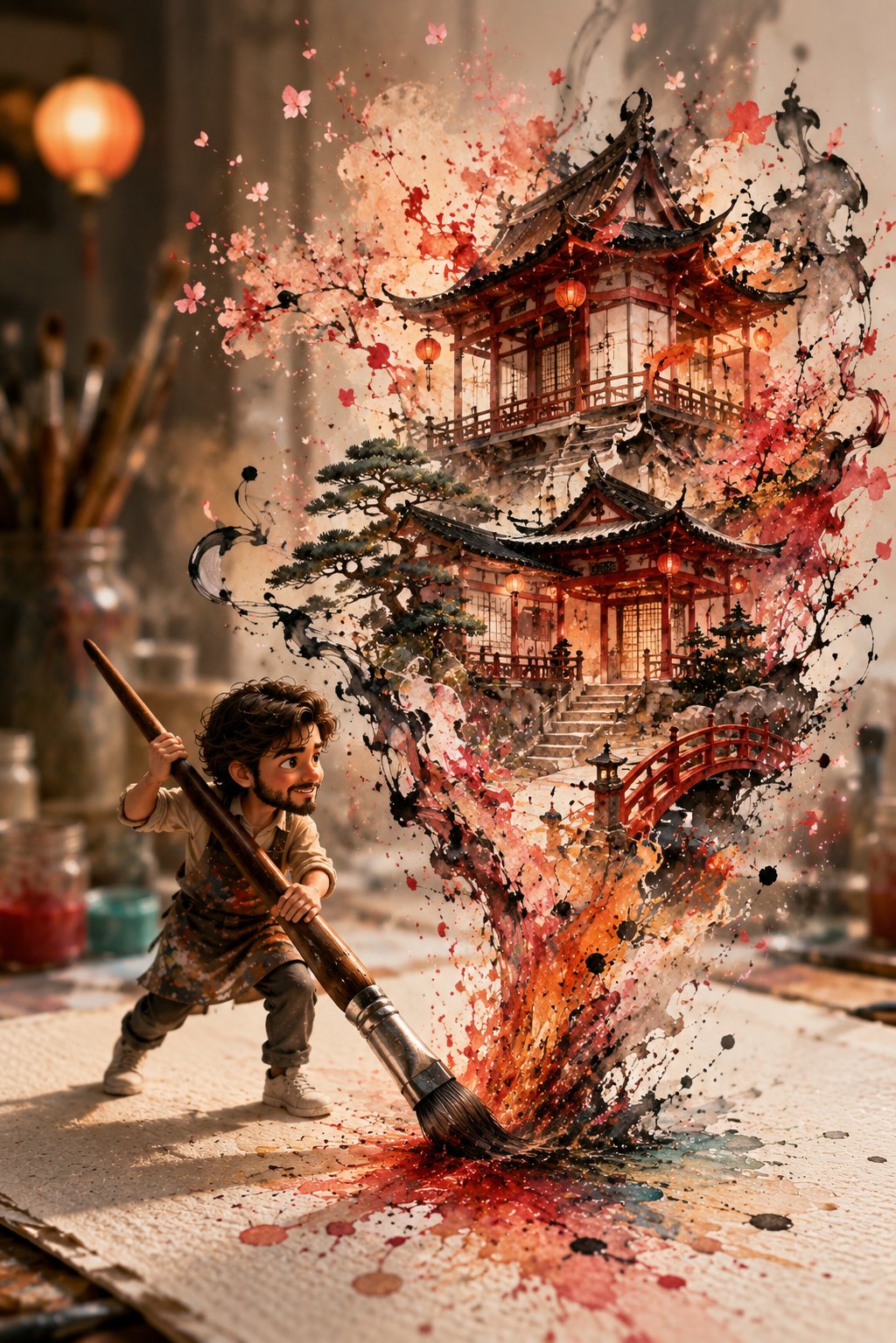
Create a whimsical cinematic image in 2.3 ASPECT_RATIO. Use CHARACTER_REFERENCE as the main character. If it is an uploaded photo, preserve the person’s recognizable facial features, face shape, skin tone, hairstyle, eyebrows, beard, and overall likeness with extreme fidelity, transforming them into a tiny storybook and anime-inspired version of themselves. If it is a text description, create the character exactly from that description. Show the character as a tiny illustrated figure standing on a large sheet of textured watercolor art paper inside an artist’s studio. The character is holding an oversized realistic paintbrush with both hands and forcefully slamming the brush tip into the paper. Important: the character’s anatomy and the brush interaction must be physically accurate and clean — exactly two arms, two hands, five fingers on each hand, normal body proportions, no duplicated limbs, no extra fingers, no brush intersecting the body, and the hands gripping the brush naturally. The brush tip must be visibly pressed against the paper at the exact moment of impact. From this precise impact point, a spectacular explosion of wet paint erupts upward and outward, transforming into a majestic traditional East Asian house made entirely of living paint. The structure should resemble a refined Japanese and Chinese-inspired temple residence, with curved tiled roofs, layered eaves, red wooden columns, sliding paper doors, ornamental lanterns, carved beams, and a peaceful courtyard aesthetic. The architecture must emerge organically from watercolor splashes in deep crimson, vermilion, terracotta, warm brown, jade green, charcoal black, and subtle gold accents. Its form should be created from fluid ink lines, translucent watercolor layers, droplets, expressive brush strokes, and delicate sketch details. The lower part of the house must remain connected to the wet paint puddle on the paper, while the upper part becomes increasingly defined, elegant, and alive. Surround the structure with swirling cherry blossom petals, drifting mist, soft lantern glow, bonsai silhouettes, and graceful ribbons of ink. The house should evoke serenity, tradition, and magical craftsmanship, as if an ancient oriental sanctuary is being painted into existence. Style: dreamy miniature fantasy diorama, delicate anime storybook aesthetic inspired by Studio Ghibli, watercolor-and-ink mixed with realistic macro photography, handcrafted artistic feel, warm studio lighting, shallow depth of field, cinematic composition, soft bokeh, highly detailed paper texture, blurred paint jars, brushes, and art supplies in the background. Rules: tiny character with oversized brush; clear brush-to-paper impact; oriental house emerges directly from the impact point; creation made entirely of watercolor, ink, and wet paint; lower structure connected to the paint splash; magical handcrafted cinematic atmosphere; realistic macro photography; no flat illustration look; no plastic toy appearance; no text, no logos, no captions. --ar 2.3 ASPECT_RATIO”