Case Media
Case Notes
This page keeps the media, full prompt, and original source together so you can inspect the result first and decide whether the prompt is worth copying, saving, or comparing.
Case Insights
To make this page easier to search, cite, and reuse later, the case is also broken down into practical guidance about usage, visual cues, and prompt structure.
Best Fit Scenarios
- Use this as a character design benchmark when you need a fast style baseline before rewriting your own prompt.
- It is especially helpful if your target overlaps with 35mm, Cinematic, Illustration and you want to judge the image result before tuning wording.
- Keep it as a control sample when you compare nearby prompt variants one variable at a time.
Visual Signals To Notice
- The clearest style signals here are 35mm, Cinematic, Illustration, so those should usually stay in your first rewrite.
- Look at silhouette, costume language, mood styling, and whether the character reads clearly at a glance.
- This case keeps one primary output, so the first image should be treated as the main visual reference.
How The Prompt Is Structured
- The prompt reads as a long, highly specified prompt, which is useful when you want to judge how much specificity this direction needs.
- Its keyword cluster is centered on 35mm, Cinematic, Illustration, so you can usually keep that cluster while swapping subject, camera, layout, or copy details.
- A practical rewrite path is: keep the outcome, keep the strongest style cues, then replace only the subject and environment blocks.
Good Follow-up Questions
- What changes first if you keep 35mm, Cinematic, Illustration but switch the subject matter?
- Which part of the result comes from section-level structure (Character Design) versus tag-level style cues?
- Which related cases in the same section give you a cleaner or more extreme variation of the same direction?
Full Prompt
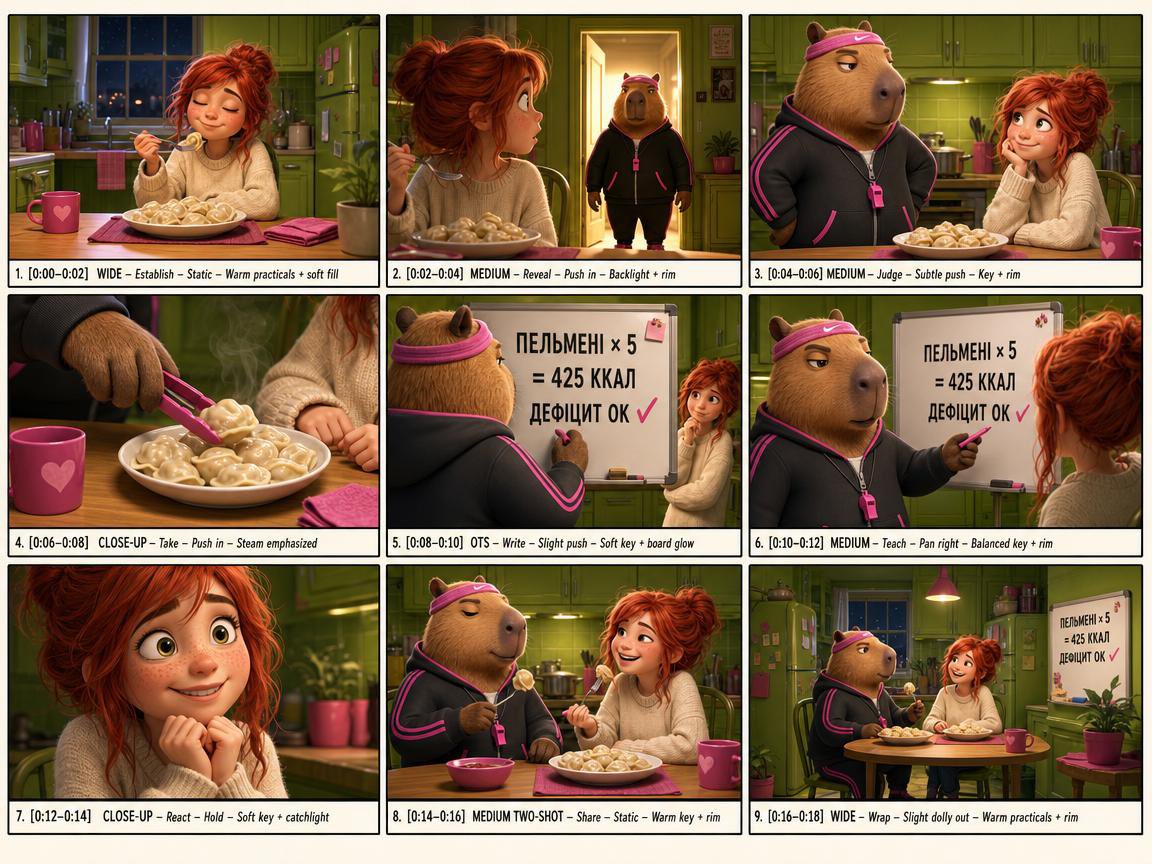
Goal: Create a 3x3 cinematic storyboard contact sheet for an animated short reel about a capybara meal-coach helping a woman track dumplings for calories. Canvas: Landscape 4:3 storyboard sheet, cream paper background, nine equal panels in a 3 columns by 3 rows grid, thin black borders, white caption strips under every frame. Warm cozy evening kitchen setting with olive-green cabinets, tiled backsplash, window with night city lights, pink props, soft practical lamp light, shallow depth of field, polished 3D animated film look. Main characters: A friendly anthropomorphic capybara coach wearing a black zip hoodie with hot-pink stripes, pink headband, pink whistle on a lanyard, rounded muzzle, calm judging expression. A young woman with messy bright red hair in a loose bun, cream cable-knit sweater, seated at a round wooden kitchen table; her face is intentionally obscured by a flat soft-edged tan/brown square privacy mask in panels where it faces camera. Keep the capybara expressive and readable. Key props: One large plate of pelmeni dumplings, one pink mug with a pale heart, pink cloth napkins, fork and spoon, a whiteboard on an easel or wall with bold Russian calorie tracking notes, pink marker, small magnets and sticky note, potted plants and kitchen utensils. Visible storyboard text: Use exactly 9 caption strips, numbered 1 through 9, with timecodes and shot notes in a handwritten storyboard style. The whiteboard must show this Russian text exactly: {argument name="whiteboard text" default="ПЕЛЬМЕНИ x 5\n= 425 ККАЛ\nДЕФИЦИТ OK ✓"}. Caption strip text should be legible and similar to: 1. [0:00--0:02] WIDE - Establish - Static - Warm practicals + soft fill; 2. [0:02--0:04] MEDIUM - Reveal - Push in - Backlight + rim; 3. [0:04--0:06] MEDIUM - Judge - Subtle push - Key + rim; 4. [0:06--0:08] CLOSE-UP - Take - Push in - Steam emphasized; 5. [0:08--0:10] OTS - Write - Slight push - Soft key + board glow; 6. [0:10--0:12] MEDIUM - Teach - Pan right - Balanced key + rim; 7. [0:12--0:14] CLOSE-UP - React - Hold - Soft key + catchlight; 8. [0:14--0:16] MEDIUM TWO-SHOT - Share - Static - Warm key + rim; 9. [0:16--0:18] WIDE - Wrap - Slight dolly out - Warm practicals + rim. Panel-by-panel layout, exactly 9 panels: Panel 1 wide establishing shot: woman alone at table about to eat dumplings, pink mug and napkin visible, green kitchen at night. Panel 2 medium reveal: woman foreground left with spoon, capybara coach appears in a glowing doorway behind her. Panel 3 medium judge: capybara stands beside seated woman, looking sideways at her plate with a suspicious coach expression. Panel 4 close-up: capybara paw uses pink tongs or marker-like utensil to pick one dumpling from steaming plate, woman hands nearby, pink mug left. Panel 5 over-the-shoulder from behind capybara: capybara writes on whiteboard with pink marker while woman watches from side. Panel 6 medium teach: capybara points at the whiteboard text with pink marker while woman listens, with capybara face partly obscured by a tan/brown privacy mask block if facing camera. Panel 7 close-up reaction: woman leaning on clasped hands, red hair filling frame, face covered by tan/brown square mask, cozy kitchen blur behind. Panel 8 medium two-shot: capybara and woman sit together at table sharing dumplings, each holding a dumpling utensil, plate centered, pink bowl and mug visible. Panel 9 wide wrap: both characters at round table in full kitchen, whiteboard visible at right with the calorie note, pendant lamp above, window behind. Visual style: High-end 3D animated family-film aesthetic, warm cinematic lighting, soft rim lights, subtle bloom, realistic food steam, saturated olive greens and pink accents, consistent character designs across panels, storyboard production-board composition. Constraints: Include exactly 9 panels and exactly 9 caption strips. Do not add extra characters. Keep all panels coherent as a single timeline reference for video animation. Maintain legible whiteboard text and visible Russian lettering; avoid logos or watermarks.