Case Media
Case Notes
This page keeps the media, full prompt, and original source together so you can inspect the result first and decide whether the prompt is worth copying, saving, or comparing.
Case Insights
To make this page easier to search, cite, and reuse later, the case is also broken down into practical guidance about usage, visual cues, and prompt structure.
Best Fit Scenarios
- Use this as a character design benchmark when you need a fast style baseline before rewriting your own prompt.
- It is especially helpful if your target overlaps with Poster, Illustration, Character and you want to judge the image result before tuning wording.
- Keep it as a control sample when you compare nearby prompt variants one variable at a time.
Visual Signals To Notice
- The clearest style signals here are Poster, Illustration, Character, so those should usually stay in your first rewrite.
- Look at silhouette, costume language, mood styling, and whether the character reads clearly at a glance.
- This case keeps one primary output, so the first image should be treated as the main visual reference.
How The Prompt Is Structured
- The prompt reads as a long, highly specified prompt, which is useful when you want to judge how much specificity this direction needs.
- Its keyword cluster is centered on Poster, Illustration, Character, so you can usually keep that cluster while swapping subject, camera, layout, or copy details.
- A practical rewrite path is: keep the outcome, keep the strongest style cues, then replace only the subject and environment blocks.
Good Follow-up Questions
- What changes first if you keep Poster, Illustration, Character but switch the subject matter?
- Which part of the result comes from section-level structure (Character Design) versus tag-level style cues?
- Which related cases in the same section give you a cleaner or more extreme variation of the same direction?
Full Prompt
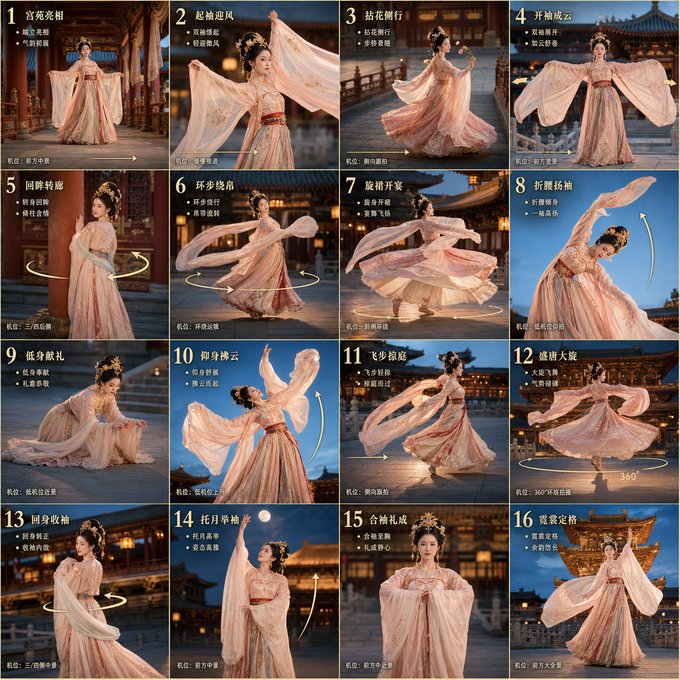
请创作一张高完成度、高清晰度的「汉唐宫廷舞 / 霓裳羽衣舞 · 16宫格分镜图」。 【整体定位】 这不是普通古风写真,也不是单纯舞蹈教学图,而是一张融合「汉唐宫廷舞」「霓裳羽衣舞」「真实宫苑空间」「电影分镜感」「16步动作编排」的高完成度分镜海报。 整体要像一段盛唐宫廷舞的完整编舞被拆解成16个关键画面,每一格既清晰独立,又有连续流动感,方便后续用于视频生成。 【场景设定】 不要舞台,不要空黑背景,不要现代摄影棚。 场景必须是一个真实、立体、优美、符合汉唐时代气质的盛唐宫苑空间: - 傍晚金蓝时刻,宫灯初上 - 朱红宫柱 - 金色宫灯 - 宫廷回廊 / 大殿外庭院 - 石阶、栏杆、轻纱帷幔 - 远处可见层叠殿宇与宫苑深景 - 空间有明确前景、中景、后景,具有真实纵深感 - 整体氛围华美、通透、盛世感强,不要乌漆麻黑,不要浑浊,不要色斑 【人物设定】 主角是一位年轻中国女舞者,带有盛唐宫廷舞者气质,端庄、华美、优雅、克制。 她在16格中必须保持同一张脸、同一人物身份、同一气质、同一套服装体系,不要每格都像换了一个人。 【服装与妆造】 服装为汉唐宫廷舞服 / 霓裳羽衣风格: - 高腰长裙 - 大袖 - 轻纱披帛 - 精致发髻 - 金色发饰、步摇 - 少量花钿或唐风妆感 - 裙摆、披帛、大袖都要有真实动态 推荐配色: - 胭脂粉 - 象牙白 - 香槟金 - 淡石青 整体华丽但不俗艳。 【版式要求】 - 画面采用 4×4 的16宫格分镜排版 - 每格都有明显编号 1-16 - 每格都有中文动作标题 - 每格可有简洁中文说明或短句提示 - 每格都要像一个独立镜头画面 - 适当加入动作方向箭头或轨迹线,增强分镜感 - 整体清晰、工整、信息完整,但不要过度拥挤 - 分辨率要非常高清,线条清楚,人物和背景都清晰,不要糊,不要脏,不要有色斑 【动作分镜顺序】 1. 宫苑亮相 舞者站在宫苑中央,微侧身,长裙曳地,一手轻提大袖,一手自然垂落,建立盛唐气场。 2. 起袖迎风 双臂缓缓抬起,大袖与披帛轻轻被带起,像乐声初起。 3. 拈花侧行 舞者缓步前行,一手做拈花或兰花指,一手大袖舒展在身后,动作优雅。 4. 开袖成云 双袖向两侧大幅展开,形成对称而华丽的大开构图,像云气铺开。 5. 回眸转廊 舞者经过宫柱或回廊边缘,身体转向侧背,再缓缓回眸。 6. 环步绕帛 脚下走环步,披帛绕身形成流动轨迹,双臂一前一后,动作圆润。 7. 旋裙开宴 原地或小范围旋转,长裙与披帛打开,形成华丽旋舞。 8. 折腰扬袖 身体轻折,一袖高扬,一袖下垂,形成斜向张力构图。 9. 低身献礼 半蹲或单膝低位,双手托袖向前,动作像宫廷献礼,具有礼乐仪式感。 10. 仰身拂云 从低位起身,上半身轻微后仰,双袖向上扬起,披帛向后飞,动作华美但真人可完成。 11. 飞步掠庭 向侧前方做一个轻盈掠步,大袖和披帛向后带出,形成位移动线。 12. 盛唐大旋 最华丽的一次大旋转,长裙、披帛、大袖同时打开,是整套最强高潮之一。 13. 回身收袖 从大旋中自然回身,双袖由外向内慢慢收回,动作从大开转向收束。 14. 托月举袖 一手高举如托月,一手横于胸前,身体向上拉长,披帛在身侧形成弧线,仪式感强。 15. 合袖礼成 双袖缓缓合拢至胸前,形成“礼成”动作,神情宁静庄重。 16. 霓裳定格 最终大定格,一袖高扬,一袖低垂,身体优雅扭转,长裙铺开,端庄华美地完成收尾。 【重点要求】 - 必须突出真实空间感与时代感 - 必须保持同一舞者一致性 - 必须有完整的大袖、披帛、长裙动态 - 必须适合后续作为视频分镜参考 - 每一格动作都要明显不同,不能过于重复 - 画面整体要华丽、优美、清晰、通透 - 不要黑压压,不要脏,不要模糊,不要色斑,不要廉价古风感