案例媒体
案例说明
这个页面把案例媒体、完整 Prompt 和出处放在一起,方便你先看结果,再判断这条 Prompt 是否值得复制、收藏或加入对比。
案例解读
为了方便搜索、引用和后续复用,这里会把案例的适用场景、画面重点和 Prompt 结构拆成更容易浏览的说明。
这类案例适合用在什么场景
- 把它当作 模型对比与社区 的基准案例最合适,先看成片方向,再决定自己的 Prompt 要往哪边改。
- 如果你的目标也落在 时尚、海报、角色 这些方向,这条案例特别适合先看图判断风格,再回头微调描述。
- 做 Prompt 对比时,也很适合作为控制组,只改一个变量去看结果变化。
画面重点与风格信号
- 这条案例最明显的风格信号集中在 时尚、海报、角色,所以第一次改写时最好先保留这些关键词。
- 这类案例最有价值的地方通常是看差异:到底改了什么、哪里崩了、是哪段 Prompt 造成的变化。
- 当前只有一张主图,所以第一张结果图就是最核心的参考基准。
Prompt 结构可以怎么理解
- 这条 Prompt 整体属于一条比较长、约束条件很多的 Prompt,很适合拿来判断这类方向到底需要写到多细。
- 关键词簇主要围绕 时尚、海报、角色 展开,所以复用时可以先保留这组风格词,再替换主体、镜头、环境或文案信息。
- 最稳的改写方式通常是先保留结果方向和最强风格信号,只替换主体设定与场景块。
如果你是带着问题来的,可以先看这些角度
- 如果保留 时尚、海报、角色,只换主体题材,结果最先变化的会是哪一部分?
- 这条结果里,哪些特征更像是 模型对比与社区 的结构特征,哪些又是标签风格本身带来的?
- 同分类的相关案例里,哪几条能给你更克制或更极致的相邻变体?
完整 Prompt
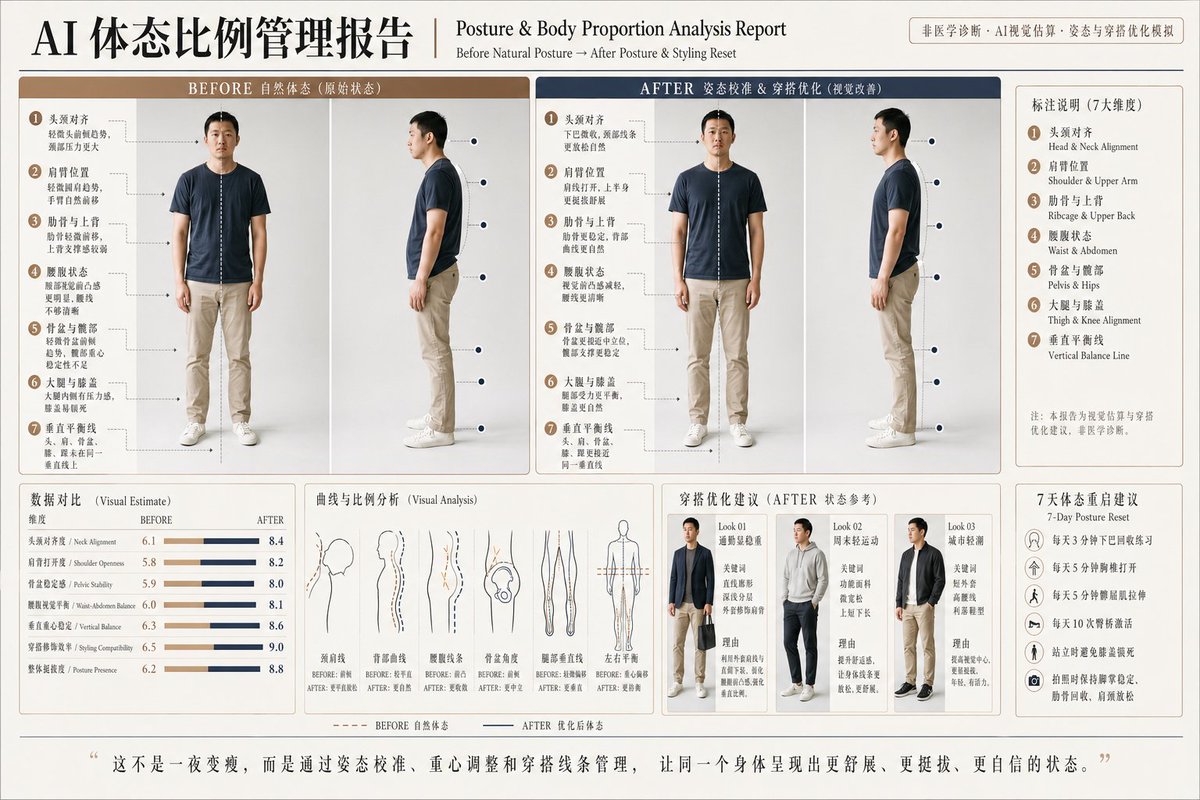
Please generate a horizontal 4:3 high-completion "AI Posture & Body Proportion Analysis Report" based on the full-body front and full-body side real-person photos I uploaded. This report is not a medical diagnosis, not a before-and-after weight loss comparison, nor an exaggerated weight loss effect image, but a "Visual Posture Analysis + Proportion Management + Outfit Optimization + Posture Calibration Simulation" report based on real-person photos. Please strictly retain the user's own facial recognition, facial features structure, sense of age, real skin texture, hairstyle and temperament, body foundation and original identity. Do not swap faces, do not turn the person into someone else, do not create exaggerated weight loss or unrealistic body changes. [Core Settings] Before: Show the user's current natural standing posture state, including front and side two perspectives, retaining the real body shape, real clothing, and natural posture. After: Show the simulated state of the same person after "Posture Calibration + Outfit Optimization + Visual Proportion Adjustment". The focus is on being more upright, more relaxed, more energetic, and showing more coordinated proportions, rather than becoming thinner, bonier, or drastically changing the body shape. Please understand After as "a better visual state presented on the same day through correct standing posture, core tightening, shoulder and neck relaxation, pelvic repositioning, and outfit line optimization". [Highest Priority Principles] 1. Do not make medical diagnoses, only perform visual posture and outfit proportion analysis. 2. Do not use humiliating words, do not judge whether the appearance is good or bad, do not create body anxiety. 3. Do not exaggerate body shape changes, do not forcefully slim down, do not change fat distribution, do not change bone structure. 4. All data should be presented in the form of "AI Visual Estimate / Visual Estimate", do not pretend to be real medical measurements. 5. The language should be gentle, professional, data-driven, and encouraging, focusing on expressing "optimizable space", "more coordinated proportions", "more relaxed posture", and "more compatible outfit". [Overall Layout] Horizontal 4:3, high-end health management consultant report + fashion magazine infographic style. The background uses clean off-white, light gray, or low-saturation warm white, paired with thin line frames, numbered labels, partial enlargement boxes, posture baseline, vertical center of gravity line, curve annotations, and concise charts. The overall information volume is rich but not crowded, professional, with a sense of design, suitable for sharing on Xiaohongshu or X. [Title Area] Main Title: AI Posture & Body Proportion Analysis Report English Subtitle: Posture & Body Proportion Analysis Report Sub Title: Before Natural Posture → After Posture & Styling Reset Corner Mark: Non-medical diagnosis · AI Visual Estimate · Posture & outfit optimization simulation [Main Visual Area] Adopt a four-image comparison structure: The left side is BEFORE: - Before Front Image: Retain the user's natural standing posture, natural outfit, and real body shape - Before Side Image: Show the natural side posture The right side is AFTER: - After Front Image: Same person, same identity, similar angle, posture is more upright, shoulders and neck are more relaxed, waist and abdomen lines are more optimized by the outfit, overall proportions are more coordinated - After Side Image: Same person, showing from the side that the head and neck position is more retracted, shoulders and back are more open, pelvis position is more neutral, forward bulging sensation of the abdomen is reduced, knees are not overly locked, overall center of gravity is more stable The four character images must be clear, similar in size, and have a clear comparison relationship. Do not let After become a completely different person, and do not over-beautify or over-slim. [Posture Analysis Annotation Area] Please use thin line arrows, numbers, and partial enlargement boxes to annotate the following parts on the Before and After images: 1. Head & Neck Position / Head & Neck Alignment Before can be annotated: Forward head, obvious neck pressure sensation After can be annotated: Chin slightly tucked, neck lines more relaxed 2. Shoulder & Upper Arm Position / Shoulder & Upper Arm Position Before can be annotated: Rounded shoulder trend, scapulae protracted, upper arm position forward After can be annotated: Shoulder lines opened, upper body more upright 3. Ribcage & Upper Back / Ribcage & Upper Back Before can be annotated: Ribcage forward bulging, insufficient back support After can be annotated: Ribcage more stable, back curves more natural 4. Waist & Abdomen Position / Waist & Abdomen Before can be annotated: Abdomen visually forward bulging, waistline unclear After can be annotated: Weaken the forward bulging sensation through posture and outfit, waistline clearer 5. Pelvis & Hip Position / Pelvis & Hip Position Before can be annotated: Anterior pelvic tilt trend, hip center of gravity not stable enough After can be annotated: Pelvis closer to neutral position, hip support more stable 6. Thigh & Knee Position / Thigh & Knee Alignment Before can be annotated: Inner thigh pressure sensation, knee locked or hyperextended trend After can be annotated: Leg force distribution more balanced, knee state more natural 7. Vertical Center of Gravity Line / Vertical Balance Line Before can be annotated: Head, shoulders, pelvis, knees, ankles are not completely on the same visual center of gravity line After can be annotated: Center of gravity line more stable, overall more upright [Data Comparison Column] Please use clear charts to show the AI Visual Estimate indicators of Before → After. All indicators must be marked with "Visual Estimate", do not write them as real medical tests. Suggested data are as follows: - Neck Alignment / Neck Alignment: 6.1 → 8.4 - Shoulder Openness / Shoulder Openness: 5.8 → 8.2 - Pelvic Stability / Pelvic Stability: 5.9 → 8.0 - Waist-Abdomen Balance / Waist-Abdomen Balance: 6.0 → 8.1 - Vertical Balance / Vertical Balance: 6.3 → 8.6 - Styling Compatibility / Styling Compatibility: 6.5 → 9.0 - Posture Presence / Posture Presence: 6.2 → 8.8 Please use progress bars, radar charts, or comparison number cards to present, visually clear but not exaggerated. [Curve & Proportion Analysis Area] Please draw lightweight line graphs or body outline curve schematics to show: - Neck and shoulder lines - Back curves - Waist and abdomen lines - Pelvic angle trends - Leg vertical lines - Front left-right balance sense The lines should look like professional posture assessment diagrams, not medical diagnosis diagrams, and must not create a sense of intimidation. [Outfit Optimization Suggestion Area] Please show 3 daily outfit plans suitable for the After state. Each set includes a small thumbnail, style keywords, and one sentence of reason: Look 01: Commuting shows steadiness Keywords: Straight silhouette, deep and light layering, coat modifies shoulders and back Reason: Through the coat shoulder line and straight-leg bottoms, weaken the forward bulging sensation of the abdomen, and enhance the vertical proportion. Look 02: Weekend light sports Keywords: Functional fabrics, slightly loose, short top and long bottom Reason: Improve comfort while making body lines more relaxed and extended. Look 03: Urban light trendy Keywords: Short coat, high waistline, neat shoe type Reason: Elevate the visual center of gravity, making the overall look more upright, younger, and more energetic. [Action Suggestion Area] Please add a small module "7-Day Posture Reset / 7-Day Posture Reset", with gentle and executable content: - 3 minutes of chin tuck exercise every day - 5 minutes of thoracic spine opening every day - 5 minutes of hip flexor stretching every day - 10 glute bridge activations every day - Avoid locking knees when standing - Keep feet stable, ribs tucked, and shoulders and neck relaxed when taking photos Please note that these suggestions can only serve as daily posture management suggestions, do not write them as treatment plans. [Bottom Summary] Please summarize with a gentle and powerful sentence: "This is not about getting thin overnight, but through posture calibration, center of gravity adjustment, and outfit line management, making the same body present a more relaxed, more upright, and more confident state." [Strictly Avoid] Do not show nudity or underwear; do not make it revealing; do not shame the body; do not use negative words like "obesity defects", "fat problems", "very bad figure"; do not exaggerate weight loss; do not pretend to make medical diagnoses; do not fabricate real body fat percentage, real waist circumference, real weight; do not turn the user into someone else; do not over-beautify; do not let After become an unrealistic influencer figure.