Case Media
Case Notes
This page keeps the media, full prompt, and original source together so you can inspect the result first and decide whether the prompt is worth copying, saving, or comparing.
Case Insights
To make this page easier to search, cite, and reuse later, the case is also broken down into practical guidance about usage, visual cues, and prompt structure.
Best Fit Scenarios
- Use this as a ui & social screens benchmark when you need a fast style baseline before rewriting your own prompt.
- It is especially helpful if your target overlaps with Cinematic, Illustration, UI and you want to judge the image result before tuning wording.
- Keep it as a control sample when you compare nearby prompt variants one variable at a time.
Visual Signals To Notice
- The clearest style signals here are Cinematic, Illustration, UI, so those should usually stay in your first rewrite.
- The important layer is usually interface density, card hierarchy, and how the screen tells the story before you read small text.
- This case keeps one primary output, so the first image should be treated as the main visual reference.
How The Prompt Is Structured
- The prompt reads as a long, highly specified prompt, which is useful when you want to judge how much specificity this direction needs.
- Its keyword cluster is centered on Cinematic, Illustration, UI, so you can usually keep that cluster while swapping subject, camera, layout, or copy details.
- A practical rewrite path is: keep the outcome, keep the strongest style cues, then replace only the subject and environment blocks.
Good Follow-up Questions
- What changes first if you keep Cinematic, Illustration, UI but switch the subject matter?
- Which part of the result comes from section-level structure (UI & Social Screens) versus tag-level style cues?
- Which related cases in the same section give you a cleaner or more extreme variation of the same direction?
Full Prompt
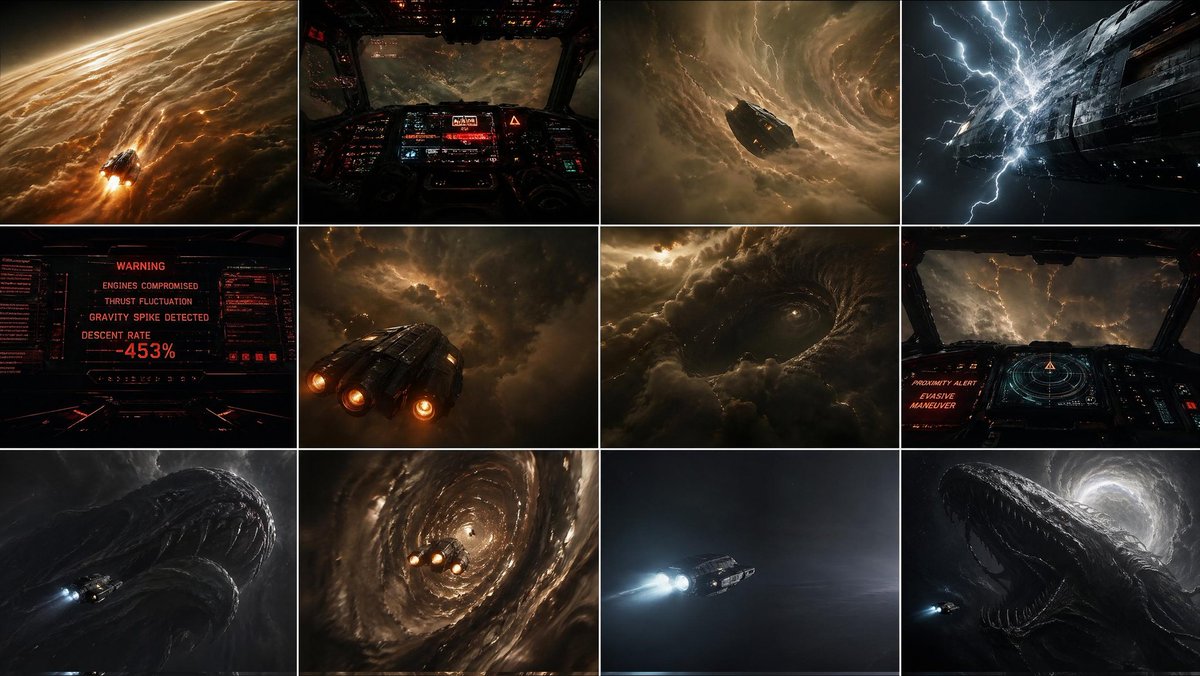
{"type":"cinematic sci-fi storyboard contact sheet","subject":{"primary":"a small futuristic spacecraft descending into a massive gas giant storm system","secondary":"an enormous leviathan-like silhouette hidden within the clouds","mood":"oppressive, catastrophic, awe-struck, high tension, cosmic dread","style":"photorealistic cinematic concept art with dark sci-fi realism, volumetric storm clouds, strong contrast, amber and black palette with occasional cold blue lightning","aspect_ratio":"16:9"},"vehicle":{"design":"compact armored deep-atmosphere ship with 3 bright rear engines, angular industrial hull, worn metallic panels","scale":"tiny compared to the planet and creature"},"layout":{"grid":{"rows":3,"columns":4,"count":12},"sections":[{"position":"row 1 col 1","description":"wide exterior shot of the ship entering the upper atmosphere of a colossal gas giant at extreme speed, glowing clouds streaked with fire and friction around the vessel, curved planetary horizon visible"},{"position":"row 1 col 2","description":"cockpit POV, dark interior filled with red and cyan holographic instruments, forward visibility collapsing into turbulent storm layers and electrical haze"},{"position":"row 1 col 3","description":"exterior mid-wide shot of the ship diving into a gigantic rotating cloud funnel, surrounded by violent spiraling storm structure"},{"position":"row 1 col 4","description":"extreme close exterior of the ship hull as bright lightning strikes dangerously close, white electric energy crawling across the metal surface"},{"position":"row 2 col 1","description":"dashboard warning screen in red, showing a critical systems failure interface with the exact visible text count of 4 warning lines and 1 large percentage readout: ['WARNING','ENGINES COMPROMISED','THRUST FLUCTUATION','GRAVITY SPIKE DETECTED','DESCENT RATE -453%']"},{"position":"row 2 col 2","description":"rear three-quarter exterior of the ship fighting turbulence inside dense storm clouds, engines burning hard while the craft barely holds course"},{"position":"row 2 col 3","description":"massive circular disturbance forming in the clouds like an eye or maw, entire storm systems displaced by something huge moving beneath"},{"position":"row 2 col 4","description":"second cockpit view with radar-like navigation display and red alert text, pilot making a blind evasive maneuver through lightning-filled darkness"},{"position":"row 3 col 1","description":"first reveal of the colossal creature shape rising near the ship, black organic surface and immense curved anatomy emerging from darkness, ship tiny at lower left"},{"position":"row 3 col 2","description":"spiral descent shot, ship caught inside a vortex tunnel of clouds, spinning downward with engines flaring as it struggles to recover"},{"position":"row 3 col 3","description":"sudden breakthrough into a calm void, minimal composition, ship flying in eerie silence through dark open space with soft mist and no visible storm around it"},{"position":"row 3 col 4","description":"final reveal, gigantic leviathan fully emerging behind or beside the ship in cleared space, backlit by a pale circular storm opening, enormous open maw-like silhouette dwarfing the craft"}],"continuity":"all 12 panels depict one continuous descent sequence from atmospheric entry to final creature reveal"},"lighting":{"primary":"glowing amber storm light","secondary":"red cockpit interface glow","accents":"blue-white lightning and engine exhaust"},"environment":{"location":"inside the upper and middle storm layers of a gigantic gas giant","weather":"violent turbulence, electrical storms, vortex funnels, cloud walls, pressure chaos","threat":"no safe zone, repeated near-failure, unknown colossal presence driving the storm"}}