Case Media
Case Notes
This page keeps the media, full prompt, and original source together so you can inspect the result first and decide whether the prompt is worth copying, saving, or comparing.
Case Insights
To make this page easier to search, cite, and reuse later, the case is also broken down into practical guidance about usage, visual cues, and prompt structure.
Best Fit Scenarios
- Use this as a ui & social screens benchmark when you need a fast style baseline before rewriting your own prompt.
- It is especially helpful if your target overlaps with Neon, Illustration, UI and you want to judge the image result before tuning wording.
- Keep it as a control sample when you compare nearby prompt variants one variable at a time.
Visual Signals To Notice
- The clearest style signals here are Neon, Illustration, UI, so those should usually stay in your first rewrite.
- The important layer is usually interface density, card hierarchy, and how the screen tells the story before you read small text.
- This case keeps one primary output, so the first image should be treated as the main visual reference.
How The Prompt Is Structured
- The prompt reads as a long, highly specified prompt, which is useful when you want to judge how much specificity this direction needs.
- Its keyword cluster is centered on Neon, Illustration, UI, so you can usually keep that cluster while swapping subject, camera, layout, or copy details.
- A practical rewrite path is: keep the outcome, keep the strongest style cues, then replace only the subject and environment blocks.
Good Follow-up Questions
- What changes first if you keep Neon, Illustration, UI but switch the subject matter?
- Which part of the result comes from section-level structure (UI & Social Screens) versus tag-level style cues?
- Which related cases in the same section give you a cleaner or more extreme variation of the same direction?
Full Prompt
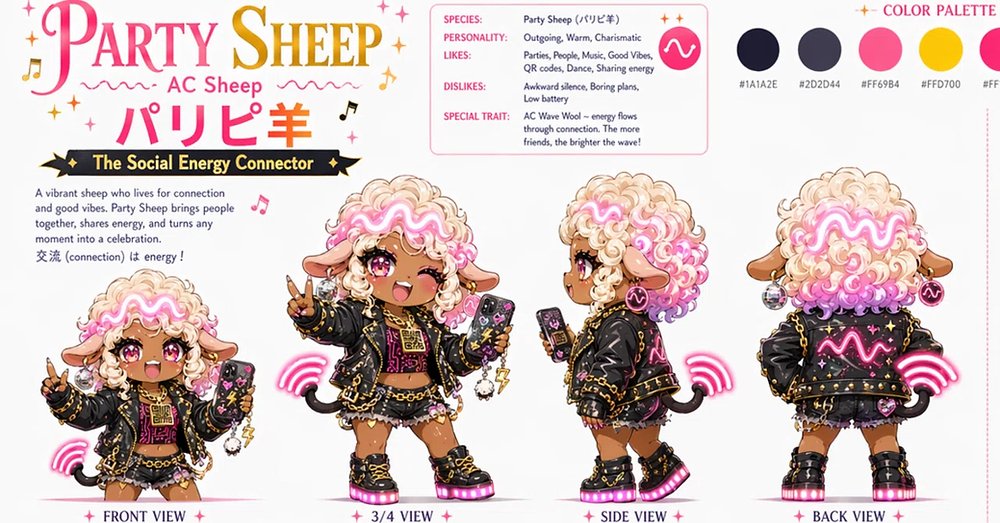
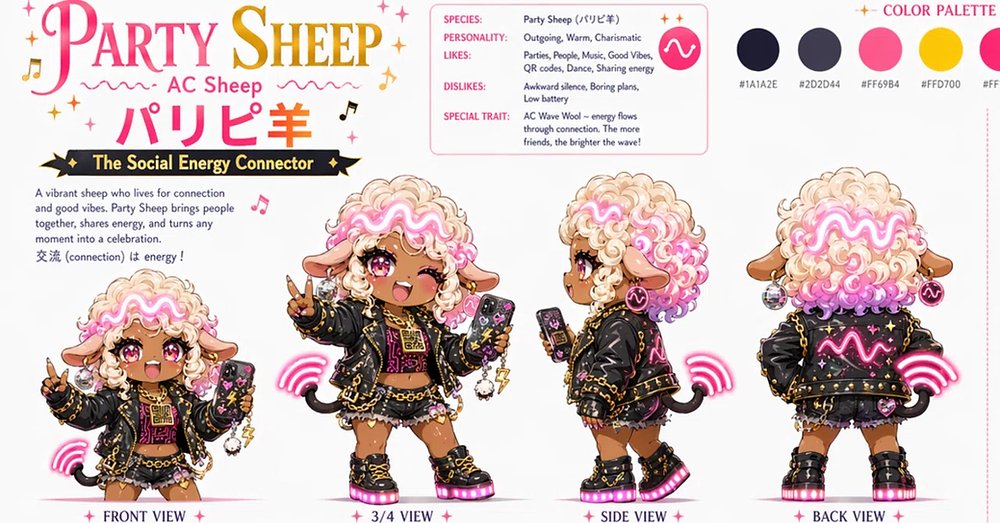
Goal: Create a polished kawaii character design sheet for {argument name="character name" default="Party Sheep"}, an energetic AC sheep mascot themed around social connection, party vibes, and glowing waveform energy. Canvas: Wide horizontal character reference sheet, clean white background, pink and gold accents, crisp print-ready layout. Use a cute Japanese idol-streetwear aesthetic with sparkles, music notes, tiny stars, and playful decorative dividers. Header and typography: Large ornate title at top left reading “PARTY SHEEP” in a pink-to-gold gradient serif display font, with smaller subtitle “AC Sheep” beneath it. Include large Japanese name text “パリピ羊” in hot pink below the subtitle. Add a black ribbon banner with gold trim reading “The Social Energy Connector.” Character details: The mascot is a chibi sheep girl with warm tan skin, big glossy pink eyes, one eye winking in some poses, sheep ears, small black tail, and very fluffy curly cream wool hair with bright pink curls. A neon pink glowing waveform runs through the front of the wool like an LED headband. Outfit: black cropped punk jacket with gold studs and chains, hot pink waveform graphics, black-and-pink patterned top, layered black mini skirt with ruffles, gold chain accessories, chunky black platform boots with glowing pink soles, hoop earrings, charms, wrist accessories, and a smartphone decorated with music and party icons. Overall expression is outgoing, cheerful, and charismatic. Layout: Show exactly 4 full-body character views across the lower area, labeled beneath each pose: 1) “FRONT VIEW” at far left, smaller chibi front pose holding a phone and making a peace sign, 2) “3/4 VIEW” center-left, larger main pose smiling with one eye closed, holding up a peace sign and a phone, 3) “SIDE VIEW” center-right, profile pose looking left while holding the phone, 4) “BACK VIEW” far right, rear view showing the jacket back with glowing pink waveform and sparkling details. Add pink wireless energy-wave effects near the character in each view, especially by the tail/back area. Information card: At the upper center-right, include a rounded rectangular pink outline profile card with exactly 5 labeled rows: “SPECIES: Party Sheep (パリピ羊)”, “PERSONALITY: Outgoing, Warm, Charismatic”, “LIKES: Parties, People, Music, Good Vibes, QR codes, Dance, Sharing energy”, “DISLIKES: Awkward silence, Boring plans, Low battery”, and “SPECIAL TRAIT: AC Wave Wool -- energy flows through connection. The more friends, the brighter the wave!” Include a hot pink circular icon with a white waveform inside the card. Intro text block: Under the ribbon on the left, add a short paragraph: “A vibrant sheep who lives for connection and good vibes. Party Sheep brings people together, shares energy, and turns any moment into a celebration. 交流 (connection) is energy!” Color palette: At the top right, add the title “COLOR PALETTE” in pink and display exactly 5 circular swatches in a row: near-black navy labeled “#1A1A2E”, charcoal purple labeled “#2D2D44”, hot pink labeled “#FF69B4”, golden yellow labeled “#FFD700”, and cream wool labeled {argument name="cream color hex" default="#FFF3E0"}. Keep palette labels small and clean. Style constraints: High-detail 2D anime/chibi concept art, clean linework, glossy highlights, soft shadows, sticker-sheet presentation, no photographic realism, no cluttered background, no extra character views, no extra labels beyond the specified text.