Case Media
Case Notes
This page keeps the media, full prompt, and original source together so you can inspect the result first and decide whether the prompt is worth copying, saving, or comparing.
Case Insights
To make this page easier to search, cite, and reuse later, the case is also broken down into practical guidance about usage, visual cues, and prompt structure.
Best Fit Scenarios
- Use this as a ui & social screens benchmark when you need a fast style baseline before rewriting your own prompt.
- It is especially helpful if your target overlaps with Neon, Illustration, UI and you want to judge the image result before tuning wording.
- Keep it as a control sample when you compare nearby prompt variants one variable at a time.
Visual Signals To Notice
- The clearest style signals here are Neon, Illustration, UI, so those should usually stay in your first rewrite.
- The important layer is usually interface density, card hierarchy, and how the screen tells the story before you read small text.
- This case keeps one primary output, so the first image should be treated as the main visual reference.
How The Prompt Is Structured
- The prompt reads as a long, highly specified prompt, which is useful when you want to judge how much specificity this direction needs.
- Its keyword cluster is centered on Neon, Illustration, UI, so you can usually keep that cluster while swapping subject, camera, layout, or copy details.
- A practical rewrite path is: keep the outcome, keep the strongest style cues, then replace only the subject and environment blocks.
Good Follow-up Questions
- What changes first if you keep Neon, Illustration, UI but switch the subject matter?
- Which part of the result comes from section-level structure (UI & Social Screens) versus tag-level style cues?
- Which related cases in the same section give you a cleaner or more extreme variation of the same direction?
Full Prompt
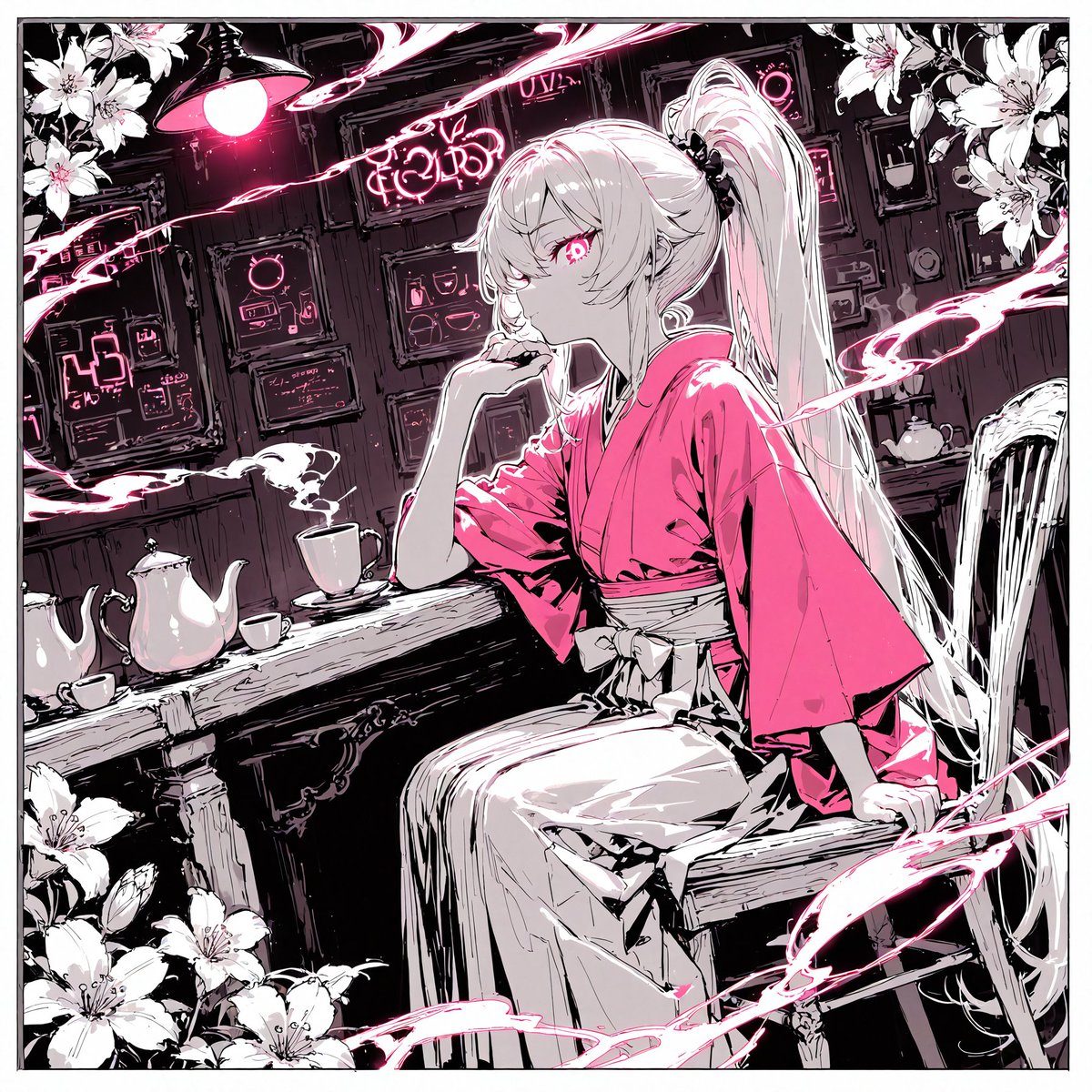
Create a square anime illustration in a high-contrast monochrome manga style with vivid hot-pink accents. Show {argument name="character name" default="a mysterious young woman"} seated sideways on a wooden chair at a rustic counter inside a dim retro cyberpunk tea room or café. She has very long {argument name="hair color" default="silver-white"} hair tied into a high ponytail that cascades behind her, pale skin, sharp bangs, and one glowing pink eye visible as she gazes to the left with a calm, aloof expression, resting her chin on one hand. Dress her in a bright {argument name="kimono color" default="hot-pink"} kimono-style top with wide sleeves, a light obi bow at the waist, and a long pale pleated skirt. The café background is dense with dark wooden panels, framed futuristic control screens, tiny interface diagrams, signs, cables, and a hanging lamp with a glowing pink bulb. On the counter place exactly five tea items: one large white teapot on the far left, two small teacups near it, one steaming mug in front of the character, and one small teapot or kettle on a rear shelf to the right. Surround the composition with exactly four clusters of white lilies: upper left corner, upper right corner, lower left corner, and lower right edge. Add sweeping ribbon-like pink energy trails and brush strokes crossing the image diagonally, with several white streaks and ink splatters, giving motion and magical atmosphere. Use thick black linework, sketchy crosshatching, limited palette of black, white, gray, and neon pink, detailed manga shading, dramatic lighting, slightly tilted perspective, ornate cluttered background, no readable modern watermark, no extra characters.