Case Media
Case Notes
This page keeps the media, full prompt, and original source together so you can inspect the result first and decide whether the prompt is worth copying, saving, or comparing.
Case Insights
To make this page easier to search, cite, and reuse later, the case is also broken down into practical guidance about usage, visual cues, and prompt structure.
Best Fit Scenarios
- Use this as a ui & social screens benchmark when you need a fast style baseline before rewriting your own prompt.
- It is especially helpful if your target overlaps with Cinematic, Illustration, UI and you want to judge the image result before tuning wording.
- Keep it as a control sample when you compare nearby prompt variants one variable at a time.
Visual Signals To Notice
- The clearest style signals here are Cinematic, Illustration, UI, so those should usually stay in your first rewrite.
- The important layer is usually interface density, card hierarchy, and how the screen tells the story before you read small text.
- This case keeps one primary output, so the first image should be treated as the main visual reference.
How The Prompt Is Structured
- The prompt reads as a long, highly specified prompt, which is useful when you want to judge how much specificity this direction needs.
- Its keyword cluster is centered on Cinematic, Illustration, UI, so you can usually keep that cluster while swapping subject, camera, layout, or copy details.
- A practical rewrite path is: keep the outcome, keep the strongest style cues, then replace only the subject and environment blocks.
Good Follow-up Questions
- What changes first if you keep Cinematic, Illustration, UI but switch the subject matter?
- Which part of the result comes from section-level structure (UI & Social Screens) versus tag-level style cues?
- Which related cases in the same section give you a cleaner or more extreme variation of the same direction?
Full Prompt
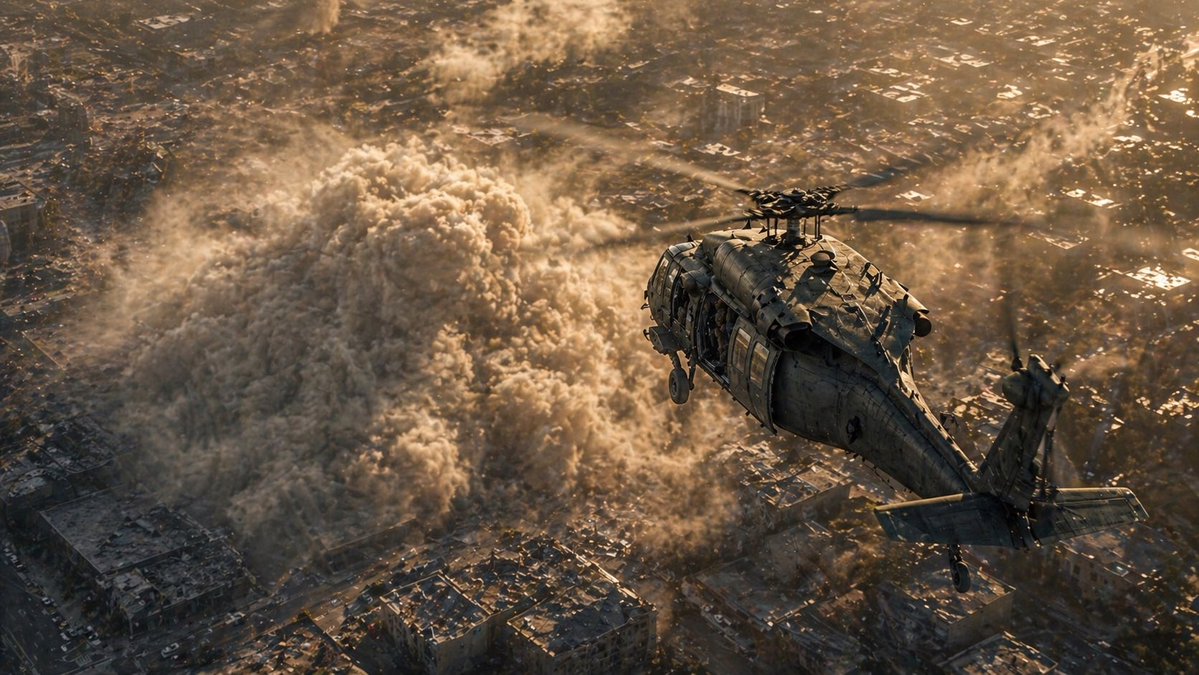
A cinematic ultra-realistic aerial disaster scene viewed from slightly above and behind a single military transport helicopter flying over a dense urban neighborhood at golden hour. The helicopter is a dark weathered matte-gray utility helicopter with 1 main rotor and 1 tail rotor, seen from the rear-right side, angled toward the upper right of the frame, with visible panel lines, antennas, landing gear, tail stabilizers, and an open side door. Below it, a massive rolling dust cloud from a building collapse or explosion surges through tightly packed city blocks, forming 1 huge mushrooming wall of beige-gray debris with turbulent texture, smaller plumes, and swirling particulate noise spreading between rooftops. The city beneath is sprawling, crowded, and sunlit in warm amber tones, with low-rise buildings, narrow streets, scattered highlights on roofs, and haze in the distance. Emphasize rotor motion blur, volumetric dust, dramatic scale, harsh backlit sunset lighting, long shadows, atmospheric perspective, intense contrast between the dark helicopter and glowing dust, and a tense war-zone or rescue-operation mood. Photorealistic, blockbuster cinematography, high detail, realistic materials, dynamic composition, wide aerial shot, no text, no interface, no extra aircraft.