Case Media
Case Notes
This page keeps the media, full prompt, and original source together so you can inspect the result first and decide whether the prompt is worth copying, saving, or comparing.
Case Insights
To make this page easier to search, cite, and reuse later, the case is also broken down into practical guidance about usage, visual cues, and prompt structure.
Best Fit Scenarios
- Use this as a ui & social screens benchmark when you need a fast style baseline before rewriting your own prompt.
- It is especially helpful if your target overlaps with Cinematic, Illustration, UI and you want to judge the image result before tuning wording.
- Keep it as a control sample when you compare nearby prompt variants one variable at a time.
Visual Signals To Notice
- The clearest style signals here are Cinematic, Illustration, UI, so those should usually stay in your first rewrite.
- The important layer is usually interface density, card hierarchy, and how the screen tells the story before you read small text.
- This case keeps one primary output, so the first image should be treated as the main visual reference.
How The Prompt Is Structured
- The prompt reads as a long, highly specified prompt, which is useful when you want to judge how much specificity this direction needs.
- Its keyword cluster is centered on Cinematic, Illustration, UI, so you can usually keep that cluster while swapping subject, camera, layout, or copy details.
- A practical rewrite path is: keep the outcome, keep the strongest style cues, then replace only the subject and environment blocks.
Good Follow-up Questions
- What changes first if you keep Cinematic, Illustration, UI but switch the subject matter?
- Which part of the result comes from section-level structure (UI & Social Screens) versus tag-level style cues?
- Which related cases in the same section give you a cleaner or more extreme variation of the same direction?
Full Prompt
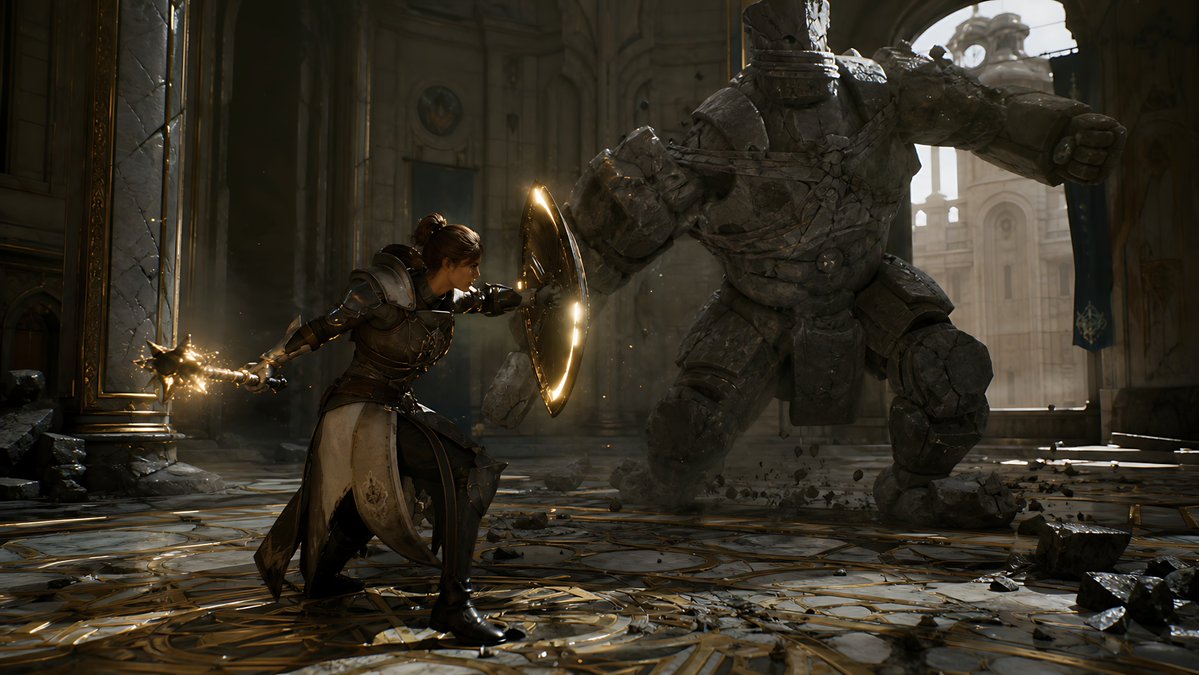
Create a cinematic dark fantasy action scene in a ruined cathedral hall: a {argument name="hero type" default="female armored knight-mage"} crouches in a defensive lunge on the left foreground, wearing ornate dark steel and leather plate armor with a long cream-and-black tabard, one arm extended behind her gripping a spiked mace or morning star crackling with golden magic sparks, the other arm braced forward behind a round glowing shield rimmed with warm light. Opposite her in the right midground is a massive {argument name="enemy type" default="headless stone golem"}, built from cracked gray masonry plates and bound with broken chains, charging with one huge fist raised and rubble falling from its body. Set the battle inside a grand, damaged palace-cathedral interior with towering arches, carved stone columns, tall broken windows, gold-trimmed marble floor in circular geometric patterns, scattered chunks of stone, dust, and debris. Use dramatic backlighting from a bright arched window behind the golem, warm golden magical highlights on the shield and weapon, deep shadows, volumetric dust beams, realistic textures, high-detail armor and stone, dynamic low-angle wide composition, shallow cinematic depth, epic game-cinematic realism, 16:9 widescreen, no text, no UI.