Case Media
Case Notes
This page keeps the media, full prompt, and original source together so you can inspect the result first and decide whether the prompt is worth copying, saving, or comparing.
Case Insights
To make this page easier to search, cite, and reuse later, the case is also broken down into practical guidance about usage, visual cues, and prompt structure.
Best Fit Scenarios
- Use this as a ui & social screens benchmark when you need a fast style baseline before rewriting your own prompt.
- It is especially helpful if your target overlaps with Portrait, Poster, Illustration and you want to judge the image result before tuning wording.
- Keep it as a control sample when you compare nearby prompt variants one variable at a time.
Visual Signals To Notice
- The clearest style signals here are Portrait, Poster, Illustration, so those should usually stay in your first rewrite.
- The important layer is usually interface density, card hierarchy, and how the screen tells the story before you read small text.
- This case keeps 2 media outputs, which makes it easier to check whether the style remains stable across multiple results.
How The Prompt Is Structured
- The prompt reads as a long, highly specified prompt, which is useful when you want to judge how much specificity this direction needs.
- Its keyword cluster is centered on Portrait, Poster, Illustration, so you can usually keep that cluster while swapping subject, camera, layout, or copy details.
- A practical rewrite path is: keep the outcome, keep the strongest style cues, then replace only the subject and environment blocks.
Good Follow-up Questions
- What changes first if you keep Portrait, Poster, Illustration but switch the subject matter?
- Which part of the result comes from section-level structure (UI & Social Screens) versus tag-level style cues?
- Which related cases in the same section give you a cleaner or more extreme variation of the same direction?
Full Prompt
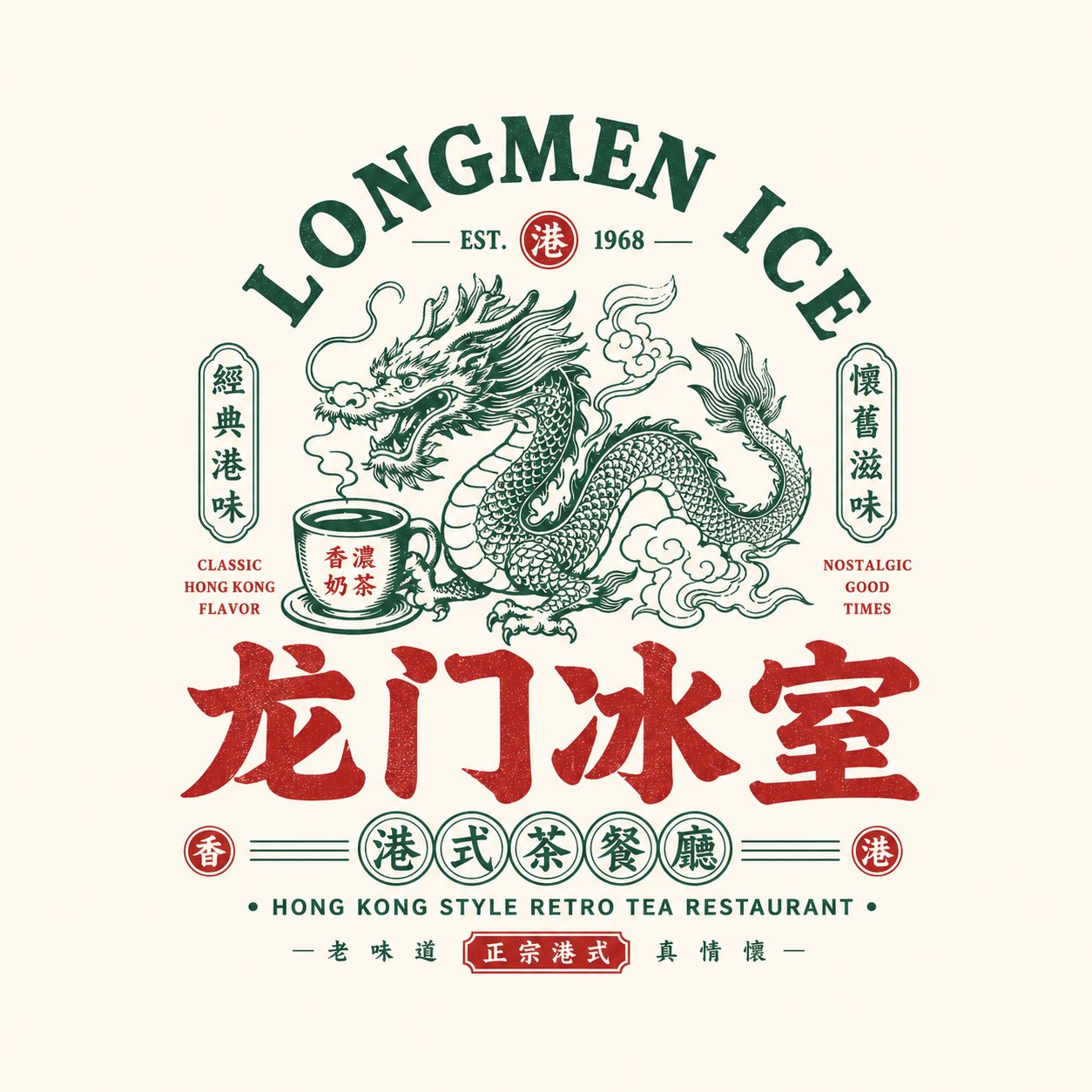
Please design a high-quality "Chinese Retro Food Emblem Logo" based on the following user-provided configuration: [User Input] - Brand Name / Project Name: [Brand Name / Project Name] - Subtitle / Product Name: [Subtitle / Product Name] - Type / Industry: [Type / Industry] - Regional Flavor: [Hong Kong / Cantonese / Hunan / Sichuan / Charcoal Grill / Night Market / Cha Chaan Teng / Roast / Seafood / Bistro, etc.] - Brand Positioning: [Brand Positioning] - Core Keywords: [Retro, Chinese Trend (Guochao), Storefront Signboard Vibe, Time-Honored Brand, Hustle & Bustle (Yanhuoqi), Martial Arts/Wuxia vibe, New Consumer Vibe, etc.] - Core Graphic: [Dragon / Phoenix / Crane / Tiger / Ox / Frog / Goose / Fish / Lobster / Utensils / Totems / Auspicious Patterns, etc.] - Core Food / Category Element: [Roast Goose / BBQ / Tea Drinks / Lobster / Noodles / Beef / Ice Room / Bistro, etc.] - Emotional Vibe: [Lively, Domineering, Retro, Classic, Regional, Bustling, Young, etc.] - Main Color: [Main Color] - Secondary Color: [Secondary Color] - Aspect Ratio: [Aspect Ratio] [Core Objective] Design a fully-realized "Chinese Retro Food Emblem Logo" ready for dining brands. This is not a poster or simple cartoon illustration, but a professional logo with a strong storefront, packaging, and brand system feel. It should focus on the main Chinese wordmark, integrating memorable graphics, category symbols, retro bilingual typography, and a structured emblem format. The final design must immediately communicate: 1. It is a dining/food brand; 2. It has a clear category and personality; 3. It feels like a mature brand primary logo rather than a decorative pattern. [Design Essence] The logo should integrate five key layers: 1. Chinese Main Wordmark: For brand recognition. 2. Graphic Symbol: For memory points and category association. 3. Emblem Structure: For overall completeness and integrity. 4. Bilingual Typography: For hierarchy and retro brand atmosphere. 5. Color System: To reinforce dining cues and emotional tone. [Key Principles] 1. The Chinese brand name must be bold, highly legible, and have a "storefront signboard" presence. 2. The logo must be a unified emblem rather than scattered elements. 3. The graphic must relate directly to the brand or food category. 4. English acts as an auxiliary element and must not overshadow the Chinese main text. 5. Highly adaptable for store signs, menus, packaging, and social media avatars. 6. Maintain a vintage, nostalgic vibe without looking messy or outdated. 7. Emphasize a "Guochao (Chinese Retro)" aesthetic rather than American cartoon or Japanese store styles. [Chinese Wordmark Requirements] 1. The Chinese brand name is the absolute protagonist. 2. Fonts should evoke vintage food signboards, classic packaging, or bold retro headlines. 3. Use bold, heavy fonts like Sans-serif (Heiti), Slab-serif (Songhei), or stylized commercial handwriting. 4. Do not use thin, minimalist, or default system fonts. [Graphic System Requirements] Create a highly relevant central graphic based on the [Core Graphic] and [Category Element]. - Options: Mythical beasts/animals (dragon, phoenix, tiger, ox, etc.), core ingredients/dishes (lobster, roast goose, noodles), traditional totems (seals, patterns), or cooking utensils/scenes. - Graphics should be memorable, stylized (e.g., retro illustration, woodcut, vintage label line art), and easy to integrate into the emblem. [Emblem Structure Requirements] Use a cohesive layout, such as: 1. Arched English text on top + central graphic + Chinese wordmark at the bottom. 2. Central main graphic + side badges + subtitle below. 3. Circular, oval, or plaque-style framing. 4. Symmetrical layouts with sub-seals and small stamp details. [Bilingual Typography Requirements] - Chinese dominant, English auxiliary (e.g., "HOUSE", "TAVERN", "BARBECUE", "ESTD", "SINCE"). - Use English to construct arches, state categories, or serve as composition borders. [Color System Requirements] Select a retro dining palette: - Black + Red (BBQ, Hotpot, Bistro) - Black + Gold/Bronze (Time-honored brands, Roast Goose, Cantonese) - Green + Red + Cream (Hong Kong café/Cha Chaan Teng) - Blue + Red + White (Seafood, modern night markets) - Red + Cream (Noodles, traditional snacks) Keep the palette cohesive, using 2-4 primary colors. [Presentation Requirements] - Displayed as a standalone logo mockup on a clean, simple background (light gray, cream, off-white). - Centered, complete, and professionally structured.