Case Media
Case Notes
This page keeps the media, full prompt, and original source together so you can inspect the result first and decide whether the prompt is worth copying, saving, or comparing.
Case Insights
To make this page easier to search, cite, and reuse later, the case is also broken down into practical guidance about usage, visual cues, and prompt structure.
Best Fit Scenarios
- Use this as a ui & social screens benchmark when you need a fast style baseline before rewriting your own prompt.
- It is especially helpful if your target overlaps with Cinematic, Illustration, UI and you want to judge the image result before tuning wording.
- Keep it as a control sample when you compare nearby prompt variants one variable at a time.
Visual Signals To Notice
- The clearest style signals here are Cinematic, Illustration, UI, so those should usually stay in your first rewrite.
- The important layer is usually interface density, card hierarchy, and how the screen tells the story before you read small text.
- This case keeps 2 media outputs, which makes it easier to check whether the style remains stable across multiple results.
How The Prompt Is Structured
- The prompt reads as a long, highly specified prompt, which is useful when you want to judge how much specificity this direction needs.
- Its keyword cluster is centered on Cinematic, Illustration, UI, so you can usually keep that cluster while swapping subject, camera, layout, or copy details.
- A practical rewrite path is: keep the outcome, keep the strongest style cues, then replace only the subject and environment blocks.
Good Follow-up Questions
- What changes first if you keep Cinematic, Illustration, UI but switch the subject matter?
- Which part of the result comes from section-level structure (UI & Social Screens) versus tag-level style cues?
- Which related cases in the same section give you a cleaner or more extreme variation of the same direction?
Full Prompt
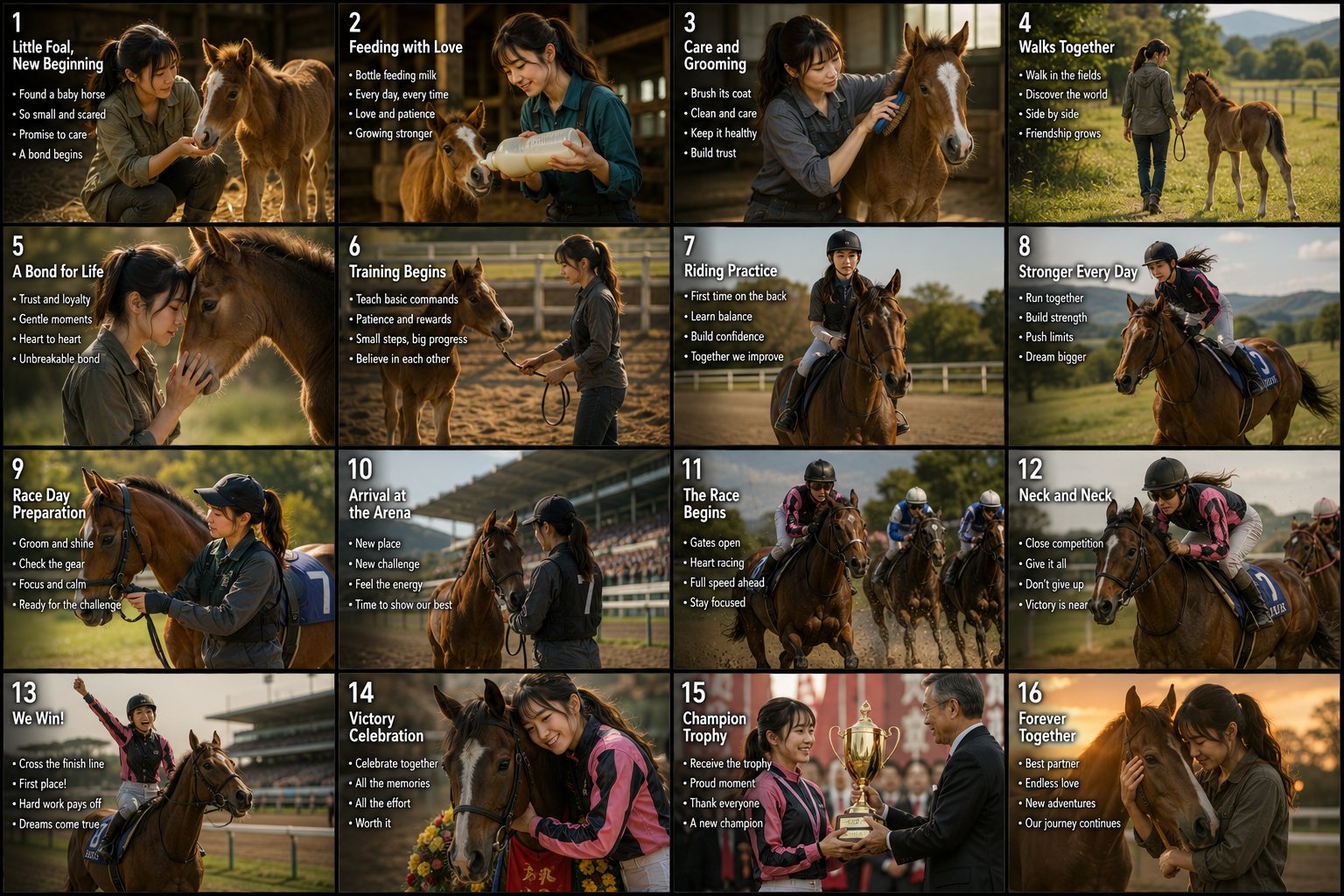
Create a cinematic 16-panel storyboard infographic showing the emotional journey of a young woman raising a small baby horse and training it into a powerful racing horse. Use a realistic movie-storyboard style with warm natural colors, countryside environments, cinematic lighting, and emotional storytelling. The same realistic young woman should appear consistently in every panel wearing casual ranch clothes, riding boots, and later professional horse-racing attire. Show the horse growing gradually from a cute foal into a strong beautiful racing horse. Arrange the storyboard in a clean 4x4 grid with numbered scenes, bold titles, small bullet points, and cinematic visual flow. Scenes should include: finding or caring for the baby horse, feeding it milk, brushing and cleaning it, training the young horse, running together in open fields, bonding emotionally, practicing horse riding daily, preparing for a horse race, arriving at the racing arena, intense race competition with other riders, dramatic fast-running shots, crossing the finish line first, celebrating victory, receiving a golden trophy, emotional crowd applause, and the final scene showing the girl hugging her winning horse proudly at sunset. Include realistic horse movement, countryside scenery, dust effects, cinematic sunlight, emotional expressions, detailed racing arena atmosphere, dynamic camera angles, and luxury sports-drama aesthetics. Ultra-realistic photography style, emotional cinematic storytelling, premium movie-quality composition, 4K detail, no anime, no cartoon, no CGI look.