Case Media
Case Notes
This page keeps the media, full prompt, and original source together so you can inspect the result first and decide whether the prompt is worth copying, saving, or comparing.
Case Insights
To make this page easier to search, cite, and reuse later, the case is also broken down into practical guidance about usage, visual cues, and prompt structure.
Best Fit Scenarios
- Use this as a ui & social screens benchmark when you need a fast style baseline before rewriting your own prompt.
- It is especially helpful if your target overlaps with Illustration, UI, Screenshot and you want to judge the image result before tuning wording.
- Keep it as a control sample when you compare nearby prompt variants one variable at a time.
Visual Signals To Notice
- The clearest style signals here are Illustration, UI, Screenshot, so those should usually stay in your first rewrite.
- The important layer is usually interface density, card hierarchy, and how the screen tells the story before you read small text.
- This case keeps one primary output, so the first image should be treated as the main visual reference.
How The Prompt Is Structured
- The prompt reads as a long, highly specified prompt, which is useful when you want to judge how much specificity this direction needs.
- Its keyword cluster is centered on Illustration, UI, Screenshot, so you can usually keep that cluster while swapping subject, camera, layout, or copy details.
- A practical rewrite path is: keep the outcome, keep the strongest style cues, then replace only the subject and environment blocks.
Good Follow-up Questions
- What changes first if you keep Illustration, UI, Screenshot but switch the subject matter?
- Which part of the result comes from section-level structure (UI & Social Screens) versus tag-level style cues?
- Which related cases in the same section give you a cleaner or more extreme variation of the same direction?
Full Prompt
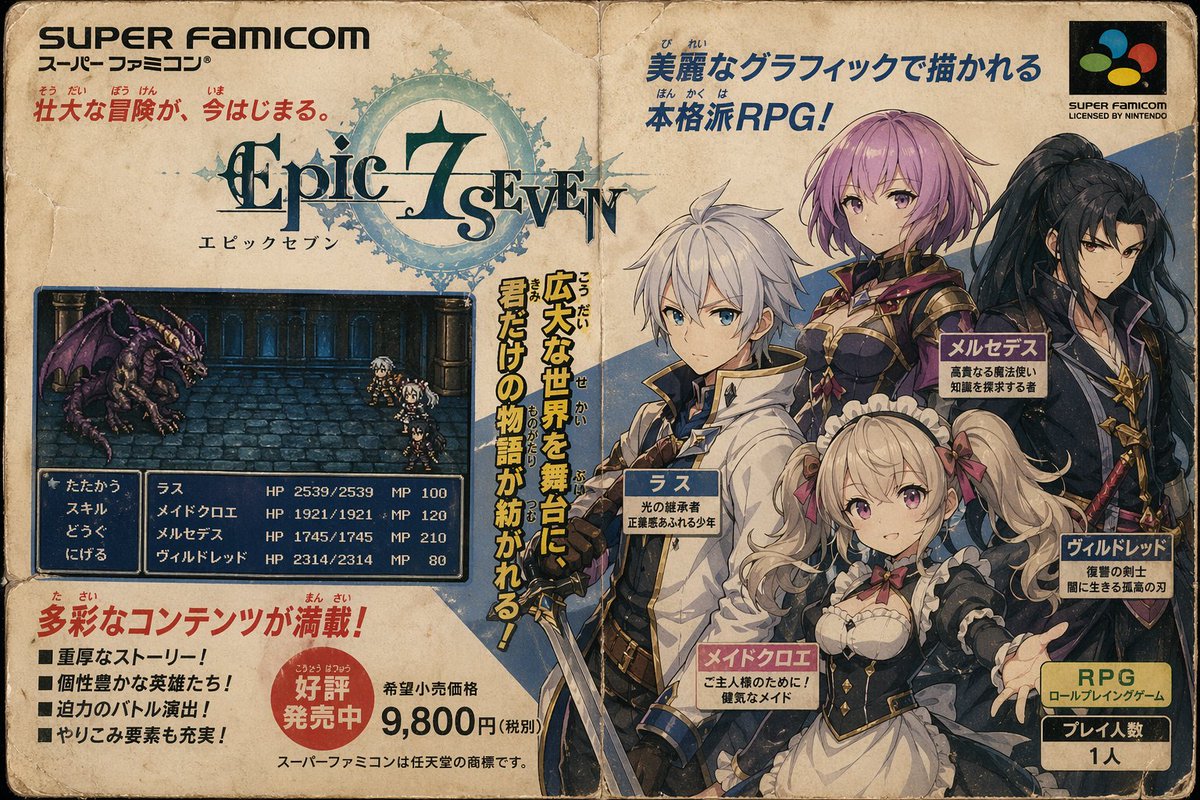
Create a full-page vintage Japanese Super Famicom game box advertisement designed like a worn 1990s magazine spread or game package front, on aged yellowed paper with creases, stains, frayed corners, fold marks, and slight print fading. The layout should feel authentically retro and densely composed, with bold Japanese promotional copy, a fake fantasy RPG logo, a character lineup on the right, a gameplay screenshot on the left, and pricing and feature callouts near the bottom. At the top left, place a large black “SUPER FAMICOM” header with smaller Japanese subtitle text beneath it, and nearby a red Japanese slogan line. At the top right, include a small Super Famicom style logo badge in a black rectangle with the English text “SUPER FAMICOM LICENSED BY NINTENDO” underneath. In the upper center, feature the game title logo “Epic 7 Seven” in ornate fantasy typography, dark teal and black, layered over a circular magical crest or sigil in pale blue. Under the logo, add small Japanese katakana subtitle text. On the right half, show 4 anime fantasy party members in a polished JRPG promotional illustration style: 1 white-haired young male hero in a white cloak and blue-black outfit holding a sword, 1 pink-haired female knight or mage in dark armor with gold trim, 1 tall long-black-haired swordsman in dark layered robes, and 1 blonde twin-tailed maid girl in a black-and-white frilled dress reaching one hand forward. Their faces should be generic and soft-featured, front-facing or three-quarter view, grouped in a heroic composition. Add 4 dark blue nameplates with Japanese character names and short class descriptions near each character. Place a tall vertical yellow Japanese slogan with black outline between the screenshot and the character group. On the left lower-middle, include 1 in-game battle screenshot framed in a dark blue rounded rectangle: a pixel-art dungeon battle scene showing 1 purple dragon monster facing a 4-character party in a stone corridor. At the bottom of the battle screen, show a classic RPG interface with 4 command options in Japanese and a party status list with character names, HP, and MP values. In the lower left, add a red Japanese headline followed by 4 black square bullet points of Japanese feature text. Near the bottom center, place a red circular burst sticker with white Japanese text indicating strong sales, beside a large printed price reading “9,800円” with smaller surrounding Japanese retail text. At the bottom right, include 1 yellow information box labeled “RPG” with additional Japanese text and a separate dark box below for player count reading “1人”. Use a muted retro print palette of cream, dark blue, teal, red, gold, black, and faded pastel character colors. The whole image should resemble a highly convincing fictional Super Famicom advertisement for a classic fantasy RPG titled {argument name="game title" default="Epic 7 Seven"}, with visible Japanese text, nostalgic print imperfections, and authentic 1990s console game marketing design.