Case Media
Case Notes
This page keeps the media, full prompt, and original source together so you can inspect the result first and decide whether the prompt is worth copying, saving, or comparing.
Case Insights
To make this page easier to search, cite, and reuse later, the case is also broken down into practical guidance about usage, visual cues, and prompt structure.
Best Fit Scenarios
- Use this as a portrait & photography benchmark when you need a fast style baseline before rewriting your own prompt.
- It is especially helpful if your target overlaps with Portrait, Cinematic, Poster and you want to judge the image result before tuning wording.
- Keep it as a control sample when you compare nearby prompt variants one variable at a time.
Visual Signals To Notice
- The clearest style signals here are Portrait, Cinematic, Poster, so those should usually stay in your first rewrite.
- Focus on framing, light direction, pose, and the distance between subject and camera.
- This case keeps 2 media outputs, which makes it easier to check whether the style remains stable across multiple results.
How The Prompt Is Structured
- The prompt reads as a long, highly specified prompt, which is useful when you want to judge how much specificity this direction needs.
- Its keyword cluster is centered on Portrait, Cinematic, Poster, so you can usually keep that cluster while swapping subject, camera, layout, or copy details.
- A practical rewrite path is: keep the outcome, keep the strongest style cues, then replace only the subject and environment blocks.
Good Follow-up Questions
- What changes first if you keep Portrait, Cinematic, Poster but switch the subject matter?
- Which part of the result comes from section-level structure (Portrait & Photography) versus tag-level style cues?
- Which related cases in the same section give you a cleaner or more extreme variation of the same direction?
Full Prompt
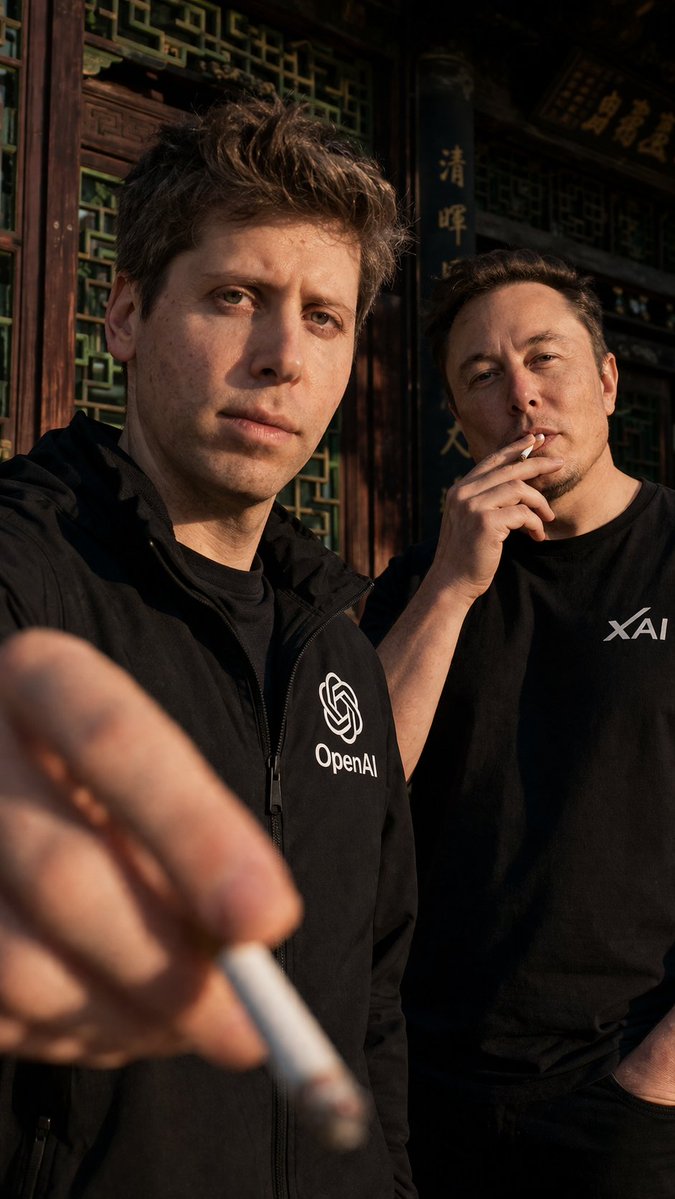
A high-quality cinematic portrait in a 9:16 vertical aspect ratio showing {argument name="foreground person" default="Sam Altman"} standing in the left foreground outdoors in front of a traditional ornate dark wood Chinese-style building with intricate green lattice windows and carved architectural details. He faces the camera and wears a black zip-up jacket with a clearly visible white OpenAI logo on the chest. His arm is extended toward the viewer, holding 1 cigarette extremely close to the lens in the lower-left foreground, making the cigarette and hand large, soft, and out of focus with strong depth-of-field blur. Slightly behind him on the right stands {argument name="background person" default="Elon Musk"}, looking at the camera while holding 1 cigarette near his mouth, wearing a black T-shirt with a white xAI logo on the chest, with his other hand tucked into a pocket. Use warm golden-hour sunlight from the side, creating sharp shadows, realistic skin texture, high contrast, and a moody amber tone across the faces, clothing, and wooden facade. The composition should feel candid but polished, tightly cropped from about mid-thigh upward, with the foreground figure dominating the frame and the second figure partially overlapped behind him. Emphasize realistic photography, cinematic color grading, shallow depth of field, natural facial proportions, subtle smoke mood, and crisp branding details on the {argument name="left chest logo" default="OpenAI"} jacket and {argument name="right chest logo" default="xAI"} shirt.