Case Media
Case Notes
This page keeps the media, full prompt, and original source together so you can inspect the result first and decide whether the prompt is worth copying, saving, or comparing.
Case Insights
To make this page easier to search, cite, and reuse later, the case is also broken down into practical guidance about usage, visual cues, and prompt structure.
Best Fit Scenarios
- Use this as a portrait & photography benchmark when you need a fast style baseline before rewriting your own prompt.
- It is especially helpful if your target overlaps with Neon, Portrait, Cinematic and you want to judge the image result before tuning wording.
- Keep it as a control sample when you compare nearby prompt variants one variable at a time.
Visual Signals To Notice
- The clearest style signals here are Neon, Portrait, Cinematic, so those should usually stay in your first rewrite.
- Focus on framing, light direction, pose, and the distance between subject and camera.
- This case keeps one primary output, so the first image should be treated as the main visual reference.
How The Prompt Is Structured
- The prompt reads as a long, highly specified prompt, which is useful when you want to judge how much specificity this direction needs.
- Its keyword cluster is centered on Neon, Portrait, Cinematic, so you can usually keep that cluster while swapping subject, camera, layout, or copy details.
- A practical rewrite path is: keep the outcome, keep the strongest style cues, then replace only the subject and environment blocks.
Good Follow-up Questions
- What changes first if you keep Neon, Portrait, Cinematic but switch the subject matter?
- Which part of the result comes from section-level structure (Portrait & Photography) versus tag-level style cues?
- Which related cases in the same section give you a cleaner or more extreme variation of the same direction?
Full Prompt
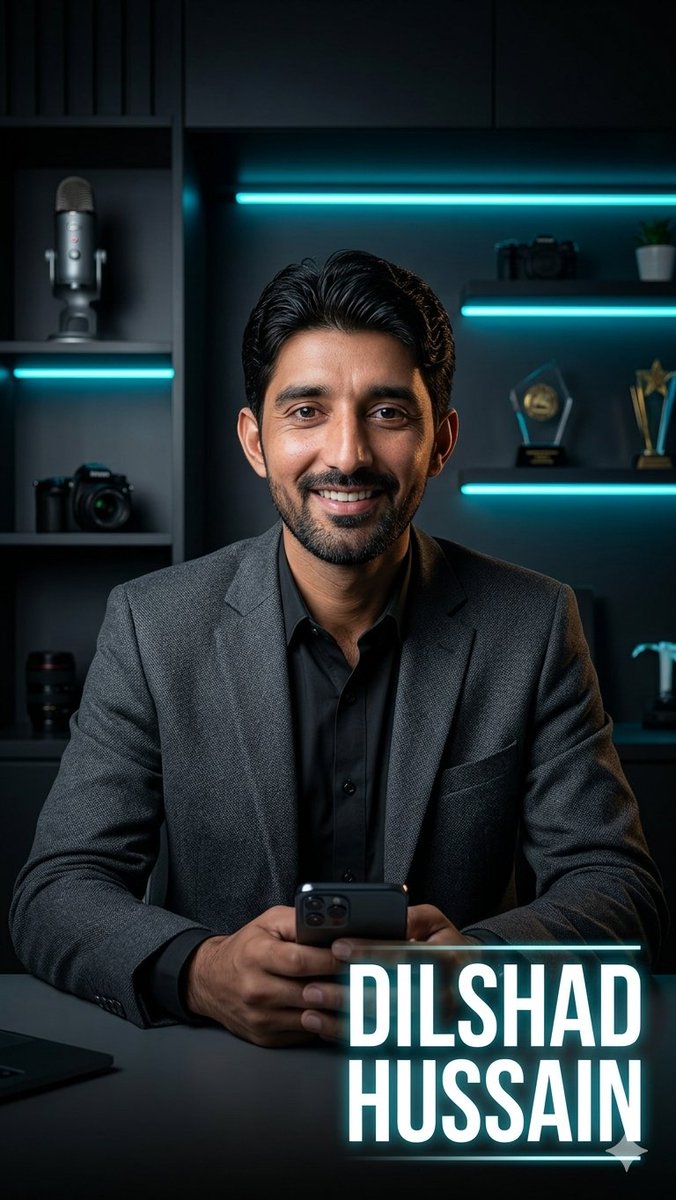
Create a cinematic vertical portrait of a confident male tech entrepreneur seated at a dark desk in a modern studio office, centered in the frame from mid-torso up. He wears a textured {argument name="blazer color" default="charcoal gray"} blazer over a black button-up shirt, with neatly slicked-back black hair, hands clasped around a smartphone at the bottom center. The face area should be covered by a plain rectangular skin-tone placeholder block, as if reserved for a face-swap or uploaded portrait. The background is a moody black shelving wall with teal cyan LED strip lights: one long horizontal light behind the head, another on a left shelf, and two on the right shelves. Include visible studio props on the shelves: one large podcast microphone on the upper left, one camera on the middle left, one camera lens on the lower left, a camera and small plant on the upper right, two awards/trophies on the middle right, and a small metallic desk object on the lower right. Use dramatic low-key lighting, teal rim light, realistic shadows, glossy highlights, shallow depth of field, premium corporate branding aesthetic, ultra-realistic photography, sharp focus on the suit and hands. Add a bold glowing name title in the lower-right corner reading {argument name="name text" default="DILSHAD\nHUSSAIN"}, in large condensed white uppercase sans-serif letters with a cyan neon glow, thin cyan horizontal line above and below the text, and a small triangular accent under the lower line. Aspect ratio 9:16, high resolution, social-media poster style.