Case Media
Case Notes
This page keeps the media, full prompt, and original source together so you can inspect the result first and decide whether the prompt is worth copying, saving, or comparing.
Case Insights
To make this page easier to search, cite, and reuse later, the case is also broken down into practical guidance about usage, visual cues, and prompt structure.
Best Fit Scenarios
- Use this as a portrait & photography benchmark when you need a fast style baseline before rewriting your own prompt.
- It is especially helpful if your target overlaps with Portrait, Typography, Product and you want to judge the image result before tuning wording.
- Keep it as a control sample when you compare nearby prompt variants one variable at a time.
Visual Signals To Notice
- The clearest style signals here are Portrait, Typography, Product, so those should usually stay in your first rewrite.
- Focus on framing, light direction, pose, and the distance between subject and camera.
- This case keeps one primary output, so the first image should be treated as the main visual reference.
How The Prompt Is Structured
- The prompt reads as a long, highly specified prompt, which is useful when you want to judge how much specificity this direction needs.
- Its keyword cluster is centered on Portrait, Typography, Product, so you can usually keep that cluster while swapping subject, camera, layout, or copy details.
- A practical rewrite path is: keep the outcome, keep the strongest style cues, then replace only the subject and environment blocks.
Good Follow-up Questions
- What changes first if you keep Portrait, Typography, Product but switch the subject matter?
- Which part of the result comes from section-level structure (Portrait & Photography) versus tag-level style cues?
- Which related cases in the same section give you a cleaner or more extreme variation of the same direction?
Full Prompt
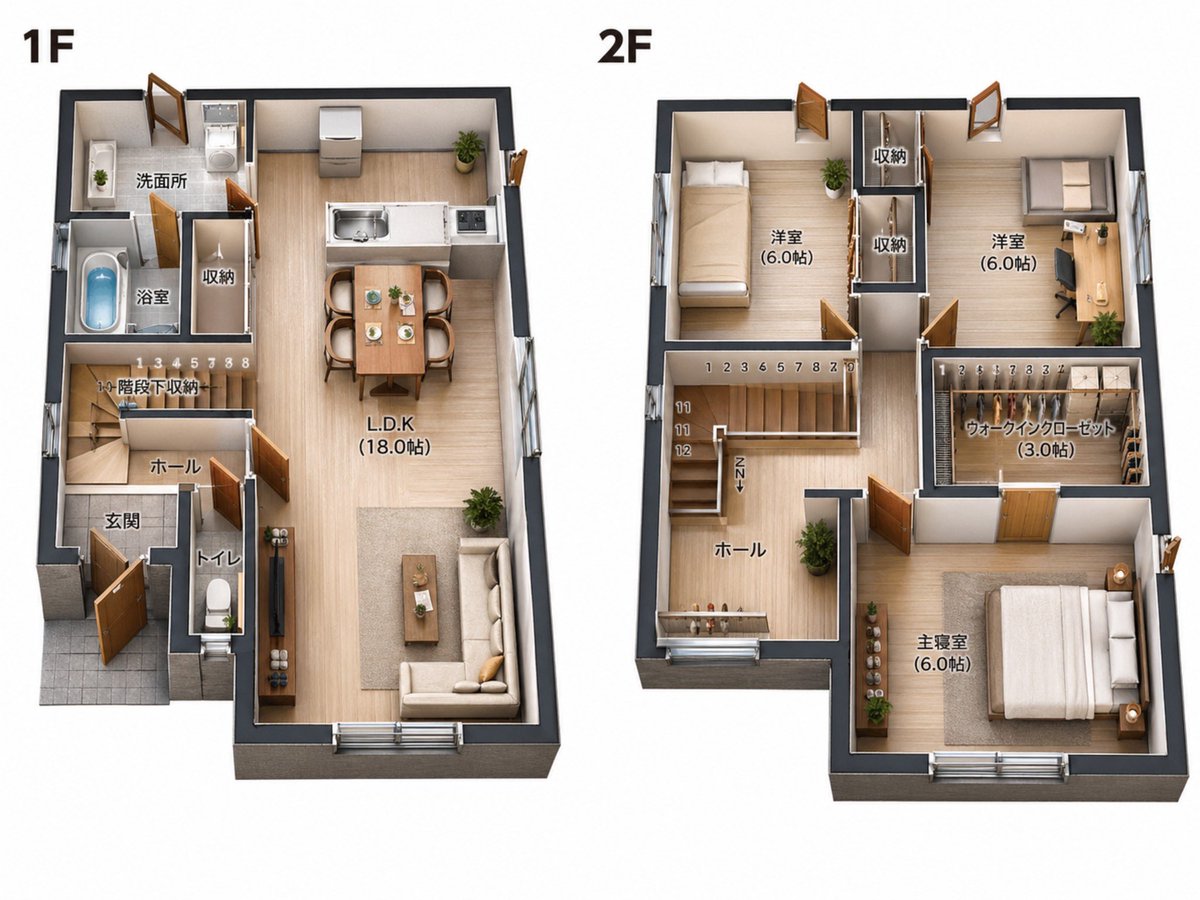
Using the provided floor plan reference image, convert the 2D black-and-white architectural plan into a clean photorealistic 3D isometric real-estate floor plan render while preserving the original layout, room sizes, labels, and the side-by-side composition of the 1F and 2F plans. Add realistic wall thickness, light wood flooring, soft neutral wall colors, doors and windows with depth, and fully furnished interiors appropriate to each room. Keep all visible Japanese room labels in place, including 1F, 2F, 洗面所, 浴室, 収納, 階段下収納, ホール, 玄関, トイレ, L.D.K (18.0帖), 洋室 (6.0帖) for 2 rooms, ウォークインクローゼット (3.0帖), and 主寝室 (6.0帖). Stage the 1F with 1 kitchen, 1 dining table set for 4, 1 living area with sofa and coffee table, 1 toilet, 1 bathroom with tub, 1 wash area, and small plants. Stage the 2F with 3 sleeping/work rooms total: 1 bedroom with a single bed, 1 room with a desk and chair, and 1 master bedroom with a double bed, plus 2 storage spaces and 1 walk-in closet with shelving. Use a bright catalog-style presentation on a plain light background, viewed from a slightly elevated angled top-down perspective, suitable for a property sales brochure.