Case Media
Case Notes
This page keeps the media, full prompt, and original source together so you can inspect the result first and decide whether the prompt is worth copying, saving, or comparing.
Case Insights
To make this page easier to search, cite, and reuse later, the case is also broken down into practical guidance about usage, visual cues, and prompt structure.
Best Fit Scenarios
- Use this as a portrait & photography benchmark when you need a fast style baseline before rewriting your own prompt.
- It is especially helpful if your target overlaps with Portrait, City Visual, Minimal and you want to judge the image result before tuning wording.
- Keep it as a control sample when you compare nearby prompt variants one variable at a time.
Visual Signals To Notice
- The clearest style signals here are Portrait, City Visual, Minimal, so those should usually stay in your first rewrite.
- Focus on framing, light direction, pose, and the distance between subject and camera.
- This case keeps 2 media outputs, which makes it easier to check whether the style remains stable across multiple results.
How The Prompt Is Structured
- The prompt reads as a long, highly specified prompt, which is useful when you want to judge how much specificity this direction needs.
- Its keyword cluster is centered on Portrait, City Visual, Minimal, so you can usually keep that cluster while swapping subject, camera, layout, or copy details.
- A practical rewrite path is: keep the outcome, keep the strongest style cues, then replace only the subject and environment blocks.
Good Follow-up Questions
- What changes first if you keep Portrait, City Visual, Minimal but switch the subject matter?
- Which part of the result comes from section-level structure (Portrait & Photography) versus tag-level style cues?
- Which related cases in the same section give you a cleaner or more extreme variation of the same direction?
Full Prompt
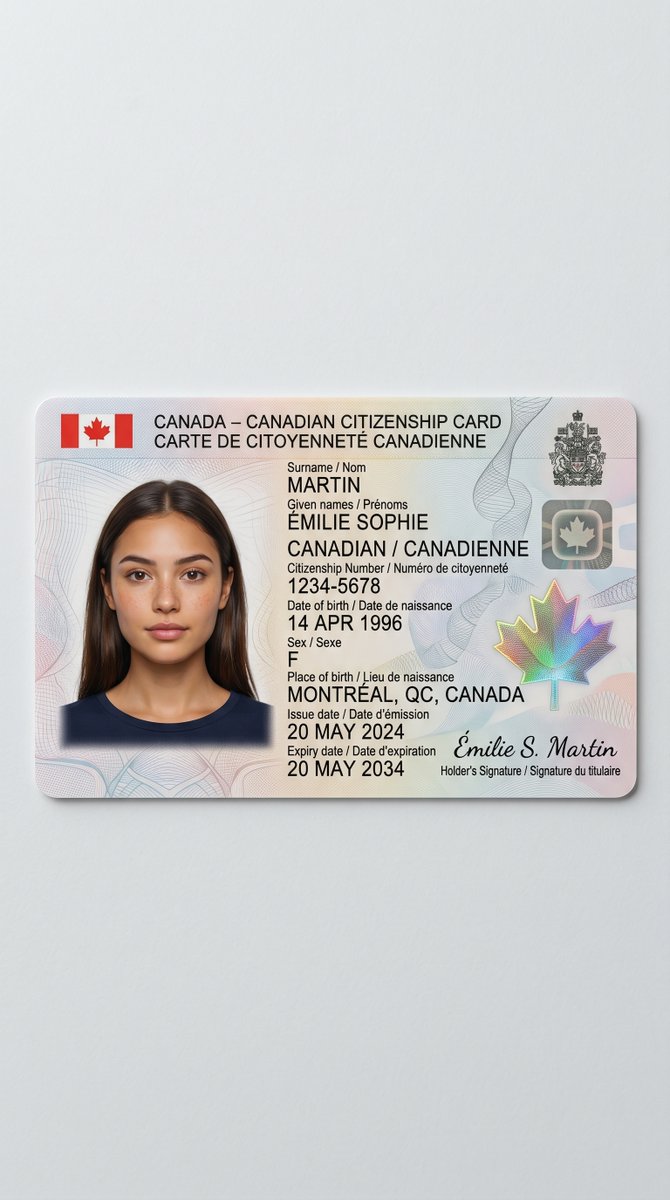
A clean studio product photo of a realistic Canadian citizenship card lying flat on a light gray matte surface, centered with generous empty space around it. The card is shown in landscape orientation with rounded corners, subtle thickness, and a soft drop shadow, photographed from a nearly top-down angle with slight perspective. The design is a bilingual Canadian ID card with a pale pastel security background of fine guilloche lines in pink, blue, and gray, plus faint abstract wave patterns. In the top left are 2 small Canadian flags flanking the header text in bold black sans-serif: “CANADA – CANADIAN CITIZENSHIP CARD” on the first line and “CARTE DE CITOYENNETÉ CANADIENNE” on the second. On the left side is 1 passport-style head-and-shoulders portrait of a woman with straight dark brown hair, center part, wearing a navy crew-neck shirt, but the face is obscured by a solid rectangular blur block for privacy. To the right of the portrait is the main ID text in black, mixing uppercase labels and values, arranged in neat left-aligned lines. Use the visible bilingual fields and values exactly as follows: “Surname / Nom” then “MARTIN”; “Given names / Prénoms” then “ÉMILIE SOPHIE”; nationality line “CANADIAN / CANADIENNE”; “Citizenship Number / Numéro de citoyenneté” then “1234-5678”; “Date of birth / Date de naissance” then “14 APR 1996”; “Sex / Sexe” then “F”; “Place of birth / Lieu de naissance” then “MONTRÉAL, QC, CANADA”; “Issue date / Date d’émission” then “20 MAY 2024”; “Expiry date / Date d’expiration” then “20 MAY 2034”. In the upper right corner include 2 official security elements: a dark Canadian coat of arms emblem and beneath it a small metallic square with a maple leaf. In the lower right include 1 large iridescent holographic maple leaf security feature with rainbow shimmer. Along the bottom right add a cursive signature reading “Émilie S. Martin” with the caption beneath it “Holder’s Signature / Signature du titulaire”. The overall style is highly realistic government-issued document photography, sharp printed text, authentic ID layout, subtle paper-plastic card texture, neutral lighting, minimal background, no hands, no extra objects.