Case Media
Case Notes
This page keeps the media, full prompt, and original source together so you can inspect the result first and decide whether the prompt is worth copying, saving, or comparing.
Case Insights
To make this page easier to search, cite, and reuse later, the case is also broken down into practical guidance about usage, visual cues, and prompt structure.
Best Fit Scenarios
- Use this as a portrait & photography benchmark when you need a fast style baseline before rewriting your own prompt.
- It is especially helpful if your target overlaps with 35mm, Portrait, Cinematic and you want to judge the image result before tuning wording.
- Keep it as a control sample when you compare nearby prompt variants one variable at a time.
Visual Signals To Notice
- The clearest style signals here are 35mm, Portrait, Cinematic, so those should usually stay in your first rewrite.
- Focus on framing, light direction, pose, and the distance between subject and camera.
- This case keeps 2 media outputs, which makes it easier to check whether the style remains stable across multiple results.
How The Prompt Is Structured
- The prompt reads as a long, highly specified prompt, which is useful when you want to judge how much specificity this direction needs.
- Its keyword cluster is centered on 35mm, Portrait, Cinematic, so you can usually keep that cluster while swapping subject, camera, layout, or copy details.
- A practical rewrite path is: keep the outcome, keep the strongest style cues, then replace only the subject and environment blocks.
Good Follow-up Questions
- What changes first if you keep 35mm, Portrait, Cinematic but switch the subject matter?
- Which part of the result comes from section-level structure (Portrait & Photography) versus tag-level style cues?
- Which related cases in the same section give you a cleaner or more extreme variation of the same direction?
Full Prompt
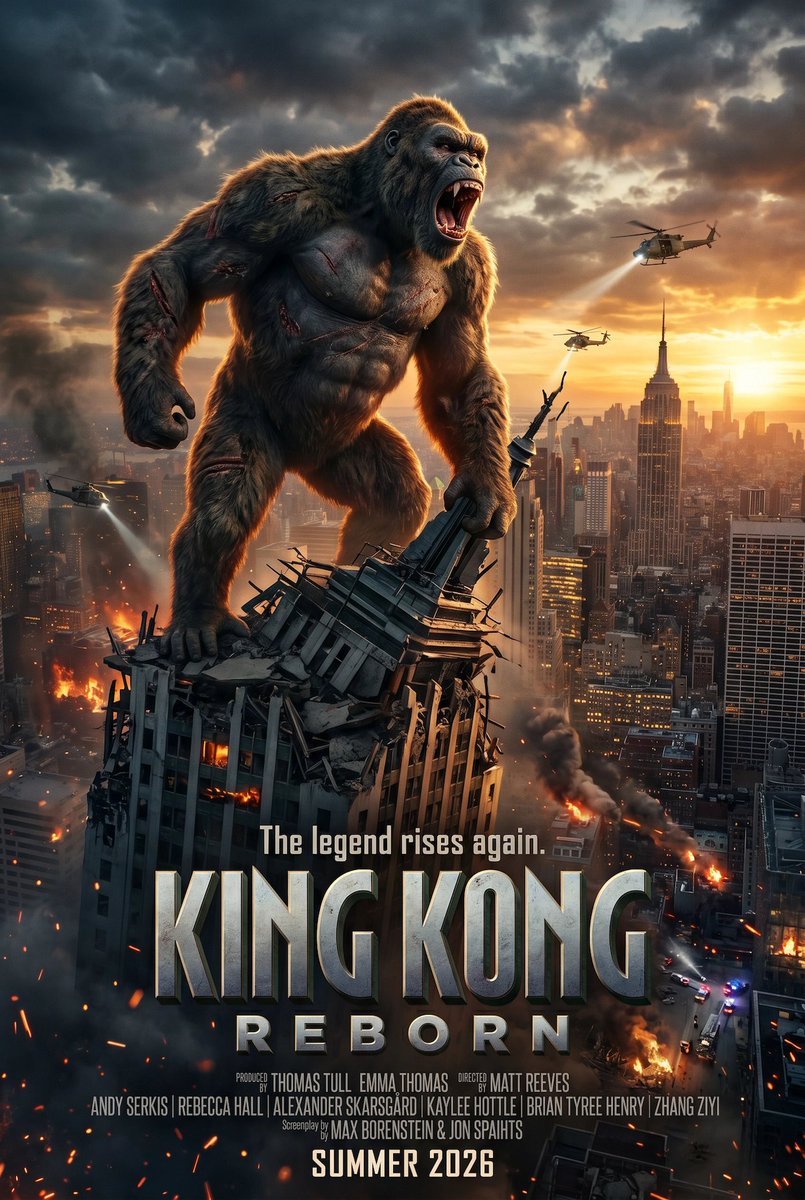
A hyper-detailed cinematic movie poster for a giant monster reboot set in Manhattan at sunset. A colossal enraged gorilla resembling King Kong stands on top of a heavily destroyed skyscraper in the foreground, roaring with mouth wide open and teeth exposed. The creature is massively muscular, covered in dark brown fur, with multiple visible battle scars and fresh wounds across the chest, arms, shoulders, and legs. One hand grips the broken steel spire and shattered crown of the building, while one huge foot crushes the rooftop. The city below is New York, with the Empire State Building clearly visible in the mid-right background and a dense skyline fading into dramatic golden haze. The sky is filled with dark storm clouds split by warm orange sunset light. Include exactly 3 military helicopters: 1 near the upper right shining a bright searchlight toward the ape, 1 smaller helicopter near the center-right skyline, and 1 lower-left helicopter sweeping a searchlight across smoky buildings. Add fires, smoke plumes, glowing embers, street-level destruction, and a sense of large-scale urban chaos. Compose it as a polished modern Hollywood theatrical one-sheet with the monster centered and towering over the city. In the lower third, add the tagline text: {argument name="tagline text" default="The legend rises again."} Above the credits, place the huge metallic embossed title in two lines: {argument name="movie title" default="KING KONG"} and below it {argument name="subtitle" default="REBORN"}. Beneath that, add a dense realistic film-credit block with multiple producer, director, cast, and screenplay lines in small condensed type. At the very bottom, add the release line: {argument name="release text" default="SUMMER 2026"}. Use ultra-realistic lighting, dramatic contrast, blockbuster poster composition, volumetric smoke, sharp details, photoreal fur, and premium action-adventure disaster-film aesthetics.