Case Media
Case Notes
This page keeps the media, full prompt, and original source together so you can inspect the result first and decide whether the prompt is worth copying, saving, or comparing.
Case Insights
To make this page easier to search, cite, and reuse later, the case is also broken down into practical guidance about usage, visual cues, and prompt structure.
Best Fit Scenarios
- Use this as a portrait & photography benchmark when you need a fast style baseline before rewriting your own prompt.
- It is especially helpful if your target overlaps with Portrait, Poster, Minimal and you want to judge the image result before tuning wording.
- Keep it as a control sample when you compare nearby prompt variants one variable at a time.
Visual Signals To Notice
- The clearest style signals here are Portrait, Poster, Minimal, so those should usually stay in your first rewrite.
- Focus on framing, light direction, pose, and the distance between subject and camera.
- This case keeps one primary output, so the first image should be treated as the main visual reference.
How The Prompt Is Structured
- The prompt reads as a long, highly specified prompt, which is useful when you want to judge how much specificity this direction needs.
- Its keyword cluster is centered on Portrait, Poster, Minimal, so you can usually keep that cluster while swapping subject, camera, layout, or copy details.
- A practical rewrite path is: keep the outcome, keep the strongest style cues, then replace only the subject and environment blocks.
Good Follow-up Questions
- What changes first if you keep Portrait, Poster, Minimal but switch the subject matter?
- Which part of the result comes from section-level structure (Portrait & Photography) versus tag-level style cues?
- Which related cases in the same section give you a cleaner or more extreme variation of the same direction?
Full Prompt
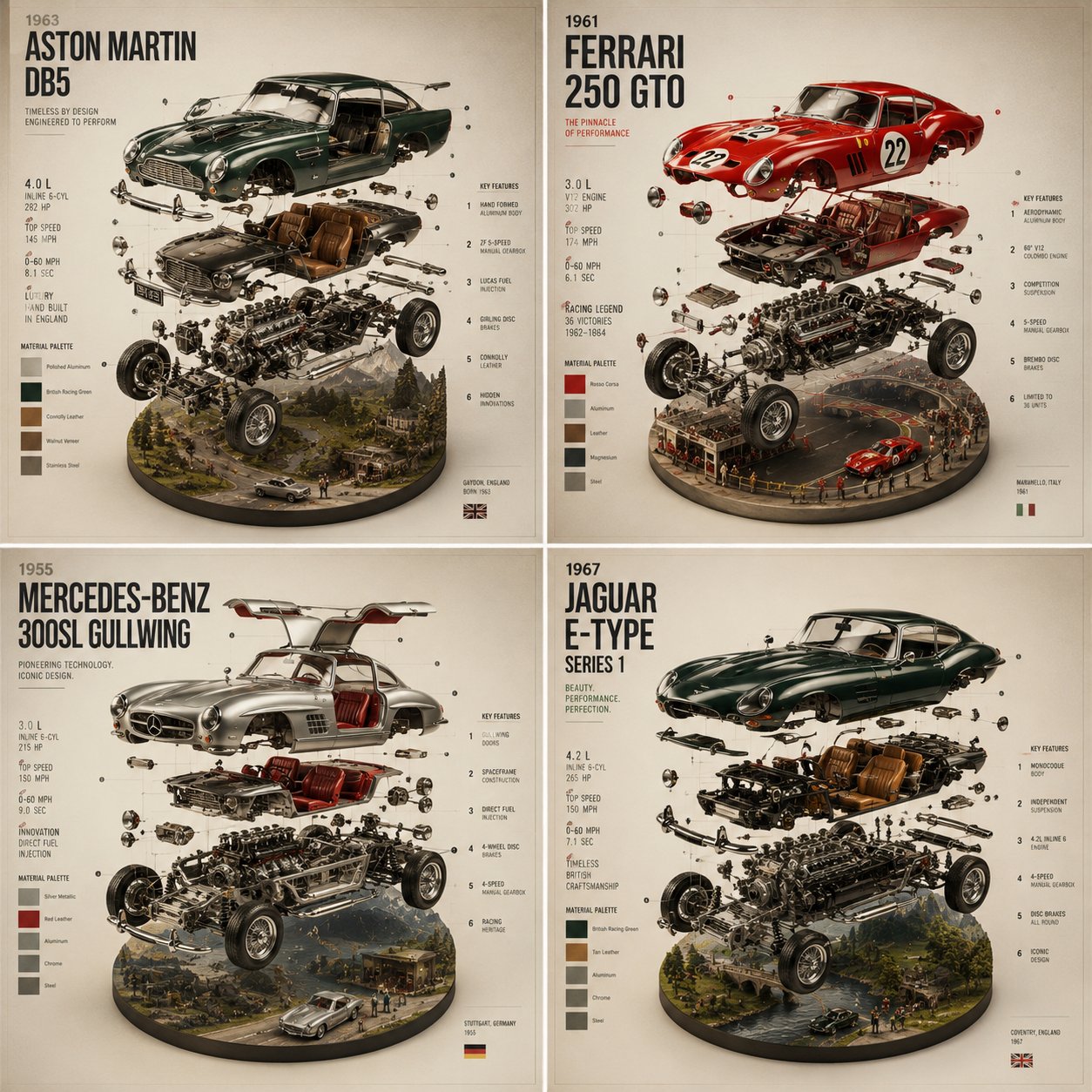
2x2 grid, 1:1, do this for 4 famous classic cars: class Product_Poster_DNA: def __init__(self): self.subject = "[PRODUCT]" self.parents = { "composition_parent": "Ultra-premium exploded-view product advertisement", "material_parent": "Luxury watch macro photography", "graphic_parent": "Bauhaus technical poster", "atmosphere_parent": "Minimalist Japanese packaging design" } self.mutations = { "semantic_mutation": "The product contains a miniature world showing its origin, use, and cultural meaning", "information_mutation": "Material swatches, micro icons, numbered callouts, invisible mechanism diagrams", "medium_mutation": "Museum catalog print with soft paper grain", "scale_mutation": "Macro object view with microscopic internal architecture" } self. style_mix = [0.35, 0.25, 0.20, 0.10, 0.10] def generate_subject(self): subject = """ [PRODUCT] floating as a premium hero object, partially exploded into components. Reveal materials, internal mechanisms, manufacturing traces, surface finish, signature features, and a miniature world inside the product showing its origin and purpose. If product details are missing, infer plausible premium materials, construction logic, and visually distinctive components. """ return render( subject, format="vertical luxury product poster", title="[PRODUCT NAME]", subtitle="[MODEL / TAGLINE]", constraints="premium, precise, minimal, no clutter, no watermark" )