Case Media
Case Notes
This page keeps the media, full prompt, and original source together so you can inspect the result first and decide whether the prompt is worth copying, saving, or comparing.
Case Insights
To make this page easier to search, cite, and reuse later, the case is also broken down into practical guidance about usage, visual cues, and prompt structure.
Best Fit Scenarios
- Use this as a portrait & photography benchmark when you need a fast style baseline before rewriting your own prompt.
- It is especially helpful if your target overlaps with Portrait, Character, Portrait & Photography and you want to judge the image result before tuning wording.
- Keep it as a control sample when you compare nearby prompt variants one variable at a time.
Visual Signals To Notice
- The clearest style signals here are Portrait, Character, Portrait & Photography, so those should usually stay in your first rewrite.
- Focus on framing, light direction, pose, and the distance between subject and camera.
- This case keeps one primary output, so the first image should be treated as the main visual reference.
How The Prompt Is Structured
- The prompt reads as a long, highly specified prompt, which is useful when you want to judge how much specificity this direction needs.
- Its keyword cluster is centered on Portrait, Character, Portrait & Photography, so you can usually keep that cluster while swapping subject, camera, layout, or copy details.
- A practical rewrite path is: keep the outcome, keep the strongest style cues, then replace only the subject and environment blocks.
Good Follow-up Questions
- What changes first if you keep Portrait, Character, Portrait & Photography but switch the subject matter?
- Which part of the result comes from section-level structure (Portrait & Photography) versus tag-level style cues?
- Which related cases in the same section give you a cleaner or more extreme variation of the same direction?
Full Prompt
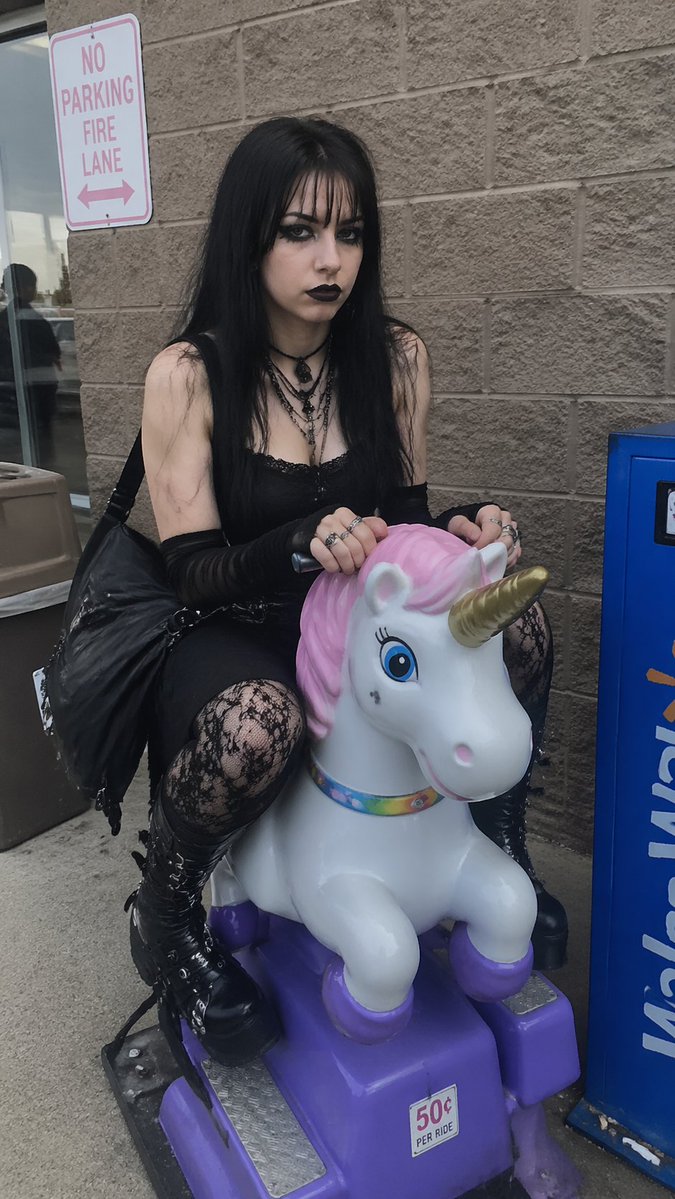
A candid, realistic photograph of a young {argument name="subject aesthetic" default="goth"} woman with pale skin, long straight black hair with bangs, heavy black eyeliner, and black lipstick. She has a {argument name="expression" default="deadpan"} expression, looking directly at the camera while sitting on a children's coin-operated {argument name="ride type" default="unicorn"} ride. She is wearing a black lace-trimmed tank top, black arm warmers, layered necklaces including a choker, black lace tights, and chunky black platform boots with buckles. A large black shoulder bag hangs from her arm. The ride is a white unicorn with a pink mane, gold horn, and purple hooves, mounted on a purple base with a small sticker reading "{argument name="ride cost" default="50¢ PER RIDE"}". The setting is outside a store with a tan cinderblock wall. To the left is a glass door reflecting a person, a brown trash can, and a white sign with red text reading "{argument name="sign text" default="NO PARKING FIRE LANE"}". To the right is a blue vending machine. Overcast, natural daylight.