Case Media
Case Notes
This page keeps the media, full prompt, and original source together so you can inspect the result first and decide whether the prompt is worth copying, saving, or comparing.
Case Insights
To make this page easier to search, cite, and reuse later, the case is also broken down into practical guidance about usage, visual cues, and prompt structure.
Best Fit Scenarios
- Use this as a portrait & photography benchmark when you need a fast style baseline before rewriting your own prompt.
- It is especially helpful if your target overlaps with Portrait, Character, Portrait & Photography and you want to judge the image result before tuning wording.
- Keep it as a control sample when you compare nearby prompt variants one variable at a time.
Visual Signals To Notice
- The clearest style signals here are Portrait, Character, Portrait & Photography, so those should usually stay in your first rewrite.
- Focus on framing, light direction, pose, and the distance between subject and camera.
- This case keeps one primary output, so the first image should be treated as the main visual reference.
How The Prompt Is Structured
- The prompt reads as a long, highly specified prompt, which is useful when you want to judge how much specificity this direction needs.
- Its keyword cluster is centered on Portrait, Character, Portrait & Photography, so you can usually keep that cluster while swapping subject, camera, layout, or copy details.
- A practical rewrite path is: keep the outcome, keep the strongest style cues, then replace only the subject and environment blocks.
Good Follow-up Questions
- What changes first if you keep Portrait, Character, Portrait & Photography but switch the subject matter?
- Which part of the result comes from section-level structure (Portrait & Photography) versus tag-level style cues?
- Which related cases in the same section give you a cleaner or more extreme variation of the same direction?
Full Prompt
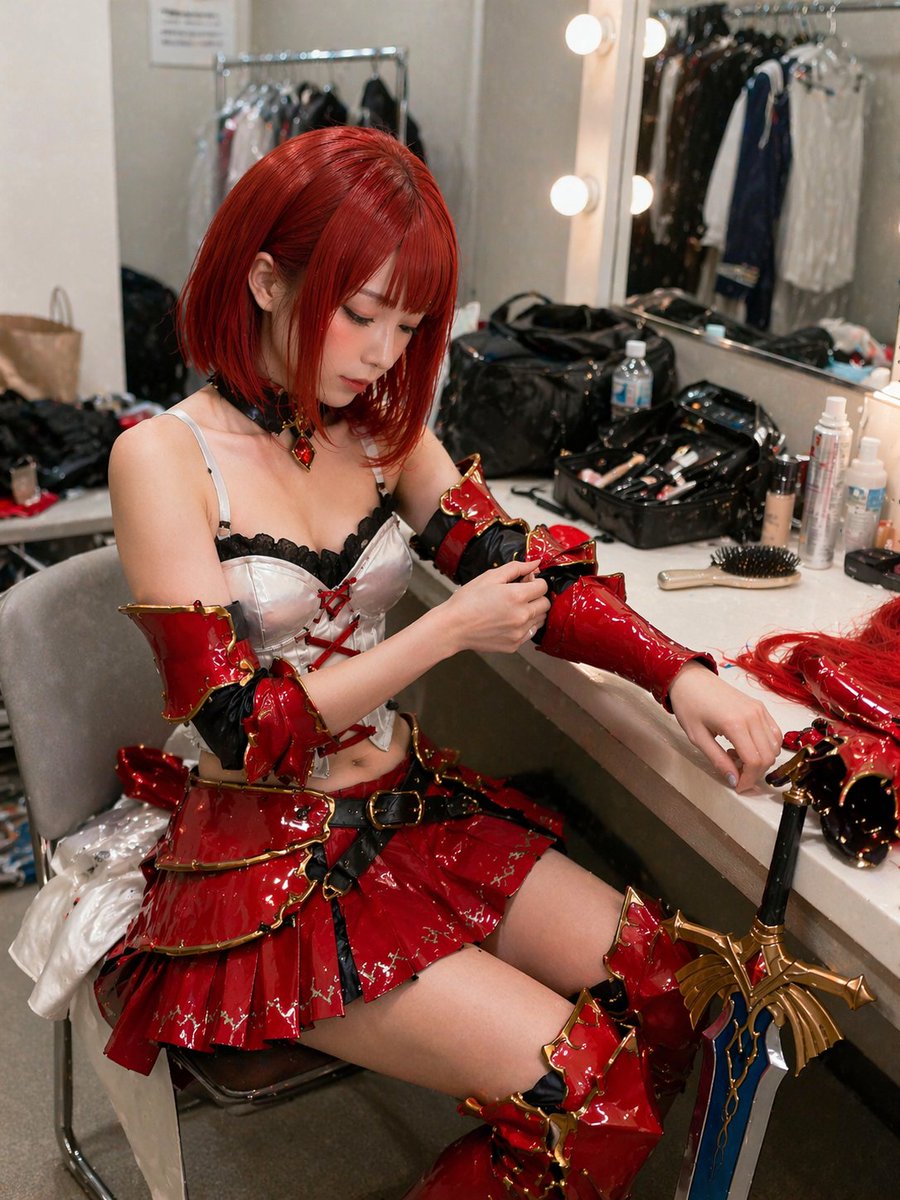
A highly detailed, realistic photograph of a young East Asian woman sitting in a cluttered backstage dressing room, getting ready for a cosplay event. She has {argument name="hair color" default="vibrant short red"} hair styled in a bob with bangs and is wearing an elaborate fantasy warrior costume featuring a {argument name="costume color" default="glossy red"} and gold tiered mini skirt, a white corset top with black lace and red lacing, matching glossy arm guards, and thigh-high boots. She is looking down with a focused expression, using her right hand to adjust the arm guard on her left arm. The vanity counter in front of her is messy, covered with makeup brushes, bottles, a hairbrush, and extra hairpieces. A large, ornate {argument name="prop" default="fantasy sword with a blue blade and gold hilt"} leans against the edge of the counter. The background shows a brightly lit vanity mirror with round bulbs reflecting a clothing rack, capturing a candid, slightly over-sharpened, and highly textured photographic style.