Case Media
Case Notes
This page keeps the media, full prompt, and original source together so you can inspect the result first and decide whether the prompt is worth copying, saving, or comparing.
Case Insights
To make this page easier to search, cite, and reuse later, the case is also broken down into practical guidance about usage, visual cues, and prompt structure.
Best Fit Scenarios
- Use this as a portrait & photography benchmark when you need a fast style baseline before rewriting your own prompt.
- It is especially helpful if your target overlaps with Portrait, Fashion, Poster and you want to judge the image result before tuning wording.
- Keep it as a control sample when you compare nearby prompt variants one variable at a time.
Visual Signals To Notice
- The clearest style signals here are Portrait, Fashion, Poster, so those should usually stay in your first rewrite.
- Focus on framing, light direction, pose, and the distance between subject and camera.
- This case keeps 2 media outputs, which makes it easier to check whether the style remains stable across multiple results.
How The Prompt Is Structured
- The prompt reads as a long, highly specified prompt, which is useful when you want to judge how much specificity this direction needs.
- Its keyword cluster is centered on Portrait, Fashion, Poster, so you can usually keep that cluster while swapping subject, camera, layout, or copy details.
- A practical rewrite path is: keep the outcome, keep the strongest style cues, then replace only the subject and environment blocks.
Good Follow-up Questions
- What changes first if you keep Portrait, Fashion, Poster but switch the subject matter?
- Which part of the result comes from section-level structure (Portrait & Photography) versus tag-level style cues?
- Which related cases in the same section give you a cleaner or more extreme variation of the same direction?
Full Prompt
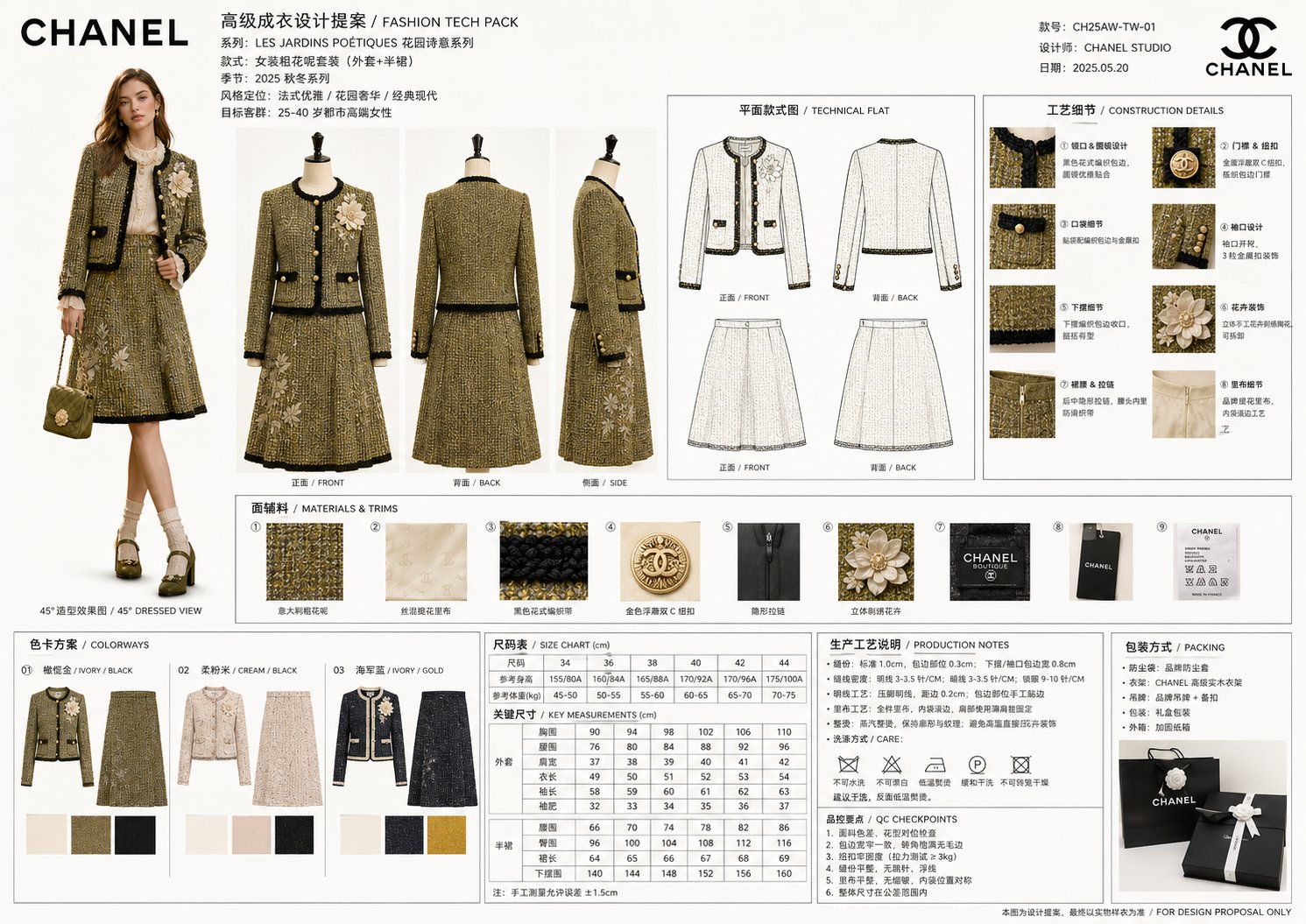
Design a high-end fashion design proposal board for [Chanel] that can be used for factory prototyping and mass production development. The garment type is [Garment Type], target audience is [Target Audience], style is [Design Style], main color is [Main Color], secondary color is [Secondary Color], accent color is [Accent Color], and fabric direction is [Fabric Type]. The image should adopt the form of a professional fashion Tech Pack / fashion industrial design drawing / high-end ready-to-wear proposal board, landscape layout, clean background, with clear information zoning. Must include: front, back, side, and 45-degree ready-to-wear visuals; front and back flat sketches; magnified process details of collars, cuffs, pockets, zippers, buttons, hems, and stitching lines; displays of main fabric, lining, auxiliary materials, zippers, buttons, woven labels, hang tags, and care labels; standard color cards and multiple color scheme sets; size charts, key dimension annotations, seam allowances, stitch length, sewing methods, washing instructions, quality control checkpoints, and packaging methods. The design should refer to international high-end ready-to-wear, award-winning works from fashion design competitions, and classic styles from mature commercial brands, possessing high-level aesthetics, brand recognition, wearing comfort, reasonable pattern cutting, fabric texture, process feasibility, and mass production viability. The overall presentation should look like a complete design proposal submitted by a professional fashion design company to a brand client and garment factory, rather than a common fashion poster. Prohibit generating exaggerated structures that cannot be mass-produced, incorrect human proportions, garbled text, false dimensions, messy annotations, plagiarized brand styles, or images with only model photos without technical drawing information. The final effect should be professional, high-end, exquisite, clear, commercially usable, ready for prototyping, and ready for mass production.