Case Media
Case Notes
This page keeps the media, full prompt, and original source together so you can inspect the result first and decide whether the prompt is worth copying, saving, or comparing.
Case Insights
To make this page easier to search, cite, and reuse later, the case is also broken down into practical guidance about usage, visual cues, and prompt structure.
Best Fit Scenarios
- Use this as a portrait & photography benchmark when you need a fast style baseline before rewriting your own prompt.
- It is especially helpful if your target overlaps with Portrait, Cinematic, Poster and you want to judge the image result before tuning wording.
- Keep it as a control sample when you compare nearby prompt variants one variable at a time.
Visual Signals To Notice
- The clearest style signals here are Portrait, Cinematic, Poster, so those should usually stay in your first rewrite.
- Focus on framing, light direction, pose, and the distance between subject and camera.
- This case keeps one primary output, so the first image should be treated as the main visual reference.
How The Prompt Is Structured
- The prompt reads as a long, highly specified prompt, which is useful when you want to judge how much specificity this direction needs.
- Its keyword cluster is centered on Portrait, Cinematic, Poster, so you can usually keep that cluster while swapping subject, camera, layout, or copy details.
- A practical rewrite path is: keep the outcome, keep the strongest style cues, then replace only the subject and environment blocks.
Good Follow-up Questions
- What changes first if you keep Portrait, Cinematic, Poster but switch the subject matter?
- Which part of the result comes from section-level structure (Portrait & Photography) versus tag-level style cues?
- Which related cases in the same section give you a cleaner or more extreme variation of the same direction?
Full Prompt
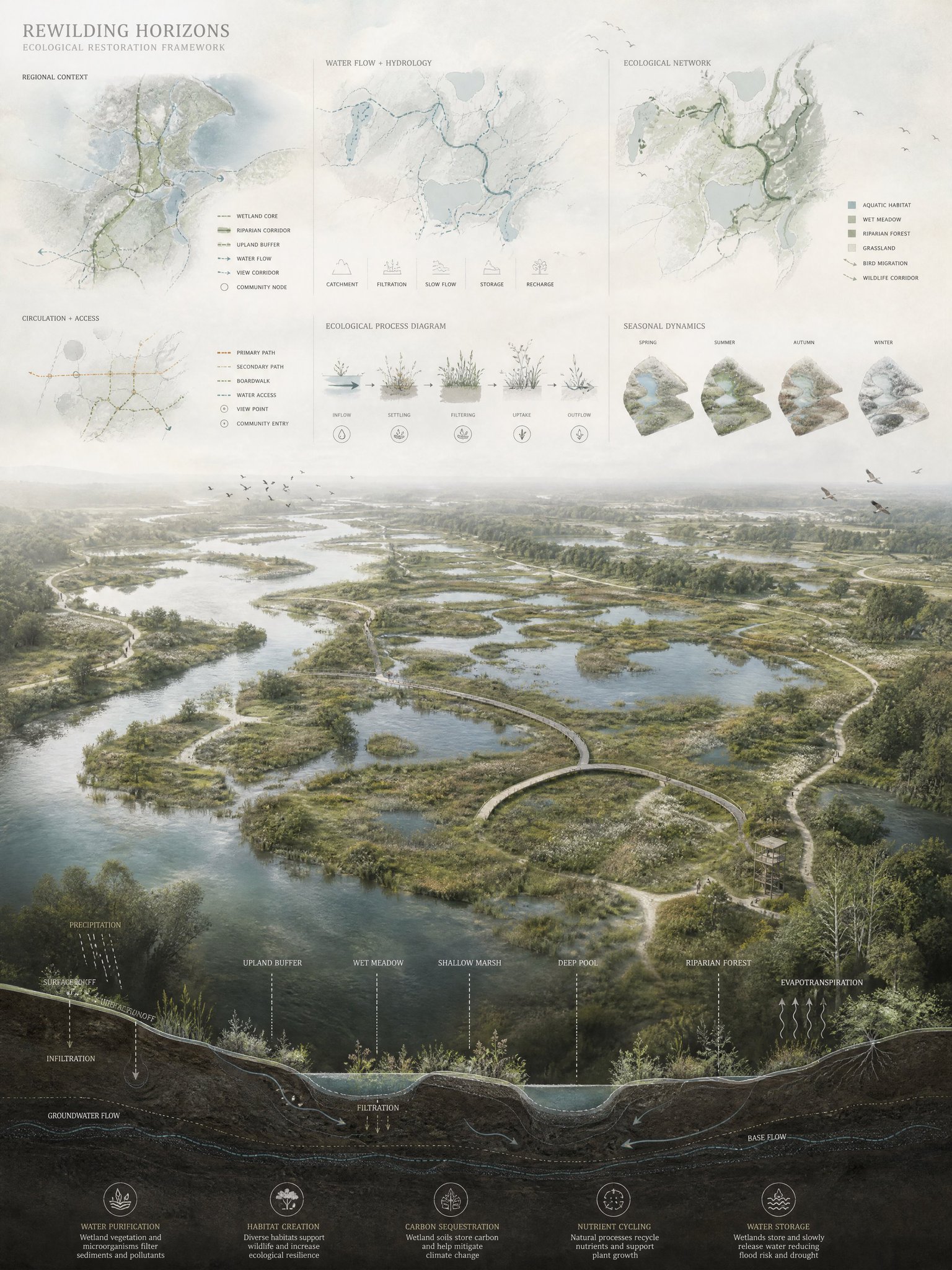
Create a competition-level 3:4 vertical architectural presentation board that transforms a landscape design into a hybrid environmental visualization combining photorealistic aerial rendering, ecological section drawings, and analytical architectural diagrams. → Composition layout Top zone: analytical diagrams and ecological mapping overlays Middle zone: large aerial landscape rendering as the primary visual focus Bottom zone: continuous sectional cut through the ecological landscape system → Overall style Hybrid of photorealistic landscape rendering and refined architectural diagram language. Calm, atmospheric, regenerative, and environmentally focused. Presentation should feel like a high-end international landscape architecture competition board. → Top analytical layer → Include simplified ecological maps with soft transparent color overlays → Ultra-thin white and pale gray linework → Diagrams showing water flow, circulation systems, ecological networks, habitat zones, and landscape connectivity → Dashed lines for movement and flow systems → Minimal annotations and soft ecological icons → Floating overlay effect above the rendering → Very light pastel tones with high transparency → Clean spacing and minimal composition → Avoid dense technical clutter → Middle aerial rendering → Bird’s-eye perspective ecological restoration landscape → Wetlands, ponds, flowing water systems, vegetation patches, bioswales, and regenerative terrain → Soft natural color palette with slightly desaturated greens, browns, and muted water blues → Atmospheric depth with subtle haze in the distance → Include gentle human and ecological activity such as walking paths, birds, and small environmental interactions → Wide landscape depth and smooth terrain transitions → Calm cinematic environmental lighting → Soft paper-texture finish integrated into the rendering → Bottom sectional cut → Continuous sectional landscape cut through terrain and ecological systems → Show soil layers, hydrology, groundwater movement, vegetation roots, ecological restoration processes, and water filtration systems → Thin white or pale linework → Muted tones with minimal color usage → Include arrows indicating water movement and ecological flow → Maintain elegant architectural drafting quality → Seamlessly integrated into the board composition → Diagram language → Extremely thin and precise linework → Slightly softened edges, avoiding sharp vector aesthetics → Minimal labels and clean scientific notation → Soft ecological symbols and analytical overlays → Balanced between scientific clarity and poetic visualization → Color system → Base palette: desaturated greens, earthy browns, muted blue water tones → Overlay palette: pale green, soft cyan, light beige, translucent pastel layers → Avoid saturated accents and harsh contrast → No bright reds or overly graphic colors → Texture and atmosphere → Soft atmospheric rendering quality → Slight environmental haze and diffused lighting → Subtle paper-grain or printed board texture → Refined competition-board aesthetic → Mood Calm, ecological, regenerative, scientific yet poetic. The board should communicate environmental intelligence, landscape restoration, and harmonious coexistence between water systems, ecology, and human movement. → Format 3:4 vertical architectural competition board composition.