Case Media
Case Notes
This page keeps the media, full prompt, and original source together so you can inspect the result first and decide whether the prompt is worth copying, saving, or comparing.
Case Insights
To make this page easier to search, cite, and reuse later, the case is also broken down into practical guidance about usage, visual cues, and prompt structure.
Best Fit Scenarios
- Use this as a model & community benchmark when you need a fast style baseline before rewriting your own prompt.
- It is especially helpful if your target overlaps with Illustration, Typography, Comparison and you want to judge the image result before tuning wording.
- Keep it as a control sample when you compare nearby prompt variants one variable at a time.
Visual Signals To Notice
- The clearest style signals here are Illustration, Typography, Comparison, so those should usually stay in your first rewrite.
- This kind of case is strongest when you watch deltas: what changed, what broke, and which prompt choice caused that shift.
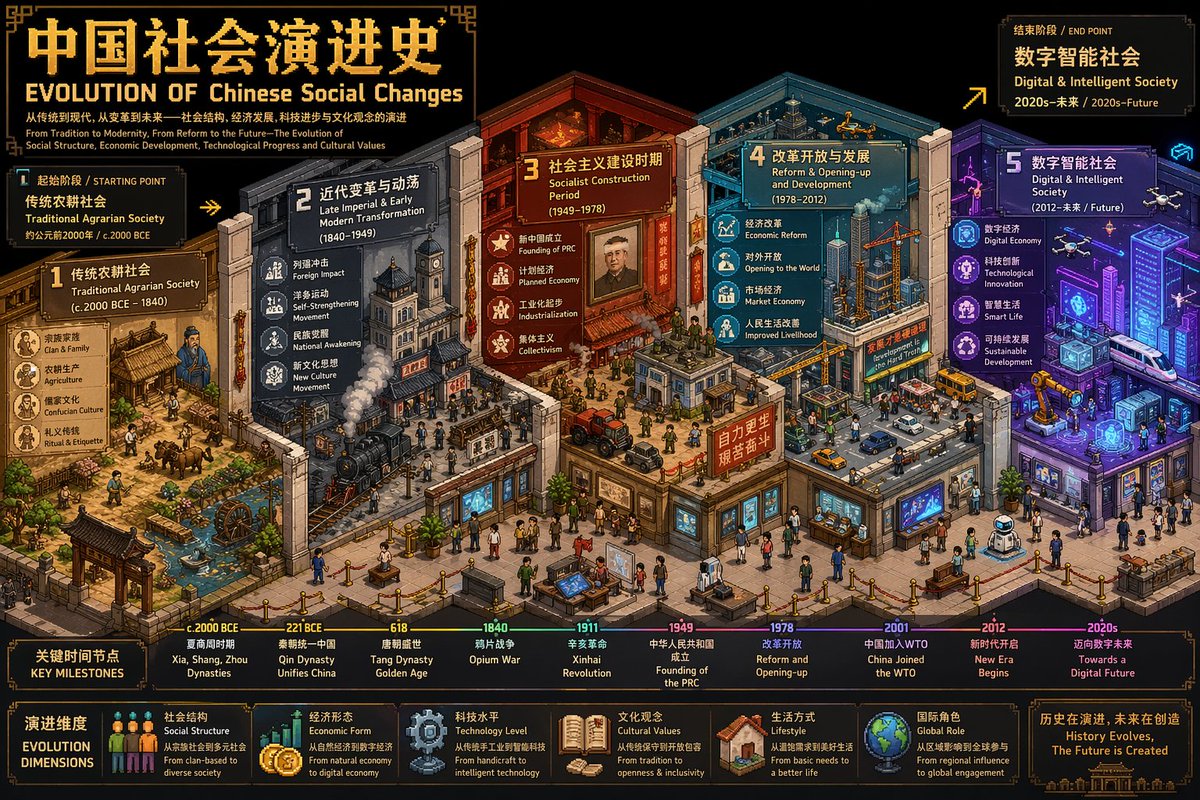
- This case keeps one primary output, so the first image should be treated as the main visual reference.
How The Prompt Is Structured
- The prompt reads as a long, highly specified prompt, which is useful when you want to judge how much specificity this direction needs.
- Its keyword cluster is centered on Illustration, Typography, Comparison, so you can usually keep that cluster while swapping subject, camera, layout, or copy details.
- A practical rewrite path is: keep the outcome, keep the strongest style cues, then replace only the subject and environment blocks.
Good Follow-up Questions
- What changes first if you keep Illustration, Typography, Comparison but switch the subject matter?
- Which part of the result comes from section-level structure (Model & Community) versus tag-level style cues?
- Which related cases in the same section give you a cleaner or more extreme variation of the same direction?
Full Prompt
[中文] 创作一张超高细节等距像素艺术时间线插画(3:4,4K),融合细节密度、象征性与隐喻。用户指定的主题为【Western Art Development】。 首先,围绕Western Art Development进行推理,确定:主题的中英文标题、涵盖的最早与最近历史时期、起始阶段标签与结束阶段标签,以及3-5个关键演进阶段及其各自的象征性元素与色彩方案。 然后构建一个以"Western Art Development"为主题的等距"演进博物馆",每个展馆区域代表一个演进阶段,空间推进即代表时间演变。采用标准等距视角(2:1),丰富的层次深度与流畅过渡。每个阶段分配3-5个与主题强烈关联的象征元素,并用差异化色彩暗示时间流动。在场景中融入双语像素字体标题:中文"[主题中文]演进史"与英文"EVOLUTION OF Western Art Development",加上起止阶段的双语副标题及关键时间节点标记。整体风格专业且具视觉张力,适合学术分析与对比可视化,直接出图。 [English] Create an ultra-high-detail isometric pixel art timeline illustration (3:4, 4K), integrating detail density, symbolism, and metaphor. The user-specified theme is [Western Art Development]. First, reason around Western Art Development to determine: the Chinese and English titles of the theme, the earliest and most recent historical periods covered, the starting stage label and the ending stage label, as well as 3-5 key evolution stages and their respective symbolic elements and color schemes. Then build an isometric "Evolution Museum" themed "Western Art Development", where each exhibition hall area represents an evolution stage, and spatial progression represents time evolution. Adopt a standard isometric perspective (2:1), rich layer depth, and smooth transitions. Allocate 3-5 symbolic elements strongly associated with the theme to each stage, and use differentiated colors to imply the flow of time. Integrate bilingual pixel font titles in the scene: Chinese "[Theme Chinese] Evolution History" and English "EVOLUTION OF Western Art Development", plus bilingual subtitles for the starting and ending stages and key time node markers. The overall style is professional and visually tense, suitable for academic analysis and comparative visualization, direct image output.