Case Media
Case Notes
This page keeps the media, full prompt, and original source together so you can inspect the result first and decide whether the prompt is worth copying, saving, or comparing.
Case Insights
To make this page easier to search, cite, and reuse later, the case is also broken down into practical guidance about usage, visual cues, and prompt structure.
Best Fit Scenarios
- Use this as a model & community benchmark when you need a fast style baseline before rewriting your own prompt.
- It is especially helpful if your target overlaps with Infographic, Comparison, Model & Community and you want to judge the image result before tuning wording.
- Keep it as a control sample when you compare nearby prompt variants one variable at a time.
Visual Signals To Notice
- The clearest style signals here are Infographic, Comparison, Model & Community, so those should usually stay in your first rewrite.
- This kind of case is strongest when you watch deltas: what changed, what broke, and which prompt choice caused that shift.
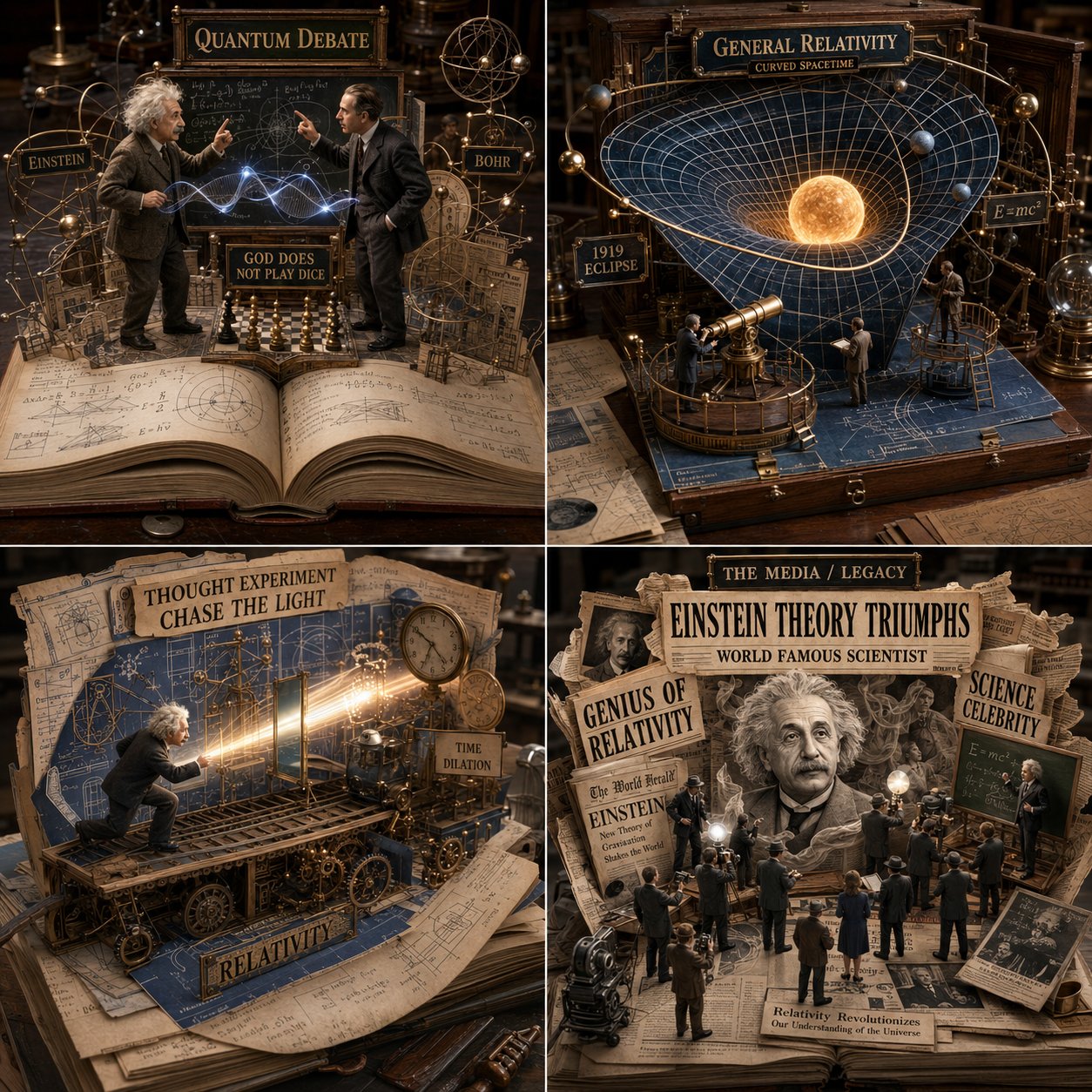
- This case keeps 2 media outputs, which makes it easier to check whether the style remains stable across multiple results.
How The Prompt Is Structured
- The prompt reads as a long, highly specified prompt, which is useful when you want to judge how much specificity this direction needs.
- Its keyword cluster is centered on Infographic, Comparison, Model & Community, so you can usually keep that cluster while swapping subject, camera, layout, or copy details.
- A practical rewrite path is: keep the outcome, keep the strongest style cues, then replace only the subject and environment blocks.
Good Follow-up Questions
- What changes first if you keep Infographic, Comparison, Model & Community but switch the subject matter?
- Which part of the result comes from section-level structure (Model & Community) versus tag-level style cues?
- Which related cases in the same section give you a cleaner or more extreme variation of the same direction?
Full Prompt
Einstein : Input Variable: [INSERT TOPIC] (e.g., Nikola Tesla, The Wright Brothers, The Manhattan Project, Leonardo da Vinci) System Instruction: Generate a hyper-realistic, 2x2 Grid of 3D Miniature Dioramas . Use the following logic to procedurally generate 4 distinct chapters of the Input Variable's history: 1. Narrative Partitioning (The 4 Chapters): Analyze the Input Variable and generate 4 distinct visual narratives: Panel 1 (The Rivalry): Identify the biggest conflict. (e.g., Tesla vs. Edison; Da Vinci vs. Michelangelo). Panel 2 (The Magnum Opus): Identify the most visual/iconic invention or creation. (e.g., Tesla Tower; The Vitruvian Man). Panel 3 (The Myth/Experiment): Identify a sensationalized or "Deep Cut" story. (e.g., The Earthquake Machine; The Flying Machine). Panel 4 (The Media/Legacy): Identify how the public viewed them (e.g., Newspaper Headlines, Propaganda, Weaponization). 2. Container CRITICAL: Do not use the same base for all 4. The base must match the narrative of the panel. If Theory/Rivalry: Use an Open Technical Book or Blueprints . The figures stand on the paper. If Invention/Hardware: Use a Vintage Radio , Wooden Cabinet , or Machine Chassis as the stage. If Media/News: Use a stack of Vintage Newspapers with legible headlines. 3. The Diorama The Transition: The 2D object (Book/Paper) physically erupts into 3D. (e.g., Blueprint lines turn into Brass Wires; Newspaper photos turn into 3D smoke). The Figures: 1:12 Scale Photorealistic Miniatures. They are not static; they are working, arguing, or operating machinery. The Scale: The invention should tower over the figures to show scale and grandeur. 4. Visual (The Details): Diegetic Text: The scene must include readable labels in the environment. Nameplates: "AC POWER - TESLA" vs "DC POWER - EDISON". Headlines: "MYSTERIOUS TREMOR SHAKES LAB!" Active Elements: The scene is alive. Energy: Electrical arcs (Tesla coils), Laser beams, Steam, or Fire must be rendered as Volumetric Light . Motion: Debris falling, gears spinning. 5. Lighting Style: "Museum Tabletop" Photography. Warm, rich wood tones in the background. Lighting: Directed Spotlights on the miniatures, creating dramatic shadows on the books/blueprints. Material: High-fidelity Wood, Brass, Paper, and Glass textures. Output: 2x2 Grid, 1:1 Aspect Ratio, Octane Render, "History Channel" Aesthetic, 8k Resolution.