Case Media
Case Notes
This page keeps the media, full prompt, and original source together so you can inspect the result first and decide whether the prompt is worth copying, saving, or comparing.
Case Insights
To make this page easier to search, cite, and reuse later, the case is also broken down into practical guidance about usage, visual cues, and prompt structure.
Best Fit Scenarios
- Use this as a model & community benchmark when you need a fast style baseline before rewriting your own prompt.
- It is especially helpful if your target overlaps with Illustration, Character, Infographic and you want to judge the image result before tuning wording.
- Keep it as a control sample when you compare nearby prompt variants one variable at a time.
Visual Signals To Notice
- The clearest style signals here are Illustration, Character, Infographic, so those should usually stay in your first rewrite.
- This kind of case is strongest when you watch deltas: what changed, what broke, and which prompt choice caused that shift.
- This case keeps one primary output, so the first image should be treated as the main visual reference.
How The Prompt Is Structured
- The prompt reads as a long, highly specified prompt, which is useful when you want to judge how much specificity this direction needs.
- Its keyword cluster is centered on Illustration, Character, Infographic, so you can usually keep that cluster while swapping subject, camera, layout, or copy details.
- A practical rewrite path is: keep the outcome, keep the strongest style cues, then replace only the subject and environment blocks.
Good Follow-up Questions
- What changes first if you keep Illustration, Character, Infographic but switch the subject matter?
- Which part of the result comes from section-level structure (Model & Community) versus tag-level style cues?
- Which related cases in the same section give you a cleaner or more extreme variation of the same direction?
Full Prompt
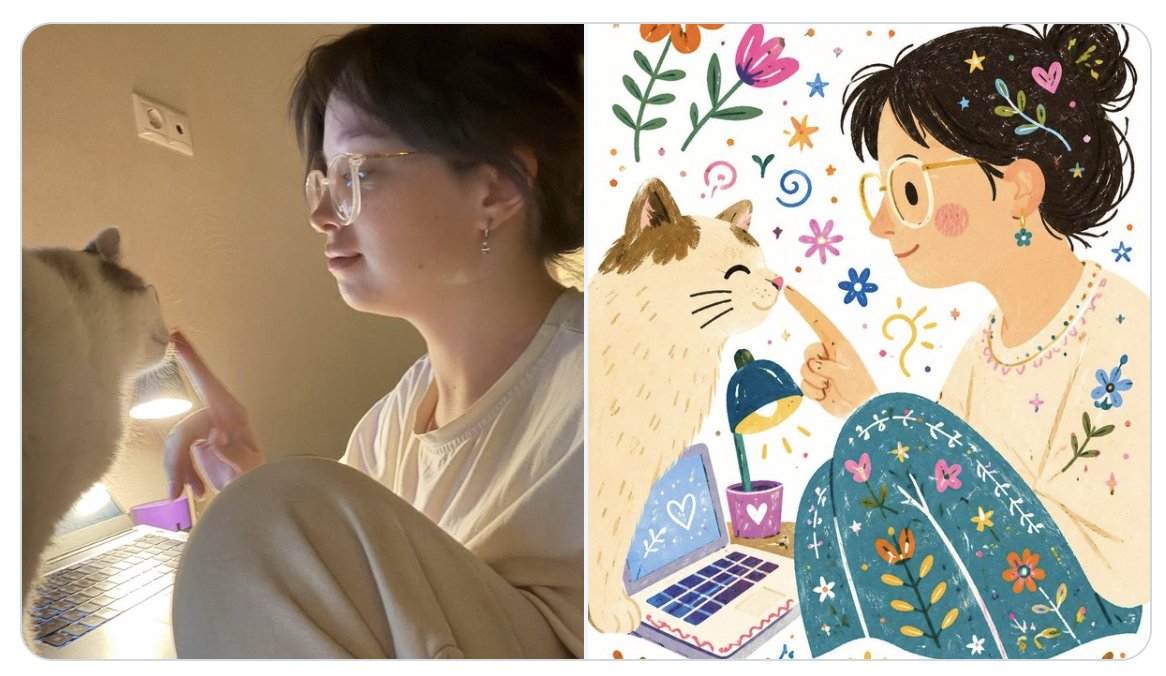
Goal: Create a side-by-side comparison image showing a casual real-life photo on the left and its transformed decorative folk flat illustration on the right. Canvas: Wide horizontal 16:9 composition with rounded outer corners and a thin light gray border, split exactly into two equal vertical panels with a clean center divider. Left panel: A warm, dimly lit indoor snapshot of {argument name="person description" default="a young woman in a loose white T-shirt and light sweatpants"} sitting curled up beside an open laptop on a desk. Her face is obscured by a soft rectangular blur. She gently touches the nose of {argument name="cat description" default="a fluffy cream-colored cat with darker ears"} with one finger. Include a small desk lamp glowing near the laptop, a purple object near the keyboard, beige wall background, and a visible wall outlet. The mood should feel candid, cozy, slightly grainy, and photographed with a phone. Right panel: Reinterpret the same scene as a single decorative folk flat illustration with doodle elements, using a bold playful color palette completely different from the photo. Simplify all details into clean flat handmade shapes with slightly imperfect edges. Show the same person and cat in matching positions: the person on the right, face obscured by a flat peach rectangular mask, black hair tied in a messy bun decorated with tiny colorful doodles, wearing a cream shirt and teal pants covered in floral embroidery-like patterns. The cat sits on the left, smiling with closed eyes as the person touches its nose. Include an illustrated laptop with a heart on the screen, a tiny desk lamp shining yellow light, and a purple cup with a heart. Fill the white background with cheerful doodles: exactly 18 visible decorative doodle groups — 3 large flowers, 3 leafy stems, 2 blue star shapes, 2 orange star/sunbursts, 2 hearts, 2 spiral curls, 2 small flower icons, 1 lightbulb doodle, and 1 scattering of colorful dots. Visual style: The left side must remain realistic and warm-toned; the right side must be whimsical, flat, hand-drawn, folk-art inspired, bright, and playful with visible crayon/paint texture. Keep the composition recognizable between panels, with no text, no watermark, and no extra characters.