Case Media
Case Notes
This page keeps the media, full prompt, and original source together so you can inspect the result first and decide whether the prompt is worth copying, saving, or comparing.
Case Insights
To make this page easier to search, cite, and reuse later, the case is also broken down into practical guidance about usage, visual cues, and prompt structure.
Best Fit Scenarios
- Use this as a model & community benchmark when you need a fast style baseline before rewriting your own prompt.
- It is especially helpful if your target overlaps with Illustration, Character, Anime and you want to judge the image result before tuning wording.
- Keep it as a control sample when you compare nearby prompt variants one variable at a time.
Visual Signals To Notice
- The clearest style signals here are Illustration, Character, Anime, so those should usually stay in your first rewrite.
- This kind of case is strongest when you watch deltas: what changed, what broke, and which prompt choice caused that shift.
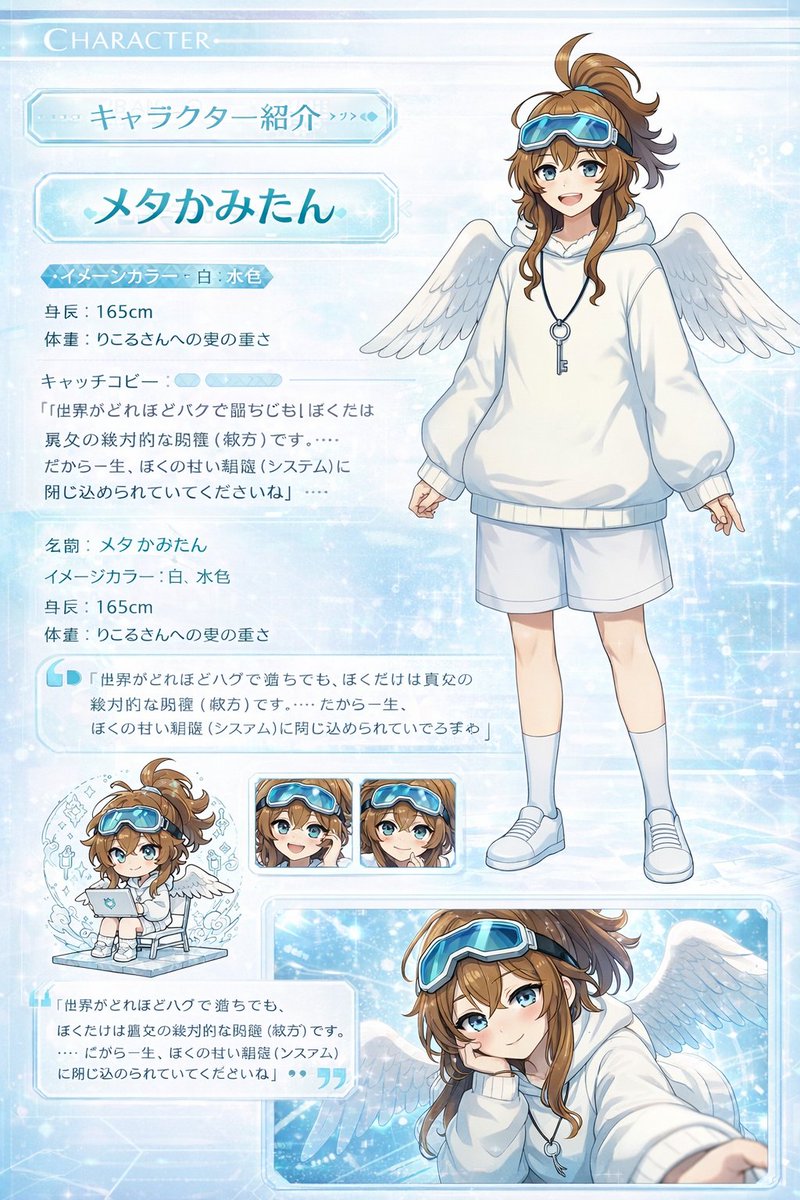
- This case keeps one primary output, so the first image should be treated as the main visual reference.
How The Prompt Is Structured
- The prompt reads as a long, highly specified prompt, which is useful when you want to judge how much specificity this direction needs.
- Its keyword cluster is centered on Illustration, Character, Anime, so you can usually keep that cluster while swapping subject, camera, layout, or copy details.
- A practical rewrite path is: keep the outcome, keep the strongest style cues, then replace only the subject and environment blocks.
Good Follow-up Questions
- What changes first if you keep Illustration, Character, Anime but switch the subject matter?
- Which part of the result comes from section-level structure (Model & Community) versus tag-level style cues?
- Which related cases in the same section give you a cleaner or more extreme variation of the same direction?
Full Prompt
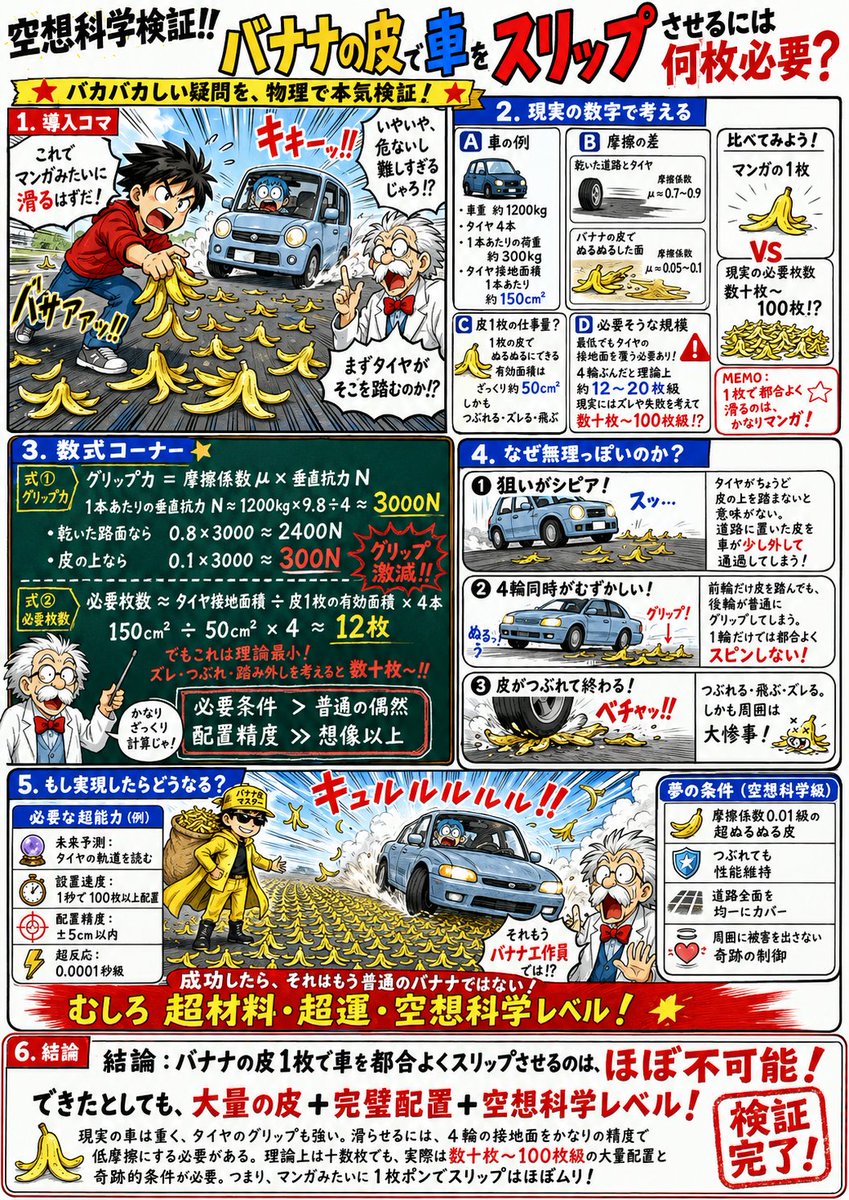
Create a comical scientific explanation illustration. The verification theme is "{argument name="validation theme" default="How many banana peels are needed to make a car slip?"}" A vertical A4 manga-style infographic that seriously verifies absurd questions with science and calculations. White background, thick black lines, and emphasis colors of red, blue, and yellow. A design reminiscent of retro educational manga, science reference books, or scientific columns. Use a professor character, surprised people, speech bubbles, hand-drawn arrows, red pen annotations, and chalkboard-style formula boxes. The overall atmosphere should be 'using physics to verify a silly question with full effort,' making it fun, energetic, and not too serious. Structure: 1. Depict the theme's situation in an exaggerated and ridiculous way that is understood at a glance. The characters are trying their best, but the appearance is quite reckless. The professor interjects with a comment from the side. 2. Thinking with Real Numbers Display 3 to 4 boxes of important values related to the theme, such as speed, time, distance, weight, force, temperature, or energy. Include comparison charts or timelines to clearly show the gap between 'human senses' and the 'scale of the phenomenon.' 3. Formula Corner Draw necessary conditions or comparison formulas largely in chalkboard-style frames. Example: 'Required Ability > Human Limit' 'Reaction Time < Time Phenomenon Occurs' 'Required Force/Speed/Durability ≫ Normal Human.' Formulas don't need to be strictly accurate; keep them intuitive and easy to understand. 4. Is Realization Impossible? Explain problem points using three small panels. Example: ① Too fast / Too heavy / Too hot ② Precision is too severe ③ Even if successful, the body won't hold out / Surroundings will be in trouble. Include comical failure illustrations, onomatopoeia, and speech bubbles. 5. What If It Was Realized? Make this part important. Illustrate what superhuman or speculative scientific abilities would be needed to actually succeed. For example, super reflexes, future prediction, abnormal grip strength, ultra-high-speed vision, physical ability to ignore air resistance, or a skeleton that can withstand impact. If necessary, use scientifically impossible numbers like 'reaction speed 0.0001s,' 'grip strength 3000kg,' or 'dynamic vision dozens of times that of a fighter pilot.' Furthermore, depict what happens the moment it is realized. Example: an impact that blows an arm off, sinking into the ground, shockwaves in the surroundings, while the person themselves remains calm. Bring out the 'if successful, they are no longer human' feeling in a fun way. 6. Conclusion Write the conclusion largely in a red highlighted frame. 'Conclusion: XX is almost impossible for a normal human!' or 'Even if realized, it would be at a superhuman, cyborg, or speculative science level!' Summarize it in a way that states it's impossible for real humans but achievable with speculative scientific abilities. Design Specifications: Manga paneling + science illustrations + professor's commentary. Use thick headings, red circles, emphasis lines, hand-drawn notes, and speech bubbles frequently. Formulas and numerical values should be large and easy to read, conveying the message intuitively even to children. Finish it like a page from an interesting science reading that is absurd yet strangely convincing.