Case Media
Case Notes
This page keeps the media, full prompt, and original source together so you can inspect the result first and decide whether the prompt is worth copying, saving, or comparing.
Case Insights
To make this page easier to search, cite, and reuse later, the case is also broken down into practical guidance about usage, visual cues, and prompt structure.
Best Fit Scenarios
- Use this as a model & community benchmark when you need a fast style baseline before rewriting your own prompt.
- It is especially helpful if your target overlaps with Minimal, Product, Comparison and you want to judge the image result before tuning wording.
- Keep it as a control sample when you compare nearby prompt variants one variable at a time.
Visual Signals To Notice
- The clearest style signals here are Minimal, Product, Comparison, so those should usually stay in your first rewrite.
- This kind of case is strongest when you watch deltas: what changed, what broke, and which prompt choice caused that shift.
- This case keeps one primary output, so the first image should be treated as the main visual reference.
How The Prompt Is Structured
- The prompt reads as a long, highly specified prompt, which is useful when you want to judge how much specificity this direction needs.
- Its keyword cluster is centered on Minimal, Product, Comparison, so you can usually keep that cluster while swapping subject, camera, layout, or copy details.
- A practical rewrite path is: keep the outcome, keep the strongest style cues, then replace only the subject and environment blocks.
Good Follow-up Questions
- What changes first if you keep Minimal, Product, Comparison but switch the subject matter?
- Which part of the result comes from section-level structure (Model & Community) versus tag-level style cues?
- Which related cases in the same section give you a cleaner or more extreme variation of the same direction?
Full Prompt
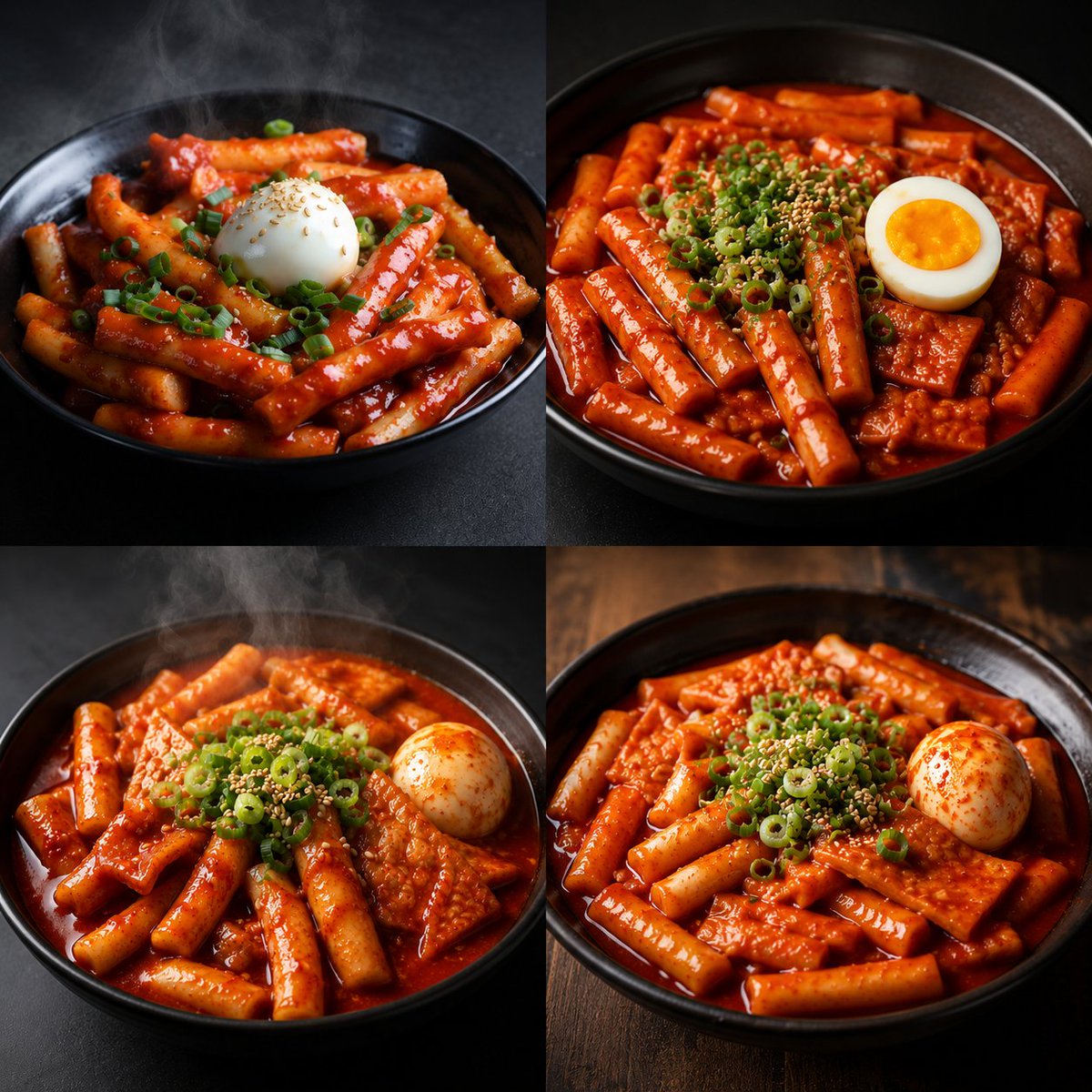
Create a photorealistic 2x2 comparison grid of four appetizing bowls of Korean tteokbokki, each occupying one equal quadrant with thin clean dividers and no text labels. Use a square canvas, dramatic food-photography lighting, shallow depth of field, high contrast, glossy spicy red gochujang sauce, and black ceramic bowls. Each quadrant should show a slightly different generated-food style while keeping the same subject: cylindrical rice cakes, fish cake pieces, chopped green onions, sesame seeds, and a boiled egg garnish. Top-left quadrant: black bowl on a dark matte surface, visible steam rising, rice cakes coated in bright red sauce, a whole peeled boiled egg centered on top with sesame seeds, green onions scattered around it. Top-right quadrant: black bowl cropped close from above, dense pile of rice cakes in deep red sauce, chopped scallions and sesame seeds in the center, a halved boiled egg on the right with vivid orange yolk, minimal steam. Bottom-left quadrant: black bowl on a dark background, saucier tteokbokki with abundant red broth, visible steam, green onion mound in the center, sesame seeds, and a whole boiled egg on the right dusted with red pepper. Bottom-right quadrant: black bowl on a rustic wooden table, warm restaurant lighting, glossy red sauce, rice cakes and rectangular fish cakes, central mound of chopped scallions and sesame seeds, whole boiled egg on the right sprinkled with chili powder. Make the food look rich, spicy, and craveable, with realistic reflections on the sauce and bowls. No people, no utensils, no captions, no watermark.