Case Media
Case Notes
This page keeps the media, full prompt, and original source together so you can inspect the result first and decide whether the prompt is worth copying, saving, or comparing.
Case Insights
To make this page easier to search, cite, and reuse later, the case is also broken down into practical guidance about usage, visual cues, and prompt structure.
Best Fit Scenarios
- Use this as a character design benchmark when you need a fast style baseline before rewriting your own prompt.
- It is especially helpful if your target overlaps with Cinematic, Illustration, Character and you want to judge the image result before tuning wording.
- Keep it as a control sample when you compare nearby prompt variants one variable at a time.
Visual Signals To Notice
- The clearest style signals here are Cinematic, Illustration, Character, so those should usually stay in your first rewrite.
- Look at silhouette, costume language, mood styling, and whether the character reads clearly at a glance.
- This case keeps one primary output, so the first image should be treated as the main visual reference.
How The Prompt Is Structured
- The prompt reads as a long, highly specified prompt, which is useful when you want to judge how much specificity this direction needs.
- Its keyword cluster is centered on Cinematic, Illustration, Character, so you can usually keep that cluster while swapping subject, camera, layout, or copy details.
- A practical rewrite path is: keep the outcome, keep the strongest style cues, then replace only the subject and environment blocks.
Good Follow-up Questions
- What changes first if you keep Cinematic, Illustration, Character but switch the subject matter?
- Which part of the result comes from section-level structure (Character Design) versus tag-level style cues?
- Which related cases in the same section give you a cleaner or more extreme variation of the same direction?
Full Prompt
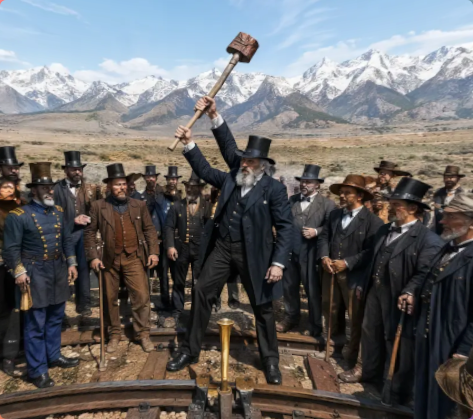
Create a photorealistic historical scene in a wide, cinematic 19th-century style: {argument name="central figure" default="an elderly bearded man in a black frock coat and tall top hat"} stands dramatically at the center on a rough wooden railroad track, legs spread in a triumphant pose, raising {argument name="raised object" default="an oversized sledgehammer"} high above his head with both hands as if about to drive the final railroad spike. Around him are exactly 22 visible onlookers, mostly men in Victorian-era suits, waistcoats, bowler hats, top hats, cowboy hats, and one blue military officer uniform, arranged in a semicircle on both sides of the track; several hold canes or walking sticks, and some faces are partly obscured at the edges. In the foreground, steel rails curve inward toward a bright golden ceremonial spike or coupling fixture positioned between the rails. The setting is an open, arid plain with sparse scrub, backed by a majestic range of snow-covered mountains under a clear pale-blue sky with wispy clouds. Use realistic lighting, crisp documentary detail, slightly humorous surreal scale for the raised hammer, natural earth tones, black and brown period clothing, and a sharp focus on the central pose, resembling a staged commemorative photograph of the transcontinental railroad ceremony in {argument name="historical era" default="the late 1800s"}.