Case Media
Case Notes
This page keeps the media, full prompt, and original source together so you can inspect the result first and decide whether the prompt is worth copying, saving, or comparing.
Case Insights
To make this page easier to search, cite, and reuse later, the case is also broken down into practical guidance about usage, visual cues, and prompt structure.
Best Fit Scenarios
- Use this as a character design benchmark when you need a fast style baseline before rewriting your own prompt.
- It is especially helpful if your target overlaps with Cinematic, Poster, Character and you want to judge the image result before tuning wording.
- Keep it as a control sample when you compare nearby prompt variants one variable at a time.
Visual Signals To Notice
- The clearest style signals here are Cinematic, Poster, Character, so those should usually stay in your first rewrite.
- Look at silhouette, costume language, mood styling, and whether the character reads clearly at a glance.
- This case keeps 2 media outputs, which makes it easier to check whether the style remains stable across multiple results.
How The Prompt Is Structured
- The prompt reads as a long, highly specified prompt, which is useful when you want to judge how much specificity this direction needs.
- Its keyword cluster is centered on Cinematic, Poster, Character, so you can usually keep that cluster while swapping subject, camera, layout, or copy details.
- A practical rewrite path is: keep the outcome, keep the strongest style cues, then replace only the subject and environment blocks.
Good Follow-up Questions
- What changes first if you keep Cinematic, Poster, Character but switch the subject matter?
- Which part of the result comes from section-level structure (Character Design) versus tag-level style cues?
- Which related cases in the same section give you a cleaner or more extreme variation of the same direction?
Full Prompt
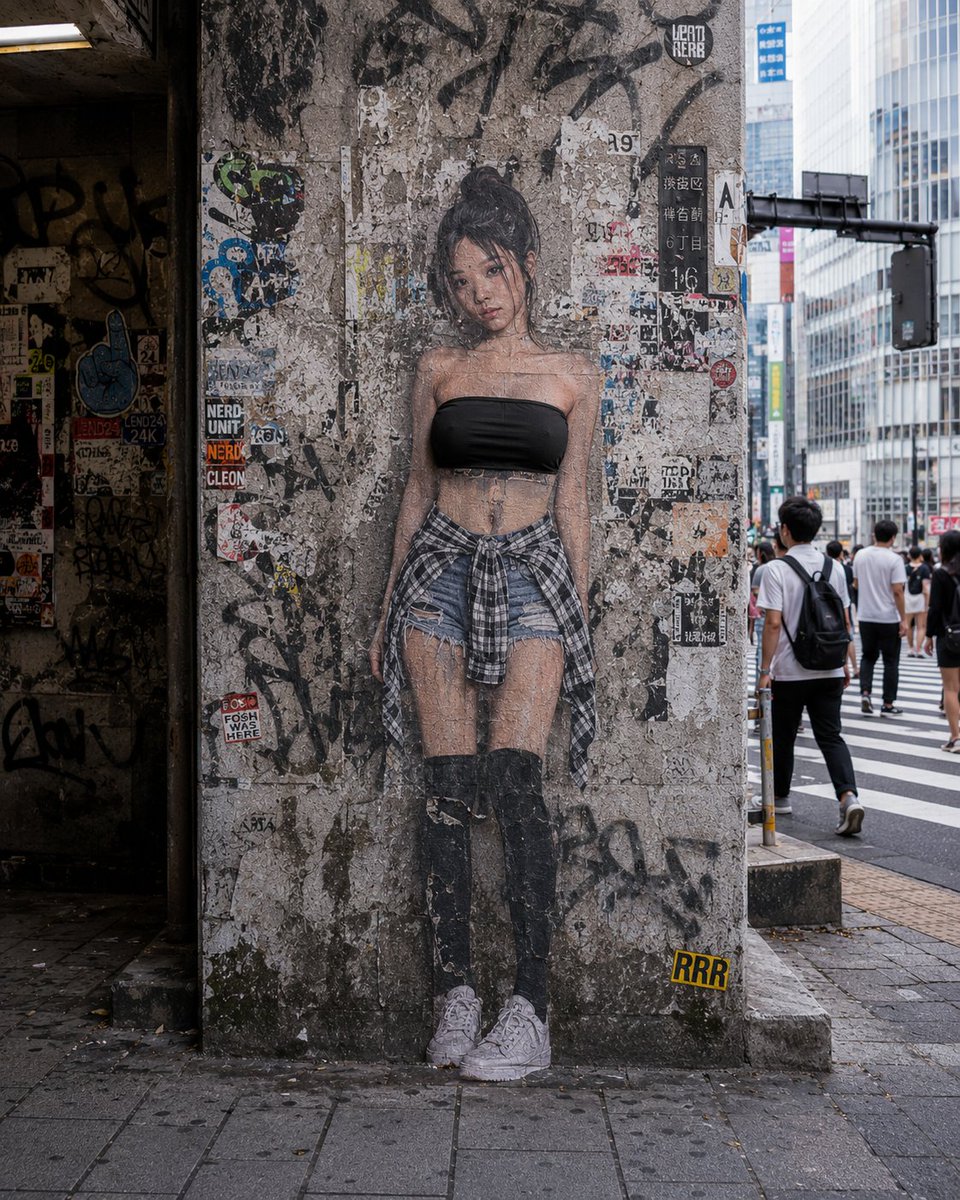
An {argument name="character setting" default="Asian adult female"} appears in {argument name="environment" default="Shibuya, Tokyo"}, close to or attached in front of a [background surface], using a front perspective, eye-level camera, and real street photography composition. The person's body is clearly divided into 2D and 3D states: the [2D body part] is a 2D flat printed image attached to the [background surface], while the [3D body part] suddenly turns into a real 3D human body starting from the [boundary position], entering the real space. The [2D body part] is completely a flat printed image, tightly attached to the [background surface], with no real thickness, volume, or protruding spatial structure. This 2D area presents the texture of real paper / poster / sticker / mural / wheatpaste poster, with a matte printing effect, slight fading, fine particles, paper fibers, aging marks, and edge wear. The edges of the 2D image can be slightly curled, peeled, or damaged, with visible glue marks, paste residue, torn paper scraps, or background texture in some areas. The texture of the [background surface] needs to show through or affect the 2D body area, such as concrete wall grains, brick wall gaps, metal plate scratches, old wood textures, graffiti marks, stains, cracks, sticker residue, etc., which should naturally blend with the 2D area of the character. The 2D body part should look like an image that has long been printed, pasted, spray-painted, or drawn on the background surface, rather than a real standing person. The [3D body part] suddenly transforms into a real 3D human body from the [boundary position], with complete real volume, anatomical structure, material details, light and shadow, perspective, occlusion, and physical contact. The 3D area should clearly enter the real space, forming a strong contrast with the 2D area. Skin, clothing, shoes, hair, accessories, or other body details should present hyper-realistic textures, with real highlights, shadows, folds, textures, and spatial depth. The [boundary position] between 2D and 3D must form a clear, sharp, precise, and visible boundary line. This boundary looks like a flat printed image and a real 3D human body being abruptly but accurately spliced together on the same body. The division cannot be blurred, gradient, or like a normal transformation or semi-transparent effect; it must clearly show: one side is a 2D flat image attached to the background, and the other side is a 3D body truly entering the real space. If there are graffiti, stickers, stains, cracks, spray paint, text, or other background elements in the scene, they can cover or press on the [2D body part], as if the background surface continued to be written on, spray-painted, or covered after the 2D image was pasted. Background elements should have a real surface relationship with the 2D body area rather than simply staying behind the person. The 3D body area needs to interact clearly with the real environment: if the [3D body part] includes feet, legs, hands, arms, head, or any body part sticking out, it must show real physical contact, shadows, occlusion, and spatial relationships. For example, feet stepping on the ground with slight pressure deformation; arms extending from the flat image, blocking the background and casting shadows on the wall or ground; the head protruding from the poster, with real facial volume, skin texture, and light/shadow structure. The overall style is surrealist real photography, maintaining the credibility of real street shots while strengthening the visual paradox of 2D and 3D body splicing. Lighting is [light condition], background is [background details], and the overall atmosphere is [visual style]. The image should have cinematic composition, high detail, real materials, real light and shadow, and real spatial perspective, hyper-realistic surreal photography, cinematic, photorealistic, high detail, 8K.