Case Media
Case Notes
This page keeps the media, full prompt, and original source together so you can inspect the result first and decide whether the prompt is worth copying, saving, or comparing.
Case Insights
To make this page easier to search, cite, and reuse later, the case is also broken down into practical guidance about usage, visual cues, and prompt structure.
Best Fit Scenarios
- Use this as a character design benchmark when you need a fast style baseline before rewriting your own prompt.
- It is especially helpful if your target overlaps with Cinematic, Poster, Illustration and you want to judge the image result before tuning wording.
- Keep it as a control sample when you compare nearby prompt variants one variable at a time.
Visual Signals To Notice
- The clearest style signals here are Cinematic, Poster, Illustration, so those should usually stay in your first rewrite.
- Look at silhouette, costume language, mood styling, and whether the character reads clearly at a glance.
- This case keeps one primary output, so the first image should be treated as the main visual reference.
How The Prompt Is Structured
- The prompt reads as a long, highly specified prompt, which is useful when you want to judge how much specificity this direction needs.
- Its keyword cluster is centered on Cinematic, Poster, Illustration, so you can usually keep that cluster while swapping subject, camera, layout, or copy details.
- A practical rewrite path is: keep the outcome, keep the strongest style cues, then replace only the subject and environment blocks.
Good Follow-up Questions
- What changes first if you keep Cinematic, Poster, Illustration but switch the subject matter?
- Which part of the result comes from section-level structure (Character Design) versus tag-level style cues?
- Which related cases in the same section give you a cleaner or more extreme variation of the same direction?
Full Prompt
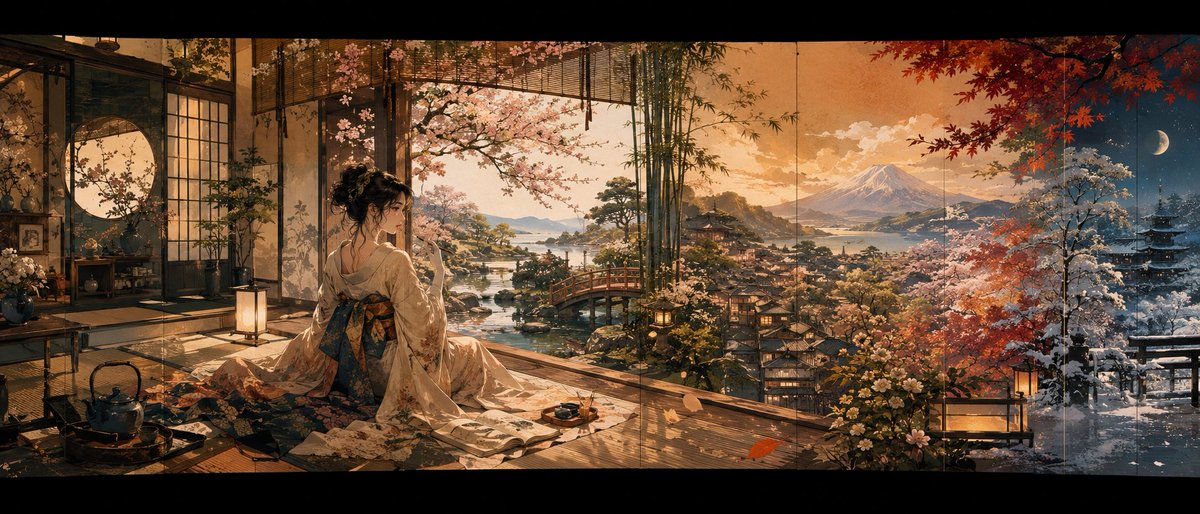
Create an ultra-wide cinematic Japanese fantasy panorama in the style of a richly detailed hand-painted anime background and historical ukiyo-e-inspired digital illustration. The scene is viewed from inside a traditional tatami room with open shoji doors, looking out over a sweeping valley toward {argument name="mountain landmark" default="Mount Fuji"}. In the foreground, place {argument name="main subject" default="a young woman in an ornate cream kimono with a dark floral obi"} seated on the wooden veranda, seen mostly from behind and slightly in profile, with elegant pinned-up black hair and a deliberately square pixelated/blurred face area. She sits among flowing kimono fabric, a tea tray, a small cup, a kettle, lanterns, tatami mats, low furniture, bamboo blinds, and flowering branches. The composition should read like a continuous painted folding screen or triptych with subtle vertical panel seams and black letterbox bars above and below. Show exactly 4 seasonal zones blended seamlessly from left to right: 1) spring interior garden with pale cherry blossoms around the open room, 2) warm summer/golden sunset landscape with water, islands, pines, a red arched bridge, and village rooftops, 3) autumn area with red maple leaves and orange dusk light, 4) winter night area with snow-covered trees, a pagoda, deep blue sky, and a crescent moon. Include exactly 3 major architectural/landscape focal points outside: the red bridge near the center-left, the distant mountain centered in the horizon, and the dark pagoda on the far right. Include exactly 2 visible tea-related foreground items: a black kettle on the left and a small tea tray with cup near the woman. Use warm lantern glow, atmospheric mist, sparkling reflections on water, intricate floral details, and dramatic depth. Color palette: amber sunset, muted gold, cherry pink, maple red, snowy blue, and deep indigo. Make the image highly detailed, painterly, romantic, serene, nostalgic, and panoramic, with no text, no watermark, and no modern objects.