Case Media
Case Notes
This page keeps the media, full prompt, and original source together so you can inspect the result first and decide whether the prompt is worth copying, saving, or comparing.
Case Insights
To make this page easier to search, cite, and reuse later, the case is also broken down into practical guidance about usage, visual cues, and prompt structure.
Best Fit Scenarios
- Use this as a character design benchmark when you need a fast style baseline before rewriting your own prompt.
- It is especially helpful if your target overlaps with Cinematic, Poster, Illustration and you want to judge the image result before tuning wording.
- Keep it as a control sample when you compare nearby prompt variants one variable at a time.
Visual Signals To Notice
- The clearest style signals here are Cinematic, Poster, Illustration, so those should usually stay in your first rewrite.
- Look at silhouette, costume language, mood styling, and whether the character reads clearly at a glance.
- This case keeps one primary output, so the first image should be treated as the main visual reference.
How The Prompt Is Structured
- The prompt reads as a long, highly specified prompt, which is useful when you want to judge how much specificity this direction needs.
- Its keyword cluster is centered on Cinematic, Poster, Illustration, so you can usually keep that cluster while swapping subject, camera, layout, or copy details.
- A practical rewrite path is: keep the outcome, keep the strongest style cues, then replace only the subject and environment blocks.
Good Follow-up Questions
- What changes first if you keep Cinematic, Poster, Illustration but switch the subject matter?
- Which part of the result comes from section-level structure (Character Design) versus tag-level style cues?
- Which related cases in the same section give you a cleaner or more extreme variation of the same direction?
Full Prompt
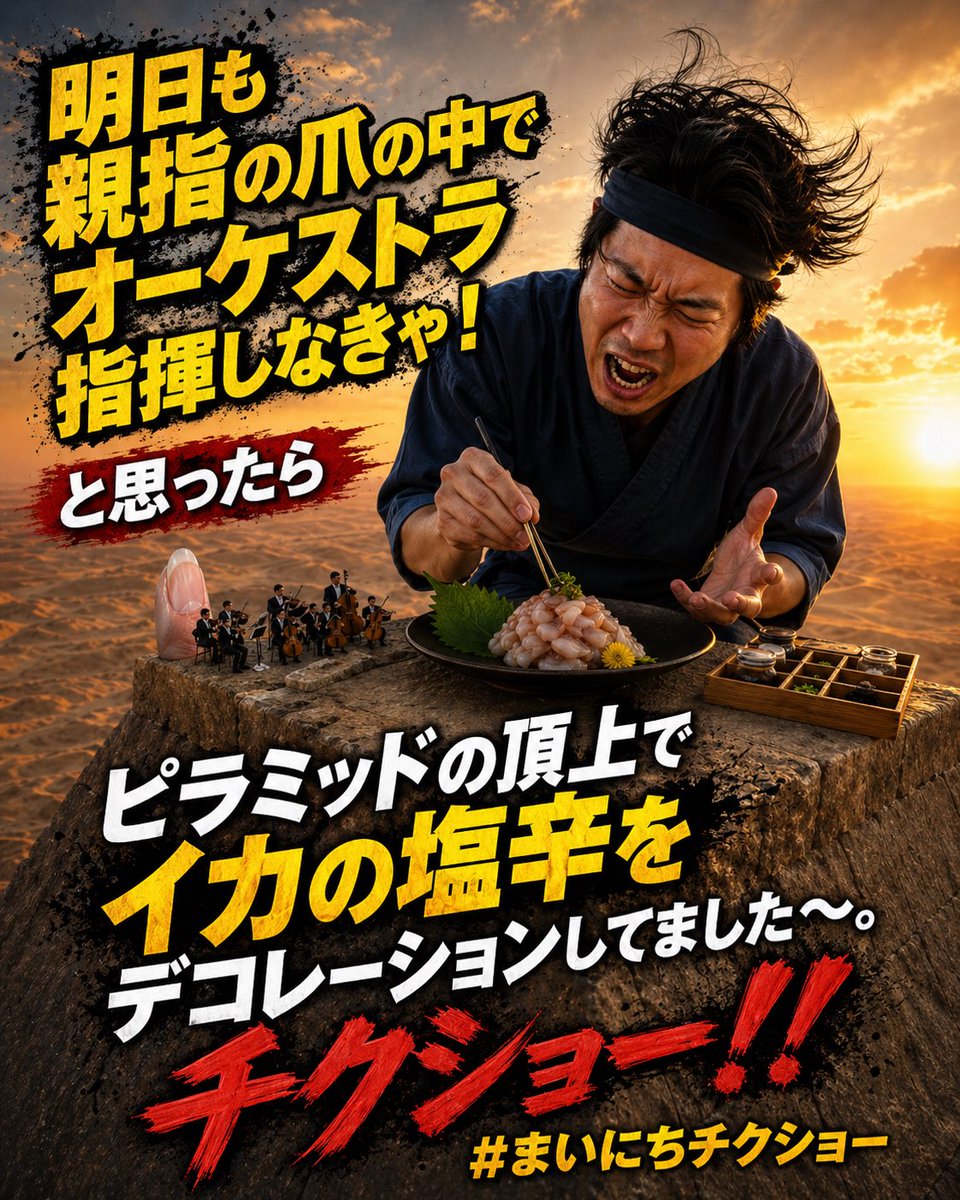
A dramatic, absurdist Japanese clickbait-style poster image at sunset in the desert, with the Great Pyramid serving as a massive stone tabletop in the foreground. A messy-haired Japanese man in a dark navy kimono-like robe kneels behind a black plate of translucent squid sashimi, delicately arranging the food with chopsticks. His expression area is obscured by a rectangular blur block, while his wild windblown hair is sharply silhouetted against a glowing orange sky with low sun and scattered clouds. On the plate are neatly piled pale pink squid pieces, a large green shiso leaf, and a small yellow garnish flower. To the right sits a wooden compartment tray with condiments and small dishes. On the left edge of the pyramid surface, show 1 giant human thumbnail standing upright like a monument, and in front of it 1 tiny orchestra of about 10 formally dressed musicians with string instruments and a conductor, staged as if performing on the stone. The visual joke is that the man was supposedly going to conduct an orchestra inside a thumbnail, but is instead decorating salted squid on top of a pyramid. Use hyper-detailed photoreal compositing, exaggerated scale contrast, cinematic sunset rim light, gritty texture, high contrast, and surreal humor. Add large Japanese headline text integrated into the composition in bold, comic YouTube-thumbnail style with thick black outlines, yellow and white lettering, red paint-brush accents, black ink splatter behind the top headline, and a huge red shout at the bottom. Include exactly 6 text blocks: top-left large yellow text "明日も親指の爪の中でオーケストラ指揮しなきゃ!", below it on a red brushstroke "と思ったら", middle-lower large white and yellow text "ピラミッドの頂上でイカの塩辛をデコレーションしてました〜。", bottom very large red text "チクショー!!", and bottom-right yellow hashtag text "#まいにちチクショー". Compose it like an over-the-top viral Japanese meme thumbnail, vertically framed, dense and attention-grabbing.