Case Media
Case Notes
This page keeps the media, full prompt, and original source together so you can inspect the result first and decide whether the prompt is worth copying, saving, or comparing.
Case Insights
To make this page easier to search, cite, and reuse later, the case is also broken down into practical guidance about usage, visual cues, and prompt structure.
Best Fit Scenarios
- Use this as a character design benchmark when you need a fast style baseline before rewriting your own prompt.
- It is especially helpful if your target overlaps with Portrait, Illustration, Character and you want to judge the image result before tuning wording.
- Keep it as a control sample when you compare nearby prompt variants one variable at a time.
Visual Signals To Notice
- The clearest style signals here are Portrait, Illustration, Character, so those should usually stay in your first rewrite.
- Look at silhouette, costume language, mood styling, and whether the character reads clearly at a glance.
- This case keeps one primary output, so the first image should be treated as the main visual reference.
How The Prompt Is Structured
- The prompt reads as a long, highly specified prompt, which is useful when you want to judge how much specificity this direction needs.
- Its keyword cluster is centered on Portrait, Illustration, Character, so you can usually keep that cluster while swapping subject, camera, layout, or copy details.
- A practical rewrite path is: keep the outcome, keep the strongest style cues, then replace only the subject and environment blocks.
Good Follow-up Questions
- What changes first if you keep Portrait, Illustration, Character but switch the subject matter?
- Which part of the result comes from section-level structure (Character Design) versus tag-level style cues?
- Which related cases in the same section give you a cleaner or more extreme variation of the same direction?
Full Prompt
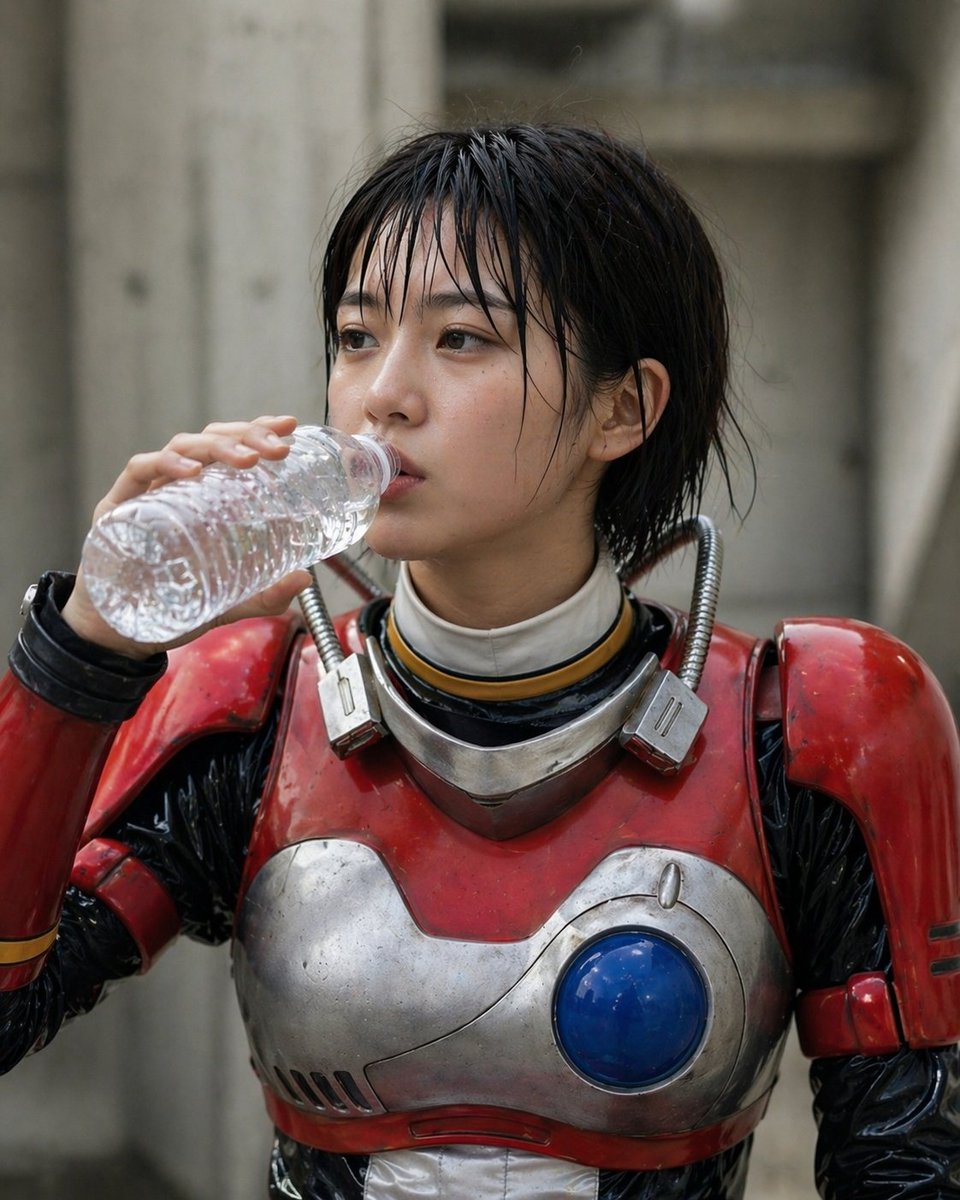
A realistic live-action-style portrait photo of a young Japanese woman in a retro sci-fi tokusatsu armored suit, framed from mid torso to just above the head, standing outdoors against a softly blurred concrete industrial background. She has {argument name="hair color" default="black"} short wet hair in a messy bob tucked behind one ear, and her face is mostly hidden by a large rectangular blur censorship block centered over the face. She is holding 1 clear crinkled plastic water bottle in one hand, raised to her mouth as if drinking. The costume is a worn vintage hero suit with 4 visible main armor components: 2 glossy red shoulder pauldrons, 1 red-and-silver chest plate with scratches and grime, and 1 circular blue orb embedded on the right side of the chest. Under the armor is a shiny black bodysuit with a white high neck undersuit collar and a thin gold ring detail at the neck. Around the collar are 2 short ribbed metallic hoses connected to 2 small rectangular metal modules near the shoulders. The armor should look practical, scuffed, slightly dirty, and heavy, like an old Japanese special-effects superhero costume rather than sleek modern armor. Natural overcast daylight, shallow depth of field, muted gray concrete tones in the background, documentary cosplay photography, candid moment, highly detailed textures, realistic skin and fabric, vertical composition.