Case Media
Case Notes
This page keeps the media, full prompt, and original source together so you can inspect the result first and decide whether the prompt is worth copying, saving, or comparing.
Case Insights
To make this page easier to search, cite, and reuse later, the case is also broken down into practical guidance about usage, visual cues, and prompt structure.
Best Fit Scenarios
- Use this as a character design benchmark when you need a fast style baseline before rewriting your own prompt.
- It is especially helpful if your target overlaps with Portrait, Cinematic, Illustration and you want to judge the image result before tuning wording.
- Keep it as a control sample when you compare nearby prompt variants one variable at a time.
Visual Signals To Notice
- The clearest style signals here are Portrait, Cinematic, Illustration, so those should usually stay in your first rewrite.
- Look at silhouette, costume language, mood styling, and whether the character reads clearly at a glance.
- This case keeps one primary output, so the first image should be treated as the main visual reference.
How The Prompt Is Structured
- The prompt reads as a long, highly specified prompt, which is useful when you want to judge how much specificity this direction needs.
- Its keyword cluster is centered on Portrait, Cinematic, Illustration, so you can usually keep that cluster while swapping subject, camera, layout, or copy details.
- A practical rewrite path is: keep the outcome, keep the strongest style cues, then replace only the subject and environment blocks.
Good Follow-up Questions
- What changes first if you keep Portrait, Cinematic, Illustration but switch the subject matter?
- Which part of the result comes from section-level structure (Character Design) versus tag-level style cues?
- Which related cases in the same section give you a cleaner or more extreme variation of the same direction?
Full Prompt
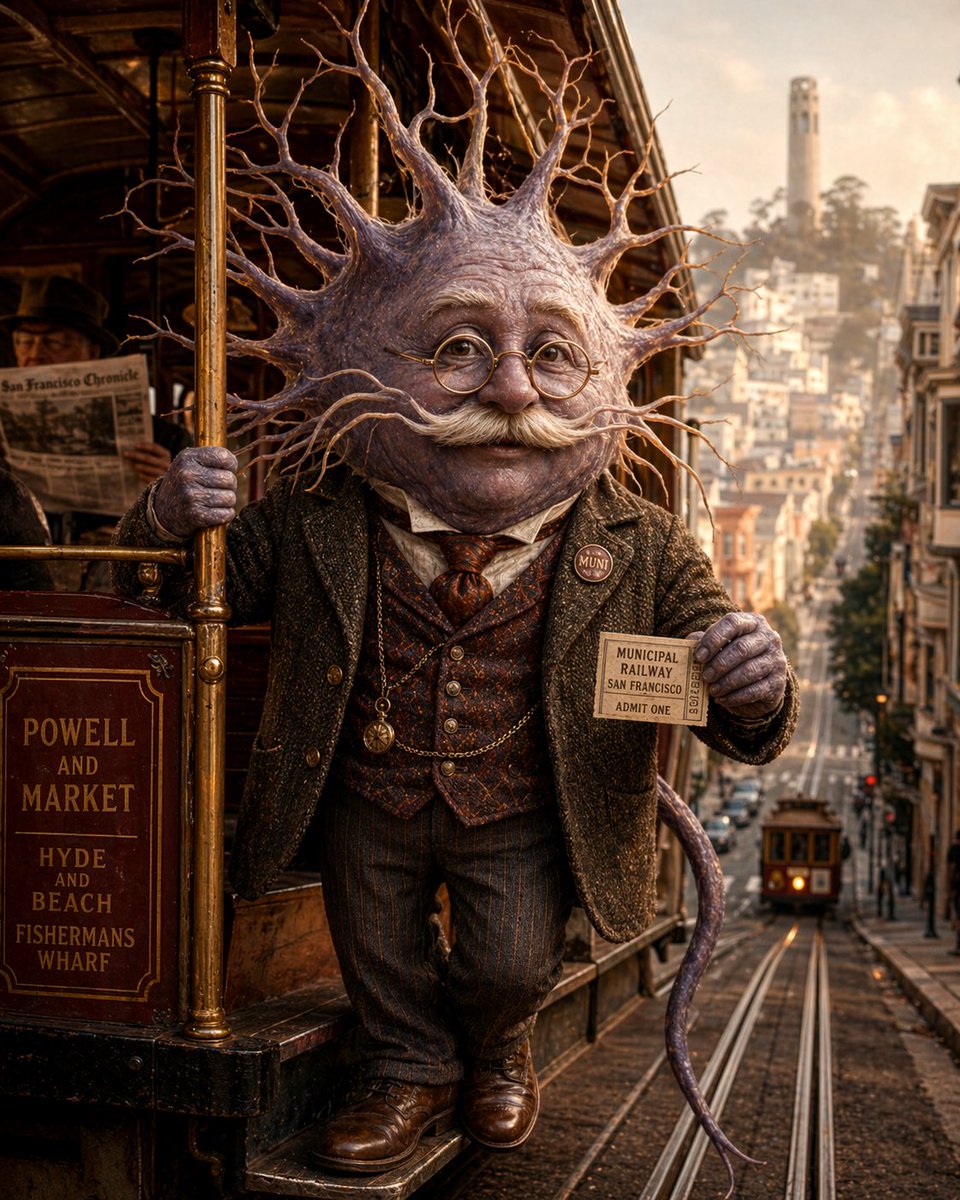
A whimsical cinematic portrait of an anthropomorphic neuron riding on the outside step of a classic San Francisco cable car at golden hour. The character has a large neuron head with a rounded central body and dozens of long branching dendrites radiating outward like a crown, textured in pale lavender, mauve, and fleshy gray with subtle organic sheen. Its face area is obscured and featureless. The figure is dressed like a Victorian or Edwardian gentleman commuter: dark tweed jacket, patterned waistcoat, collared shirt, necktie, pinstriped trousers, polished brown leather shoes, and a pocket watch chain. One hand grips a brass pole on the cable car, and the other hand holds up a vintage transit ticket reading "MUNICIPAL RAILWAY SAN FRANCISCO ADMIT ONE." Add a small round lapel pin that says "MUNI." A slender purple tail-like axon curls behind the body. The cable car is richly detailed varnished wood and brass, with a route sign on the side reading "POWELL AND MARKET / HYDE AND BEACH / FISHERMANS WHARF." In the background, show a steep San Francisco street with cable tracks descending into the distance, a second cable car far down the hill, dense urban buildings on both sides, and Coit Tower visible on a hazy hilltop. Warm nostalgic lighting, shallow depth of field, ultra-detailed textures, surreal realism, humorous but elegant mood, centered full-body composition, vertical framing.