Case Media
Case Notes
This page keeps the media, full prompt, and original source together so you can inspect the result first and decide whether the prompt is worth copying, saving, or comparing.
Case Insights
To make this page easier to search, cite, and reuse later, the case is also broken down into practical guidance about usage, visual cues, and prompt structure.
Best Fit Scenarios
- Use this as a character design benchmark when you need a fast style baseline before rewriting your own prompt.
- It is especially helpful if your target overlaps with Character, City Visual, Character Design and you want to judge the image result before tuning wording.
- Keep it as a control sample when you compare nearby prompt variants one variable at a time.
Visual Signals To Notice
- The clearest style signals here are Character, City Visual, Character Design, so those should usually stay in your first rewrite.
- Look at silhouette, costume language, mood styling, and whether the character reads clearly at a glance.
- This case keeps one primary output, so the first image should be treated as the main visual reference.
How The Prompt Is Structured
- The prompt reads as a long, highly specified prompt, which is useful when you want to judge how much specificity this direction needs.
- Its keyword cluster is centered on Character, City Visual, Character Design, so you can usually keep that cluster while swapping subject, camera, layout, or copy details.
- A practical rewrite path is: keep the outcome, keep the strongest style cues, then replace only the subject and environment blocks.
Good Follow-up Questions
- What changes first if you keep Character, City Visual, Character Design but switch the subject matter?
- Which part of the result comes from section-level structure (Character Design) versus tag-level style cues?
- Which related cases in the same section give you a cleaner or more extreme variation of the same direction?
Full Prompt
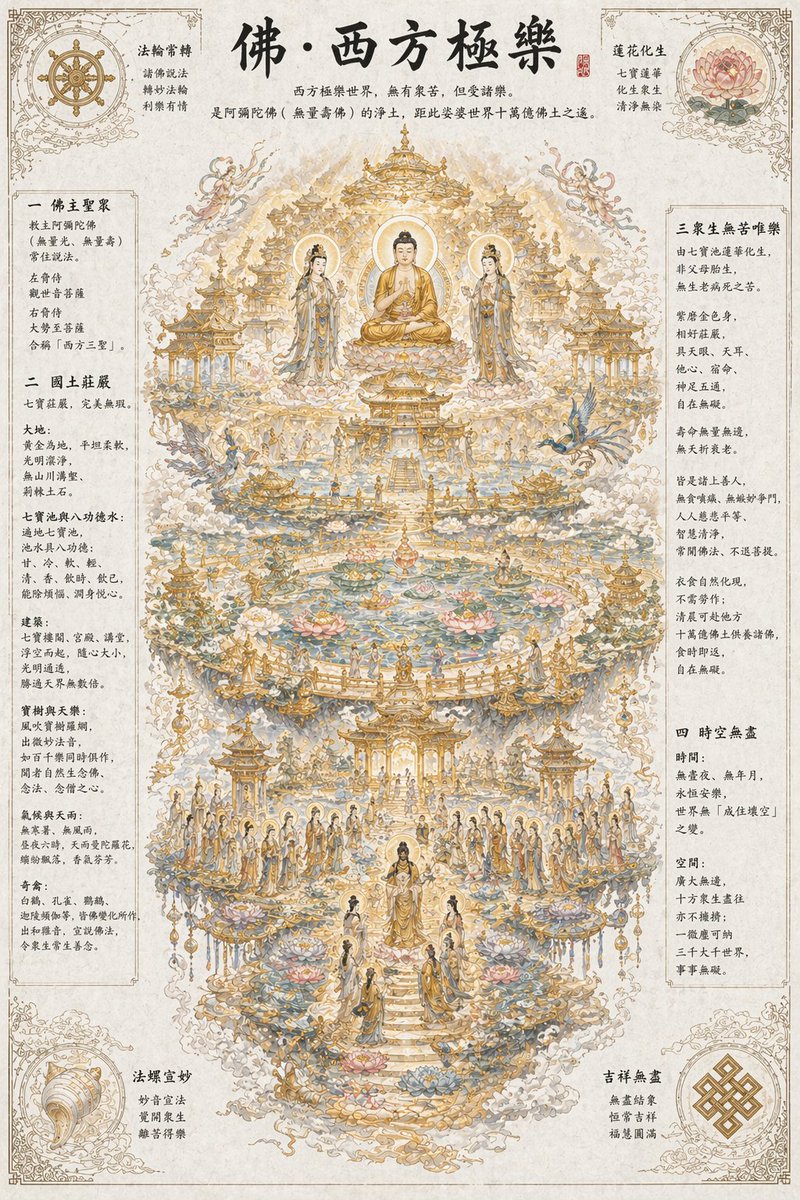
The Western Pure Land of Ultimate Bliss (also known as the Western Pure Land, the Land of Peaceful Nurturance), is the Buddha-land of Amitabha Buddha (Buddha of Infinite Life), whose core characteristic is the absence of all suffering and the reception of only joy, forming a stark contrast with our "Endurance" (Saha) world. Located in the west of our world, at a distance of ten trillion Buddha-lands away (from the "Amitabha Sutra"). Buddha Lord: The founding teacher Amitabha Buddha (Infinite Light, Infinite Life), resides permanently to teach the Dharma; the left and right attendants are Avalokitesvara Bodhisattva and Mahasthamaprapta Bodhisattva, collectively known as the "Three Sages of the Western Pure Land". Land Environment: Adorned with seven treasures, flawless and perfect Earth: The ground is made of gold, flat and soft, bright and clean, with no mountains, rivers, ditches, thorns, dirt, or stones. Seven Treasure Ponds and Water of Eight Virtues: Seven Treasure Ponds are everywhere (gold, silver, lapis lazuli, crystal, agate, ruby, carnelian). The pond water possesses eight virtues: sweet, cold, soft, light, clear, fragrant, when drinking, and after drinking, it can eliminate afflictions, nourish the body, and please the mind. Golden sand at the bottom of the ponds, seven-treasure paths and steps, lotus flowers in the ponds are as large as cartwheels, in blue, yellow, red, and white, each radiating light. Architecture: Seven Treasure pavilions, palaces, and lecture halls, floating in the sky, changing size at will, bright and transparent, surpassing the heavenly realms countless times. Treasure Trees and Celestial Music: Seven rows of trees, seven rows of railings, seven rows of nets, all made of four treasures. When the wind blows through the treasure trees and nets, it produces subtle Dharma sounds, like hundreds and thousands of musical instruments playing simultaneously; those who hear it naturally give rise to the mind of mindfulness of the Buddha, mindfulness of the Dharma, and mindfulness of the Sangha. Climate and Celestial Rain: No cold or heat, no wind or rain, forever mild and comfortable; during the six periods of day and night, celestial Mandarava flowers rain down, falling colorfully, with a fragrant scent. Rare Birds: White cranes, peacocks, parrots, Kalavinkas, are all manifestations created by the Buddha, emitting harmonious and elegant sounds, proclaiming the Buddha Dharma, causing sentient beings to constantly give rise to good thoughts. Sentient Beings: No suffering, only joy, infinite lifespan Method of Rebirth: Sentient beings are born by transformation from lotus flowers in the Seven Treasure Ponds, not from the womb of parents, free from the suffering of birth, aging, illness, and death. Physical Form: Purple-golden bodies, with magnificent marks, similar to Amitabha Buddha; possessing the five supernatural powers of the heavenly eye, heavenly ear, knowledge of others' minds, knowledge of past lives, and spiritual penetration, free and unhindered. Lifespan: Boundless and limitless asamkhyeya kalpas, almost eternal, without premature death or aging. Mentality: All are supreme good people, free from greed, anger, and ignorance, free from jealousy and fighting, everyone is compassionate and equal, with pure wisdom, constantly hearing the Buddha Dharma, never retreating from Bodhi. Life: Clothing and food naturally manifest, no labor required; in the early morning, one can go to other Buddha-lands ten trillion away to make offerings to the Buddhas, returning by mealtime, free and unhindered. Time and Space: Infinite and eternal Time: No day or night, no years or months, eternal bliss, the world has no changes of "formation, existence, destruction, and emptiness". Space: Vast and boundless, even if all sentient beings of the ten directions go there, it will not be crowded; one speck of dust can contain a Three Thousand Great Thousand Worlds, all things are unhindered.