Case Media
Case Notes
This page keeps the media, full prompt, and original source together so you can inspect the result first and decide whether the prompt is worth copying, saving, or comparing.
Case Insights
To make this page easier to search, cite, and reuse later, the case is also broken down into practical guidance about usage, visual cues, and prompt structure.
Best Fit Scenarios
- Use this as a character design benchmark when you need a fast style baseline before rewriting your own prompt.
- It is especially helpful if your target overlaps with Cinematic, Illustration, Character and you want to judge the image result before tuning wording.
- Keep it as a control sample when you compare nearby prompt variants one variable at a time.
Visual Signals To Notice
- The clearest style signals here are Cinematic, Illustration, Character, so those should usually stay in your first rewrite.
- Look at silhouette, costume language, mood styling, and whether the character reads clearly at a glance.
- This case keeps one primary output, so the first image should be treated as the main visual reference.
How The Prompt Is Structured
- The prompt reads as a long, highly specified prompt, which is useful when you want to judge how much specificity this direction needs.
- Its keyword cluster is centered on Cinematic, Illustration, Character, so you can usually keep that cluster while swapping subject, camera, layout, or copy details.
- A practical rewrite path is: keep the outcome, keep the strongest style cues, then replace only the subject and environment blocks.
Good Follow-up Questions
- What changes first if you keep Cinematic, Illustration, Character but switch the subject matter?
- Which part of the result comes from section-level structure (Character Design) versus tag-level style cues?
- Which related cases in the same section give you a cleaner or more extreme variation of the same direction?
Full Prompt
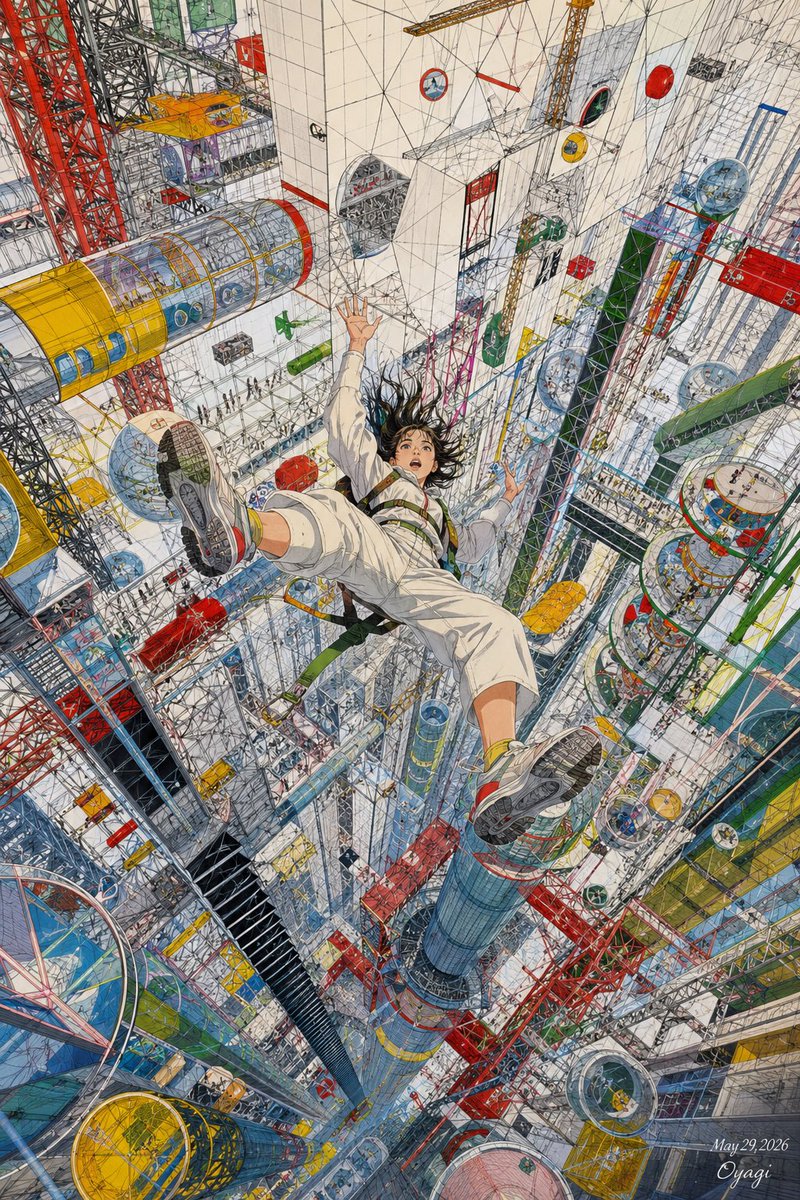
Create a vertical 2:3 ultra-detailed anime illustration titled by mood as {argument name="theme" default="endless structure"}: one young person, {argument name="character name" default="a faceless windblown youth"}, is falling backward through an immense infinite architectural construction site, seen from a dramatic high-angle fisheye perspective looking down into a dizzying vertical abyss. The character is centered slightly above the middle, body foreshortened, arms reaching upward, legs spread toward the viewer, long dark hair flying, face intentionally blurred or featureless, wearing a loose off-white work jumpsuit with rolled sleeves and cropped pants, green safety harness straps, white socks, and chunky gray-white sneakers with red accents and highly detailed soles. Surround the figure with an impossibly dense lattice of scaffolding, cables, wireframe beams, catwalks, cranes, towers, glass tubes, capsules, spherical observation pods, circular platforms, elevators, pipes, and unfinished building modules, all receding endlessly downward. Use exactly one main falling figure and include at least five prominent construction cranes or crane-like structures: one large red tower crane on the left edge, one yellow overhead crane near the upper left, one yellow crane near the upper center, one red crane arm on the right, and one red tower crane crossing the lower right. Add many tiny silhouetted workers on distant catwalks for scale, but keep them secondary. The architecture should mix white concrete megablocks, transparent blue glass cylinders, yellow capsule bridges, red structural frames, green walkways, circular orbital rails, and fine black engineering linework, like a futuristic city under permanent construction. Style: highly intricate Japanese sci-fi illustration, clean ink lines, watercolor and marker-like color, obsessive architectural detail, transparent technical drawing overlays, bright daylight, pale cream background, saturated red/yellow/blue/green accents, cinematic vertigo, no readable signage except an optional small handwritten date and signature in the bottom right reading {argument name="signature text" default="May 29, 2026 Oyagi"}. Make the composition feel vast, weightless, chaotic, and endless, with the falling figure as the only large human subject.