Case Media
Case Notes
This page keeps the media, full prompt, and original source together so you can inspect the result first and decide whether the prompt is worth copying, saving, or comparing.
Case Insights
To make this page easier to search, cite, and reuse later, the case is also broken down into practical guidance about usage, visual cues, and prompt structure.
Best Fit Scenarios
- Use this as a character design benchmark when you need a fast style baseline before rewriting your own prompt.
- It is especially helpful if your target overlaps with Cinematic, Illustration, Character and you want to judge the image result before tuning wording.
- Keep it as a control sample when you compare nearby prompt variants one variable at a time.
Visual Signals To Notice
- The clearest style signals here are Cinematic, Illustration, Character, so those should usually stay in your first rewrite.
- Look at silhouette, costume language, mood styling, and whether the character reads clearly at a glance.
- This case keeps one primary output, so the first image should be treated as the main visual reference.
How The Prompt Is Structured
- The prompt reads as a long, highly specified prompt, which is useful when you want to judge how much specificity this direction needs.
- Its keyword cluster is centered on Cinematic, Illustration, Character, so you can usually keep that cluster while swapping subject, camera, layout, or copy details.
- A practical rewrite path is: keep the outcome, keep the strongest style cues, then replace only the subject and environment blocks.
Good Follow-up Questions
- What changes first if you keep Cinematic, Illustration, Character but switch the subject matter?
- Which part of the result comes from section-level structure (Character Design) versus tag-level style cues?
- Which related cases in the same section give you a cleaner or more extreme variation of the same direction?
Full Prompt
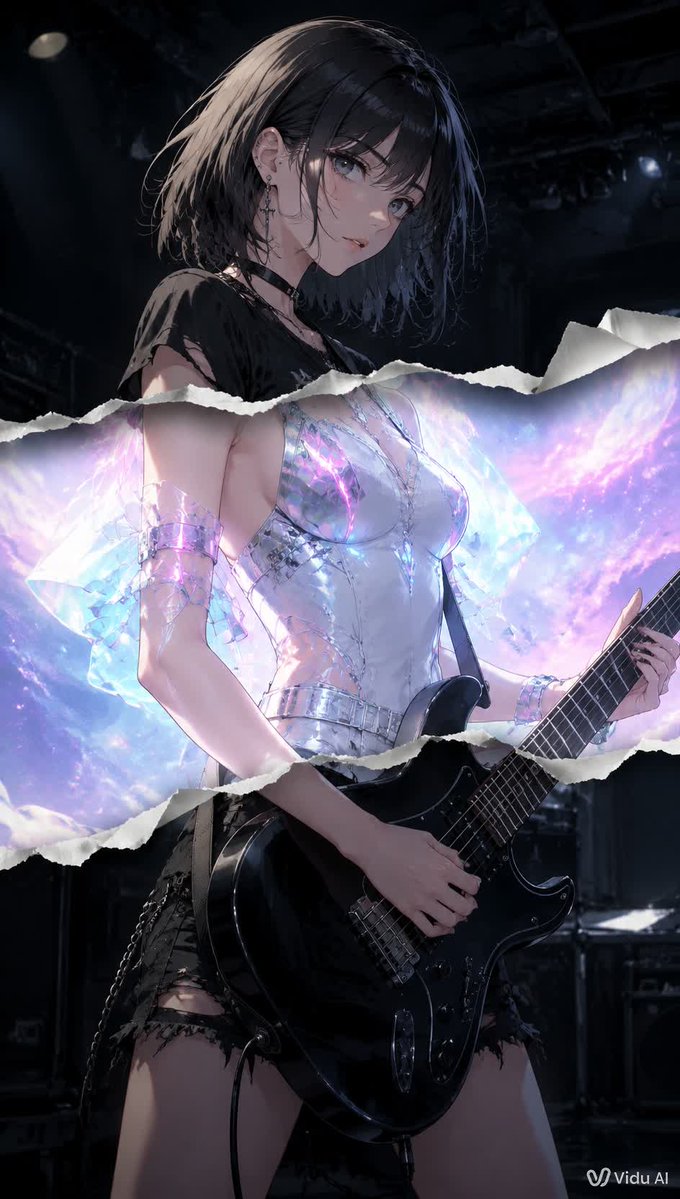
Create a vertical 2:3 cinematic anime-style illustration of one {argument name="character role" default="young female rock guitarist"} standing on a dark concert stage, holding one glossy black electric guitar with a shoulder strap, her left hand on the neck and right hand near the strings. She has short messy {argument name="hair color" default="black bob hair"}, pale skin, punk earrings, a black choker, and a torn black grunge top with ripped black shorts and chain details. Place a flat opaque square censor block over the center of her face, colored muted gray-brown, hiding facial features. Add a dramatic torn-paper collage effect across the middle of the image: exactly one wide horizontal ripped paper opening with two irregular white torn edges, the upper edge crossing around her chest/shoulders and the lower edge crossing around her waist/forearms. Inside this torn opening, reveal a brighter alternate version of the character wearing a luminous futuristic translucent iridescent white-silver outfit with crystalline sleeves and metallic bracelets, glowing with pastel cyan, violet, pink, and galaxy-like light behind her. Outside the torn opening, keep the scene dark, moody, and realistic-anime with black stage rigging, dim spotlights, speakers, and drum hardware in the background. Use strong contrast between the dark punk concert layer and the glowing ethereal sci-fi layer, highly detailed fabric, reflective guitar highlights, dramatic rim lighting, shallow depth of field, no extra characters, no extra text except a small {argument name="watermark text" default="Vidu AI"} watermark in the bottom-right corner.