Case Media
Case Notes
This page keeps the media, full prompt, and original source together so you can inspect the result first and decide whether the prompt is worth copying, saving, or comparing.
Case Insights
To make this page easier to search, cite, and reuse later, the case is also broken down into practical guidance about usage, visual cues, and prompt structure.
Best Fit Scenarios
- Use this as a character design benchmark when you need a fast style baseline before rewriting your own prompt.
- It is especially helpful if your target overlaps with Cinematic, Illustration, Character and you want to judge the image result before tuning wording.
- Keep it as a control sample when you compare nearby prompt variants one variable at a time.
Visual Signals To Notice
- The clearest style signals here are Cinematic, Illustration, Character, so those should usually stay in your first rewrite.
- Look at silhouette, costume language, mood styling, and whether the character reads clearly at a glance.
- This case keeps one primary output, so the first image should be treated as the main visual reference.
How The Prompt Is Structured
- The prompt reads as a long, highly specified prompt, which is useful when you want to judge how much specificity this direction needs.
- Its keyword cluster is centered on Cinematic, Illustration, Character, so you can usually keep that cluster while swapping subject, camera, layout, or copy details.
- A practical rewrite path is: keep the outcome, keep the strongest style cues, then replace only the subject and environment blocks.
Good Follow-up Questions
- What changes first if you keep Cinematic, Illustration, Character but switch the subject matter?
- Which part of the result comes from section-level structure (Character Design) versus tag-level style cues?
- Which related cases in the same section give you a cleaner or more extreme variation of the same direction?
Full Prompt
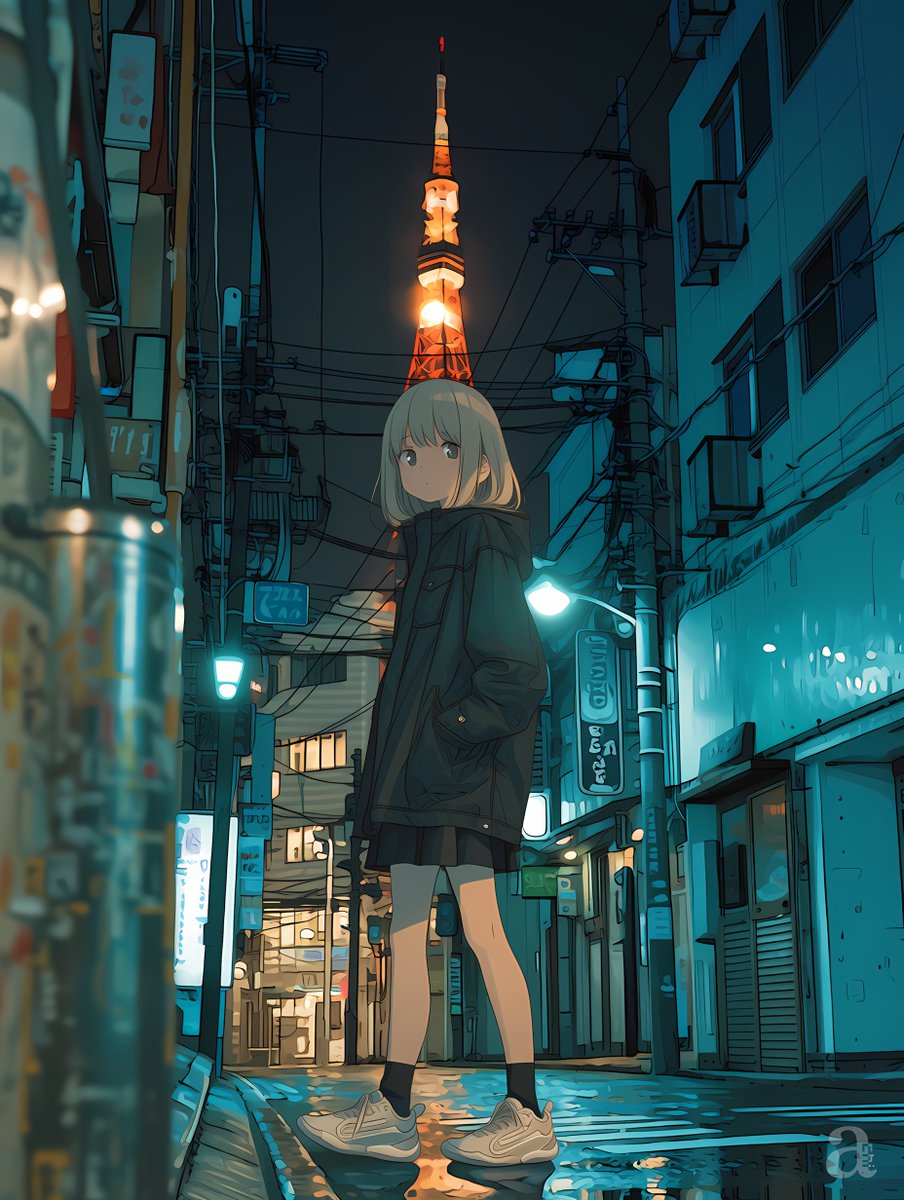
Create a vertical anime-style night street illustration of {argument name="character name" default="a quiet teenage girl"} standing full-body in the middle of a narrow Tokyo back alley after rain, viewed from a low street-level perspective. She has {argument name="hair color" default="short ash-blonde bob hair with straight bangs"}, pale skin, large muted eyes, and a calm slightly melancholy expression, looking toward the viewer. She wears an oversized dark hooded jacket with bulky pockets, a short dark skirt, black ankle socks, and chunky beige sneakers, hands tucked into her jacket pockets. Behind her, perfectly centered above her head, the illuminated orange-and-white Tokyo Tower rises in the distance like a glowing spire, with its bright central light creating a warm halo that contrasts against the deep blue night sky. The alley is dense with urban details: tall narrow buildings on both sides, air-conditioning units, shop shutters, small signs, street lamps, utility poles, tangled overhead power lines, balconies, pipes, and wet reflective pavement with puddles. Use a teal-and-cyan color palette for the buildings and street lighting, with warm orange highlights from the tower and shop interiors. The composition should feel cinematic and slightly surreal, with strong perspective depth, moody lighting, crisp manga linework, soft painterly shading, reflective wet ground, and subtle bokeh lights in the foreground on the left. Keep the character noticeably large compared with the background perspective, as if the scale is slightly imperfect but visually charming. No readable text, no extra characters, no vehicles, no watermark.