Case Media
Case Notes
This page keeps the media, full prompt, and original source together so you can inspect the result first and decide whether the prompt is worth copying, saving, or comparing.
Case Insights
To make this page easier to search, cite, and reuse later, the case is also broken down into practical guidance about usage, visual cues, and prompt structure.
Best Fit Scenarios
- Use this as a character design benchmark when you need a fast style baseline before rewriting your own prompt.
- It is especially helpful if your target overlaps with Character, Product, Brand and you want to judge the image result before tuning wording.
- Keep it as a control sample when you compare nearby prompt variants one variable at a time.
Visual Signals To Notice
- The clearest style signals here are Character, Product, Brand, so those should usually stay in your first rewrite.
- Look at silhouette, costume language, mood styling, and whether the character reads clearly at a glance.
- This case keeps 2 media outputs, which makes it easier to check whether the style remains stable across multiple results.
How The Prompt Is Structured
- The prompt reads as a long, highly specified prompt, which is useful when you want to judge how much specificity this direction needs.
- Its keyword cluster is centered on Character, Product, Brand, so you can usually keep that cluster while swapping subject, camera, layout, or copy details.
- A practical rewrite path is: keep the outcome, keep the strongest style cues, then replace only the subject and environment blocks.
Good Follow-up Questions
- What changes first if you keep Character, Product, Brand but switch the subject matter?
- Which part of the result comes from section-level structure (Character Design) versus tag-level style cues?
- Which related cases in the same section give you a cleaner or more extreme variation of the same direction?
Full Prompt
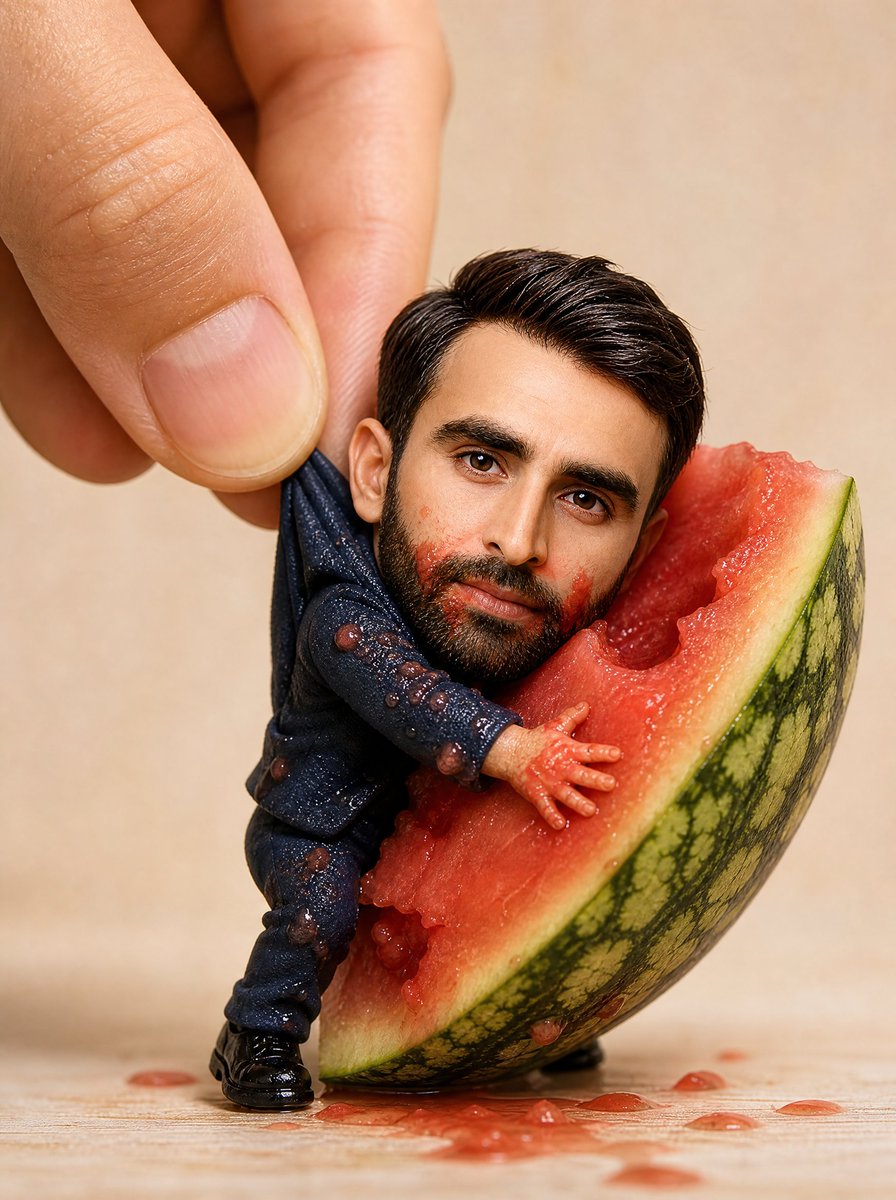
Create a hyper-realistic macro photograph of a premium handmade collectible doll version of {argument name="character name" default="the person"}, designed with a slightly oversized head and a tiny realistic body. The doll is wearing one complete outfit: a dark navy fitted jacket, matching dark navy trousers, and glossy black shoes. The fabric is wet and speckled with small watermelon pulp droplets. The doll has {argument name="hair color" default="short black"} neatly styled hair with realistic individual strands and a natural side-swept texture. Show one large human hand entering from the upper left, with thumb and finger gently pinching the back of the doll’s jacket to hold it upright, emphasizing the miniature scale. Place the doll leaning against one large wedge of watermelon, cut open with vivid red flesh, pale rind, and dark green striped skin; the doll’s small hand presses into the juicy red fruit. Include exactly one watermelon wedge, one visible human hand, one miniature doll, and scattered juice drops and pulp on a light wooden tabletop. Use a warm beige studio background with shallow depth of field, soft diffused lighting, crisp macro detail, realistic skin texture on the fingers, glossy wet fruit texture, handmade collectible craftsmanship, and premium toy-photography realism. Keep the composition vertical, close-up, and centered on the doll and watermelon, with the watermelon wedge angled diagonally from lower center to right side. Avoid text, logos, extra characters, or cartoon styling.