Case Media
Case Notes
This page keeps the media, full prompt, and original source together so you can inspect the result first and decide whether the prompt is worth copying, saving, or comparing.
Case Insights
To make this page easier to search, cite, and reuse later, the case is also broken down into practical guidance about usage, visual cues, and prompt structure.
Best Fit Scenarios
- Use this as a character design benchmark when you need a fast style baseline before rewriting your own prompt.
- It is especially helpful if your target overlaps with Cinematic, Illustration, Character and you want to judge the image result before tuning wording.
- Keep it as a control sample when you compare nearby prompt variants one variable at a time.
Visual Signals To Notice
- The clearest style signals here are Cinematic, Illustration, Character, so those should usually stay in your first rewrite.
- Look at silhouette, costume language, mood styling, and whether the character reads clearly at a glance.
- This case keeps one primary output, so the first image should be treated as the main visual reference.
How The Prompt Is Structured
- The prompt reads as a long, highly specified prompt, which is useful when you want to judge how much specificity this direction needs.
- Its keyword cluster is centered on Cinematic, Illustration, Character, so you can usually keep that cluster while swapping subject, camera, layout, or copy details.
- A practical rewrite path is: keep the outcome, keep the strongest style cues, then replace only the subject and environment blocks.
Good Follow-up Questions
- What changes first if you keep Cinematic, Illustration, Character but switch the subject matter?
- Which part of the result comes from section-level structure (Character Design) versus tag-level style cues?
- Which related cases in the same section give you a cleaner or more extreme variation of the same direction?
Full Prompt
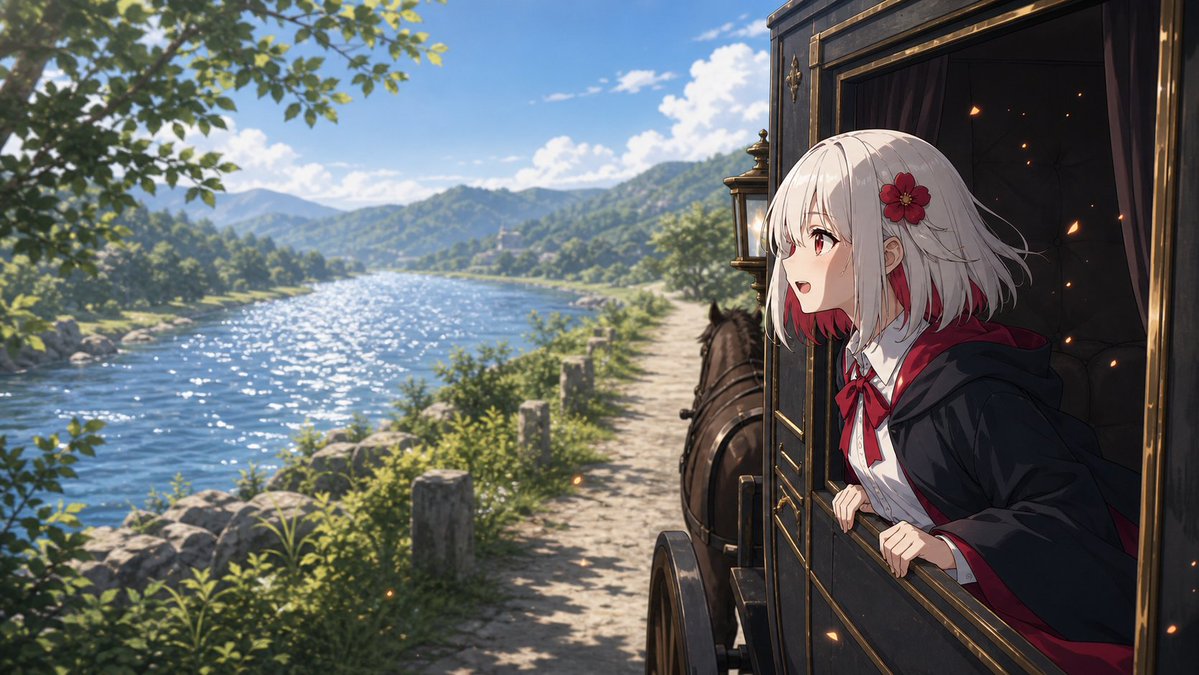
Create a cinematic anime fantasy travel scene in a wide 16:9 composition. Show exactly 1 young female mage, {argument name="character name" default="the scarlet magician"}, leaning out of the open window of an ornate black horse-drawn carriage on the right side of the frame, smiling with wonder as she looks left toward the landscape. She has {argument name="hair color" default="short silver-white hair"} with soft bangs, red underlayer accents near the ends, red eyes, and exactly 1 red flower hair ornament by her ear. Her outfit is a white blouse with a red ribbon tie, a dark hooded cloak with crimson lining, and delicate fantasy-school uniform details. The carriage is glossy black with gold trim, carved panels, a hanging lantern, dark curtains inside, and warm glowing ember-like magic particles drifting around the window; exactly 1 brown horse is partially visible pulling it along a narrow riverside dirt road. The left and center of the image open into a bright summer valley: a sparkling blue river running into the distance, rocky shoreline, wooden fence posts along the road, lush green shrubs and overhanging tree branches framing the top left, forested hills and distant blue mountains under a clear sky with scattered white clouds. Use radiant midday sunlight, shimmering water highlights, soft breeze moving the girl’s hair and cloak, high-detail anime rendering, painterly background, strong depth, warm adventurous mood, and crisp focus on the girl and carriage with the river valley receding into atmospheric perspective. No text, no logos, no modern vehicles.