Case Media
Case Notes
This page keeps the media, full prompt, and original source together so you can inspect the result first and decide whether the prompt is worth copying, saving, or comparing.
Case Insights
To make this page easier to search, cite, and reuse later, the case is also broken down into practical guidance about usage, visual cues, and prompt structure.
Best Fit Scenarios
- Use this as a character design benchmark when you need a fast style baseline before rewriting your own prompt.
- It is especially helpful if your target overlaps with Cinematic, Illustration, Character and you want to judge the image result before tuning wording.
- Keep it as a control sample when you compare nearby prompt variants one variable at a time.
Visual Signals To Notice
- The clearest style signals here are Cinematic, Illustration, Character, so those should usually stay in your first rewrite.
- Look at silhouette, costume language, mood styling, and whether the character reads clearly at a glance.
- This case keeps one primary output, so the first image should be treated as the main visual reference.
How The Prompt Is Structured
- The prompt reads as a long, highly specified prompt, which is useful when you want to judge how much specificity this direction needs.
- Its keyword cluster is centered on Cinematic, Illustration, Character, so you can usually keep that cluster while swapping subject, camera, layout, or copy details.
- A practical rewrite path is: keep the outcome, keep the strongest style cues, then replace only the subject and environment blocks.
Good Follow-up Questions
- What changes first if you keep Cinematic, Illustration, Character but switch the subject matter?
- Which part of the result comes from section-level structure (Character Design) versus tag-level style cues?
- Which related cases in the same section give you a cleaner or more extreme variation of the same direction?
Full Prompt
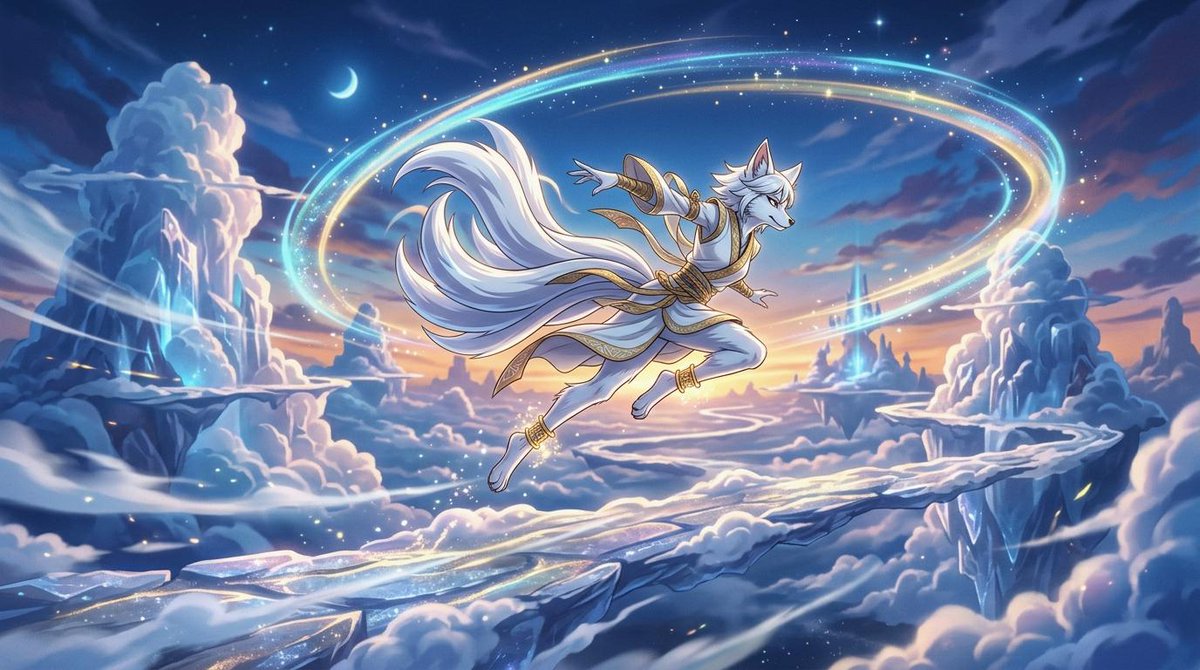
Create a wide cinematic fantasy anime illustration of {argument name="character name" default="a graceful white nine-tailed fox spirit"} leaping through the air above a dreamlike celestial cloud kingdom at twilight. The character is an anthropomorphic fox with white fur, a slim dancer-like body, pointed ears, a delicate muzzle, and exactly nine long flowing tails fanning dramatically behind them; they wear an elegant {argument name="outfit style" default="white and gold celestial dancer outfit"} with ornate gold arm bands, waist sash, ankle bracelets, and trailing fabric ribbons. Pose the fox mid-flight, one arm reaching forward and one leg bent back, as if gliding across the sky. Surround the character with exactly two large luminous elliptical magic trails, one cyan-blue and one warm gold, crossing behind and around the body with sparkling stardust. The environment is an expansive high-altitude fantasy landscape with exactly four major floating ice-and-cloud landforms: a tall icy cloud tower on the left, a small distant island near the center horizon, a crystalline spire island on the right horizon, and a broad foreground ice bridge/platform sweeping from lower left to lower right. Add fluffy sculpted clouds, translucent blue crystal cliffs, misty wind ribbons, tiny star particles, and one crescent moon in the upper left sky. Use a rich twilight palette of {argument name="sky colors" default="deep navy, cobalt blue, lavender, peach, and golden sunset"}, soft glowing rim light, highly polished digital painting, clean anime linework, dramatic perspective, ethereal atmosphere, and a sense of magical motion. No text, no watermark, no modern objects, no extra characters.